
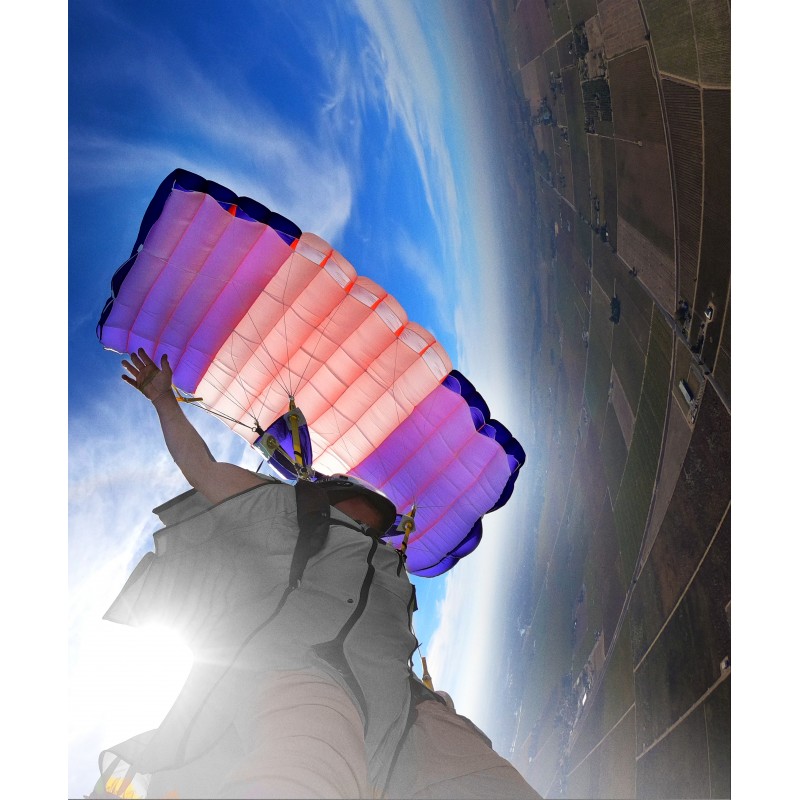
Icarus OM-7 Main Canopy

€2,300.00
Product Description.
The Icarus OM-7 Main Canopy, also styled as the Icarus ōm, is a seven-cell, semi-elliptical tapered ram-air parachute designed primarily to address the deployment challenges created by modern high-performance wingsuits. Its hybrid zero-porosity and ultralight fabric construction helps reduce packing volume, while its specialized nose geometry and internal reinforcement structure are intended to promote soft, progressive, and more consistently directional openings. Although the design targets wingsuit pilots, it can also suit qualified skydivers seeking the predictable behavior of a contemporary seven-cell main canopy. The published recommended wing-loading range is approximately 0.75 to 1.60 pounds per square foot; however, canopy selection must always be approved by a competent instructor, canopy coach, rigger, or safety officer.
Icarus OM-7 Main Canopy: Modern Seven-Cell Performance for Wingsuit and Everyday Skydiving
Understanding the Icarus OM-7 Main Canopy
Parachute Jump Australia and Regional Suitability
A skydiver planning a parachute jump Australia experience may encounter coastal winds, heat, turbulence, and varying landing areas. Whether jumping near Skydive Byron Bay or researching Cairns skydiving, the user must consider local conditions, exit procedures, landing patterns, and drop-zone requirements. The OM-7 does not remove environmental risk; instead, it provides a specialized flight platform that must be matched to the pilot’s training and experience.
Weight Limit Skydiving and Wing Loading
A weight limit skydiving calculation involves more than body weight. Exit weight includes the jumper, clothing, helmet, parachute system, and accessories. Wing loading is calculated by dividing total exit weight by canopy area. Therefore, the smallest canopy is never automatically the best choice.
A generic skydiving downsizing chart cannot evaluate judgment, currency, landing consistency, turbulence experience, or emergency skills. Because the manufacturer publishes a recommended range rather than one universal loading, the correct size should be selected with professional guidance.
Wingsuit Sport and Vector Wingsuit Compatibility
The OM-7 was engineered with the wingsuit sport in mind. A large vector wingsuit, gliding suit wingsuit, or advanced skydiving gliding suit may create a substantial wake behind the pilot. That disturbed airflow can influence deployment behavior.
The OM-7 uses a 2+3+2 nose configuration, with the outer inlets partially closed and the central inlets fully open. Combined with parabolic low-distortion reinforcement tapes, this arrangement is designed to manage inflation progressively and support soft, more stable openings.
Searches for wing suits for sale, price of wingsuit, fly suits, or tandem wingsuit equipment should never replace instruction. Likewise, experience in an indoor wingsuit facility does not automatically qualify someone for outdoor flight.
Tracking Jump and Deployment Control
During a tracking jump, the jumper must manage direction, separation, altitude, and deployment readiness. Although the OM-7 is optimized for stable inflation, it cannot correct poor body position, insufficient separation, an unstable deployment, or an improperly packed system.
Deployment should occur only after the jumper has reduced unwanted movement and established an appropriate body position. The canopy’s multi-stage inflation characteristics may support predictable deployment, but correct technique remains essential.
Parachute Rig and Container Compatibility
The OM-7 forms the main wing inside a complete parachute rig or skydiving rig. The system also includes the harness, risers, deployment bag, pilot chute, bridle, reserve canopy, and other components.
A qualified rigger must confirm container skydive compatibility because fabric type, canopy size, pack volume, container model, deployment-bag dimensions, and closing-loop tension affect installation. Hybrid construction can provide relatively low pack volume, but compatibility should never be assumed from nominal square footage alone.
Parts of a Parachute and Structural Engineering
Understanding the parts of a parachute helps the owner inspect the system responsibly. The OM-7 includes cells, ribs, load-bearing ribs, top and bottom skins, suspension lines, steering lines, stabilizers, slider, nose openings, and a trailing edge.
Its low-distortion reinforcement tapes help control structural deformation under load. Meanwhile, trailing-edge control ribs contribute to steering response and flare efficiency. This engineering approach allows the canopy to combine seven-cell predictability with useful glide and landing performance.
Linewear and Skydiving Rigging
Regular inspection for linewear is essential. Heat damage, abrasion, uneven line shrinkage, broken stitching, damaged connector links, and altered trim can influence openings and flight.
Professional skydiving rigging support should be obtained whenever unusual deployment behavior, visible damage, persistent turns, steering irregularities, or line deterioration appears. The owner should also inspect the pilot chute, bridle, deployment bag, slider, and attachment points according to the applicable manual. General Icarus guidance emphasizes inspecting the pilot chute, bridle, stitching, fabric, and related deployment components for wear or damage.
Skydiving Helmet and Visibility Equipment
A skydiving helmet, sky diving helmet, or sky helmet skydiving model does not directly affect the OM-7’s aerodynamic design, but it remains part of the overall equipment system. Buyers may compare skydive helmets, a full face skydiving helmet, G35 helmet, Cookie G4 helmet, or another skydiving helmet full face design.
The best skydiving helmet is one that fits properly, maintains visibility, and suits the intended discipline. A jumper asking, can you wear glasses while skydiving, should use securely fitted skydiving glasses or skydiver goggles approved by the instructor or drop zone.
Hook Blade Knife and Emergency Tools
A hook blade knife, hook knife skydiving tool, or skydive hook knife may be carried as an emergency cutting device. However, it does not form part of the OM-7 and must not be treated as a solution for poor equipment maintenance or inadequate emergency training.
Terms such as fire parachute and CYPRES fire skydiving concern completely different systems. The OM-7 is a main canopy; it does not activate an automatic activation device, deploy a reserve, or make emergency decisions for the jumper.
Canopy Flight, Risers, and Landing Performance
During canopy flight, the OM-7 is designed to offer modern seven-cell stability, usable glide, responsive handling, and a strong flare. Its efficient trailing-edge design contributes to landing performance, while the seven-cell planform favors practical reliability.
The phrase landing flight risers may refer to riser input during approach, but aggressive maneuvers require dedicated coaching. Neither skydiving speed nor speed sky diving ability proves canopy competence. Landing decisions must account for traffic, wind, obstacles, altitude, and personal skill.
Base Jumping and Base Canopy Distinction
Base jumping, sometimes incorrectly called baseline jumping, uses specialized procedures and equipment. A base canopy is not interchangeable with a normal aircraft-skydiving main canopy.
The OM-7 should be used only within the applications approved by its manufacturer and relevant aviation authority. Its wingsuit-oriented design does not make it suitable for every activity involving a parachute.
Additional Equipment and Search Considerations
A freefly pud handle, gear bag skydive setup, and complete skydiving equipment list should be reviewed with a rigger. Related canopy searches such as Safire 3 and Fluid Wings describe different products with different handling characteristics.
Similarly, CRW skydiving, a jumper pilot role, ifly Colorado Springs, skydiving tube training, and destination searches such as Skydive Belize or skydiving Blue Hole Belize do not describe OM-7 features.
Finally, phrases such as nude parachute jump, skydiving nude, new skydive, #skydiving latest, and skydiving website represent general searches rather than engineering specifications. The OM-7 should be evaluated through verified manufacturer information, professional fitting, appropriate training, and a supervised demonstration jump—not through unrelated search trends.
Flight Characteristics, Deployment Behavior, Packing, and Maintenance
Purpose-Built Canopy Design
This main canopy combines a seven-cell planform with modern aerodynamic shaping to support controlled deployments, predictable handling, and practical landing performance. Its construction is intended to suit experienced users who value stability without sacrificing responsive control.
The canopy should always be selected according to the pilot’s total exit weight, experience, recent activity, landing consistency, and training history. Size selection must not be based only on personal preference or a desire for faster flight. A qualified instructor, canopy coach, or rigger should review the intended configuration before purchase or installation.
Although the canopy offers carefully developed performance characteristics, it cannot compensate for poor judgment, unsuitable weather, incorrect packing, unstable deployment, or inadequate training.
Progressive Deployment Behavior
Deployment quality is especially important when air behind the jumper may be disturbed. The canopy has been shaped to encourage a progressive inflation sequence rather than an abrupt expansion.
During deployment, the slider, suspension lines, air inlets, internal ribs, and fabric structure work together. The deployment bag releases the canopy, the lines extend, the slider controls the rate of expansion, and air gradually enters the cells.
A well-maintained canopy that has been packed correctly may provide consistent opening behavior. However, opening performance can still be affected by body position, airspeed, line condition, packing technique, deployment method, and equipment compatibility.
The jumper should establish a stable position before deployment whenever possible. Excessive rotation, steep diving movement, or asymmetrical body posture may influence heading and inflation.
Heading Performance
Directional consistency is valuable because it gives the jumper more time to assess traffic and complete post-deployment checks. Nevertheless, no manufacturer can guarantee an identical heading on every opening.
Factors that may affect direction include:
- Uneven line tension
- Incorrect packing
- Harness movement
- Damaged or altered lines
- Twisted risers
- Body asymmetry
- Air turbulence
- Slider position
- Uneven brake settings
After deployment, the pilot should immediately check the canopy, direction of flight, nearby traffic, altitude, and control system. If a problem is identified, emergency procedures must be followed according to training.
Stable and Predictable Flight
The seven-cell layout generally supports a stable flight profile and controlled recovery after moderate inputs. The wing should feel manageable when flown within an appropriate loading range by a properly trained pilot.
Stability does not mean that the canopy cannot dive, turn rapidly, or lose altitude. Aggressive control inputs can still produce significant speed and descent. Therefore, turns should be initiated only when sufficient altitude and clear airspace are available.
The pilot should practice basic control exercises at a safe altitude. These may include gentle turns, controlled flares, rear-control input, slow flight, and recovery from normal maneuvers. Such exercises should be completed under qualified supervision.
Steering Response
The control system allows the pilot to adjust direction, descent, and approach. Smooth input usually creates a more progressive response, while deeper or faster input may produce a sharper turn.
Uneven control input can cause an unintended heading change. Therefore, both handles should be checked after deployment, and the pilot should confirm that the brake lines move freely.
Steering lines require regular inspection because wear, shrinkage, incorrect length, or poor attachment can change handling and flare performance. Any persistent turn or unusual control pressure should be examined by a qualified professional.
Glide and Descent Performance
The canopy is designed to provide useful forward movement while maintaining the predictable descent characteristics commonly associated with a seven-cell wing.
Actual glide depends on several factors, including loading, wind, air density, trim, line condition, and control position. A lightly loaded configuration may feel more forgiving, while a heavier loading may increase speed, descent rate, and control sensitivity.
The pilot must understand that wind direction changes the ground track but does not remove aerodynamic risk. Strong headwinds may reduce forward movement over the ground, while strong tailwinds may increase landing speed.
Landing plans should be adjusted early rather than through sudden low-altitude corrections.
Flare Performance
A properly executed flare converts forward speed into lift and reduces the descent rate before touchdown. The canopy’s control system is intended to provide useful flare authority when the wing is flown within its approved operating conditions.
Successful landings depend on more than the design. Timing, control range, wind, surface conditions, loading, and pilot technique all affect the result.
The flare should be smooth and symmetrical. Pulling too early may cause the canopy to level out high and lose energy before touchdown. Pulling too late may leave insufficient time to reduce descent. An uneven flare may also create a turn near the ground.
Pilots should develop consistent timing through supervised training rather than experimentation at low altitude.
Packing Considerations
Correct packing supports reliable deployment. The canopy should be packed according to the manufacturer’s instructions and the procedures approved by the responsible authority.
Before packing, the user should confirm that:
- The lines are continuous and untangled
- The slider is correctly positioned
- The steering system is properly set
- The fabric is free from major damage
- The stabilizers are correctly arranged
- The deployment bag is compatible
- The closing sequence is correct
The packer should avoid pulling, twisting, or forcing components in ways that could damage the fabric or alter line organization.
New fabric may initially feel slippery and difficult to control. Careful folding, proper preparation, and patient technique can help produce a secure pack job.
Container and Deployment-System Fit
Nominal canopy size does not guarantee proper compatibility with every harness-and-container system. Fabric type, construction method, age, pack volume, and container design all influence fit.
An excessively tight installation may create closing difficulty or affect deployment. An excessively loose fit may allow unwanted movement inside the container.
A qualified rigger should inspect the complete installation, including the deployment bag, pilot chute, bridle, closing loop, risers, links, and reserve separation. The canopy should not be forced into equipment that was not designed to accommodate its actual packed volume.
Inspection and Line Maintenance
Routine inspection helps identify deterioration before it causes a significant problem. The owner should examine the fabric, seams, reinforcement points, suspension lines, steering lines, attachment points, and slider.
Warning signs may include:
- Frayed or discolored lines
- Uneven line lengths
- Broken stitching
- Fabric tears
- Heat damage
- Damaged reinforcement
- Hard openings
- Persistent turning
- Reduced flare power
- Irregular inflation
Line dimensions can change gradually through use. As a result, handling may change even when the lines do not appear severely damaged. Professional measurement may be required to determine whether replacement is necessary.
Cleaning and Storage
The canopy should be stored clean, dry, and protected from direct sunlight. Ultraviolet exposure can weaken fabric and lines over time.
Petroleum products, solvents, acids, bleach, and strong cleaning chemicals should be kept away from the equipment. Dirt should not be removed with aggressive scrubbing or household detergents unless the manufacturer specifically approves the method.
When the canopy becomes wet, it should be dried naturally in a shaded and ventilated area. Direct heat should never be used because high temperatures may damage fabric coatings and structural fibers.
Long-term storage should take place in a cool, dry environment. The system should not remain compressed in a hot vehicle, damp room, or contaminated equipment area.
Professional Service and Responsible Ownership
A main canopy is a life-support component. Therefore, repairs, relining, structural inspection, and compatibility decisions should be handled by appropriately qualified professionals.
The owner should maintain records of jumps, inspections, repairs, line changes, unusual openings, and major service work. These records can help identify performance changes and support future resale or maintenance decisions.
Ultimately, dependable performance comes from combining suitable equipment with correct packing, disciplined inspections, professional servicing, conservative decision-making, and continuous training.
Practical Use, Performance Expectations, Safety, and Ownership Guidance
Preparing the Canopy for Use
Before each jumping day, the complete system should be inspected carefully. The user should confirm that the fabric, lines, slider, steering system, attachment points, deployment components, and risers are in serviceable condition.
A proper inspection should not be rushed. Small signs of wear may become more serious when they are ignored over time. Fraying, unusual discoloration, damaged stitching, distorted fabric, uneven lines, and worn control components should be examined by a qualified professional.
The canopy should also be matched correctly with the harness-and-container system. A poor fit may affect packing, closing pressure, deployment, or general handling. Therefore, installation should be checked by a qualified rigger before the canopy is placed into regular service.
Selecting an Appropriate Size
Canopy size should be chosen according to total exit weight, experience, currency, training, landing history, and local operating conditions.
A smaller size usually increases forward speed, descent rate, responsiveness, and landing energy. Consequently, it may reduce the amount of time available to correct mistakes. A larger size may provide more forgiving handling, although it still requires proper technique and judgment.
The user should avoid choosing a size only because it fits into a smaller container or appears more advanced. A suitable size should support consistent landings, manageable control pressure, reliable recovery, and confident operation in normal conditions.
Professional advice is especially important when changing size, design, or loading.
Understanding Real-World Opening Performance
Opening behavior can vary from one jump to another. Even a canopy designed for controlled inflation may respond differently because of airspeed, body position, packing method, line condition, equipment configuration, or turbulence.
A soft opening should not automatically be expected after every deployment. Likewise, one unusual opening does not always mean that the canopy has a structural problem.
The user should look for patterns. Repeated hard openings, persistent turns, slow inflation, slider hesitation, or frequent heading changes may indicate a packing, trim, component, or compatibility issue.
When abnormal behavior continues, the canopy should be removed from service until the cause has been identified.
Post-Deployment Checks
Immediately after deployment, the pilot should complete a structured check.
The canopy should be fully inflated, the slider should descend correctly, the lines should be clear, and the steering system should operate normally. The pilot should also check altitude, traffic, direction of flight, and available landing options.
If a problem is present, the user must follow trained emergency procedures. Delaying a necessary decision may reduce the available altitude and increase risk.
The canopy should never be treated as safe simply because it appears open. A careful assessment is still required.
Handling During Flight
Smooth and deliberate control input usually produces the most predictable response. Sudden or excessive input can increase bank angle, speed, and altitude loss.
Pilots should remain aware of how quickly the canopy responds at their loading and experience level. A turn that feels moderate at altitude may create serious consequences near the ground.
Control exercises should be practiced only at a safe altitude and under appropriate supervision. These exercises can help the pilot understand turn rate, recovery, slow flight, flare range, and rear-control response.
The purpose of practice is to build consistency rather than encourage aggressive maneuvering.
Planning the Landing Pattern
A safe landing pattern should be planned early. The pilot should identify wind direction, traffic flow, obstacles, alternate areas, and the intended final approach.
Late corrections should be avoided. Sudden low-altitude turns may produce a rapid increase in speed and descent rate.
The pilot should follow local procedures and maintain adequate separation from others. Personal preference should not override established traffic rules.
Conditions may change during descent. Therefore, the plan should remain flexible enough to allow a safer alternate approach when necessary.
Managing Wind and Turbulence
Wind affects ground speed, landing distance, and approach planning. Stronger conditions may also create turbulence near buildings, trees, hills, or other obstacles.
Turbulence can cause temporary changes in pressure, heading, or inflation. The pilot should maintain sufficient altitude and distance from known hazards.
When conditions exceed personal experience or confidence, the safer decision may be to remain on the ground. Equipment capability should never be used as a reason to ignore unsuitable weather.
Flare Technique and Landing Consistency cypress fire skydiving
Landing performance depends on timing, symmetry, control range, loading, wind, and pilot skill.
The flare should be completed smoothly and evenly. An early flare may reduce energy before touchdown, while a late flare may not provide enough time to slow the descent.
Uneven input may cause a turn close to the ground. Therefore, both control handles should be used symmetrically unless a trained corrective action is required.
Consistent landings develop through repetition, coaching, and careful review. The pilot should not attempt advanced techniques before basic accuracy and control have been demonstrated reliably.
Long-Term Care
The canopy should be protected from moisture, direct sunlight, excessive heat, chemicals, sharp objects, and rough surfaces.
After exposure to water or damp conditions, the equipment should be dried naturally in a shaded and ventilated area. Direct heat can damage fabric coatings and structural fibers.
The system should not remain stored in a hot vehicle or damp room. Long-term compression may also affect certain components.
Regular professional inspection can help identify gradual deterioration that may not be obvious during routine packing.
Line Condition and Trim Changes
Lines change over time through friction, loading, heat, and repeated use. These changes may alter trim, opening behavior, steering pressure, glide, and flare performance.
Visible wear is not the only concern. A line set may appear intact while its dimensions have changed enough to affect flight characteristics.
Professional measurement should be considered when the canopy develops unusual handling or inconsistent openings. Relining should be completed before performance becomes severely degraded skydiving tube.
Responsible Ownership
A main canopy is a critical life-support component. Responsible ownership includes correct selection, regular inspection, professional maintenance, careful packing, accurate recordkeeping, and conservative decision-making.
The owner should record repairs, relines, unusual openings, damage, and significant service work. These records help track the condition of the equipment and may support future resale.
Reliable performance comes from combining suitable equipment with proper training, disciplined preparation, current skills, and sound judgment.
Be the first to review “Icarus OM-7 Main Canopy”
Related products
Canopies

Canopies
Reviews
There are no reviews yet.