
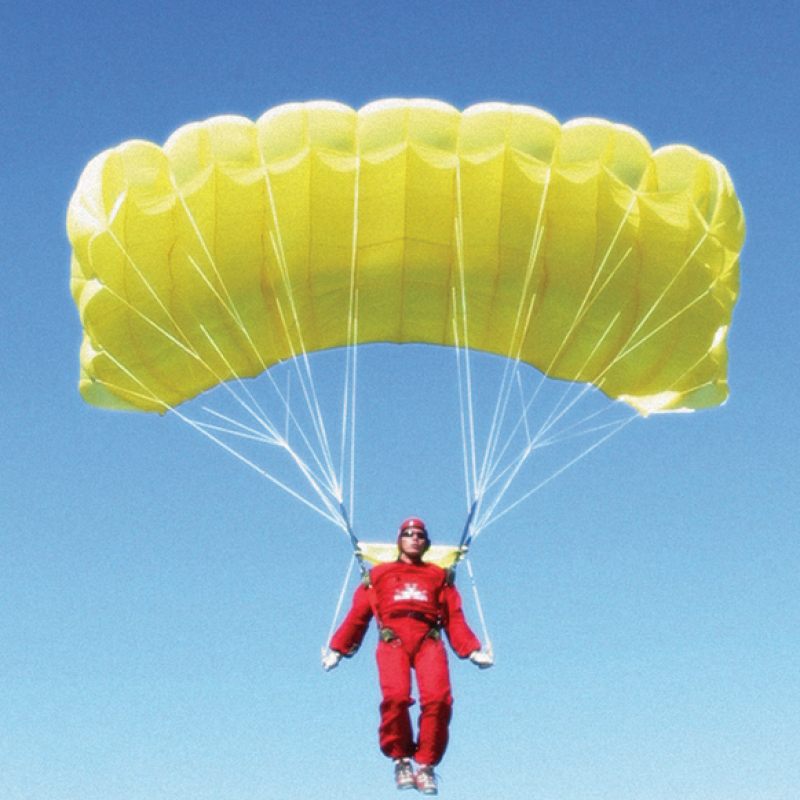
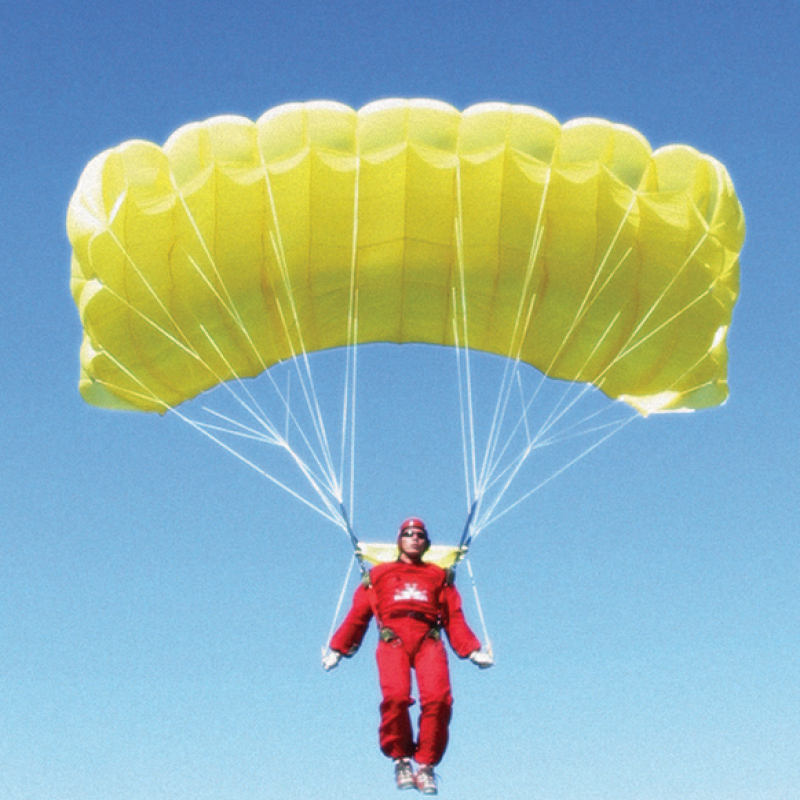
R-Max Reserve Canopy
€1,400.00
R-Max Reserve Canopy Product Description
The R-Max Reserve Canopy is a dependable seven-cell emergency parachute engineered for reliable deployment, stable flight and controlled landings when a main canopy cannot be used safely. Developed by Precision Aerodynamics, it is designed to meet the demands of modern skydiving disciplines, including freeflying, tracking and other high-speed activities.
Its durable low-porosity fabric, reinforced construction and carefully designed suspension-line system help manage opening forces while supporting predictable inflation. Once deployed, the canopy provides responsive yet manageable steering, allowing the jumper to identify a safe landing area and establish a controlled approach.
Available in a broad range of sizes, the R-Max can accommodate different exit weights, experience levels and compatible harness-container systems. The correct size should always be selected conservatively with assistance from a qualified instructor and certificated parachute rigger.
Each installation must match the approved container volume and be inspected, packed and maintained by authorised personnel. Regular reserve repacks, line inspections and accurate service records are essential for continued reliability.
For skydivers seeking a professionally engineered backup canopy with proven high-speed testing, practical flight characteristics and dependable emergency performance, the R-Max offers an important combination of strength, stability and confidence.
R-Max Reserve Canopy – High-Speed Emergency Parachute Performance, Reliable Deployment and Controlled Reserve Flight
R-Max Reserve Canopy Overview
High-Speed Reserve Protection for Modern Skydiving
The R-Max Reserve Canopy is a seven-cell emergency parachute developed by Precision Aerodynamics for modern skydivers who may experience freefall speeds beyond those associated with traditional belly flying. According to current product information, the reserve has been drop-tested at 250 mph while carrying 20% more than its stated maximum operating weight. This demanding test background makes it particularly relevant to head-down freeflying, a tracking jump, speed sky diving and other disciplines that may create elevated deployment speeds.
Available sizes include 108, 118, 128, 138, 148, 168, 188, 208, 228, 248, 268 and 288 square feet. Therefore, the canopy can support a wide range of jumper weights, experience levels and harness-container combinations. Nevertheless, final sizing must be approved by a qualified instructor and certificated parachute rigger.
Parachute Rig and Container Compatibility
A complete parachute rig includes a harness, container skydive system, main canopy, reserve, deployment components and associated safety equipment. Among the essential parts of a parachute, the reserve serves as the emergency wing when the main cannot be landed safely.
The reserve must fit the container according to the harness-container manufacturer’s approved volume range. A qualified rigger should inspect the canopy, suspension lines, links, freebag and deployment system before assembly. Proper skydiving rigging is critical because incorrect installation may affect deployment speed, line organisation or container closure.
The canopy should never be selected simply because it is the smallest canopy that fits a particular container. Safe reserve sizing must consider exit weight, experience, landing ability and expected wing loading.
Weight Limit Skydiving and Reserve Sizing
The phrase weight limit skydiving may refer to a drop zone’s tandem limit, equipment certification or canopy loading. For reserve selection, the jumper must calculate total exit weight, including body weight, clothing, helmet, parachute system and accessories.
A skydiving downsizing chart may help explain general progression, but reserve selection requires greater caution than choosing a high-performance main. The manufacturer’s manual notes that smaller wings can behave more responsively than larger wings at the same numerical loading. Therefore, a qualified professional should assess both size and experience before approving the installation.
Canopy Flight and Landing Performance
After deployment, stable canopy flight becomes the immediate priority. The jumper should confirm that the reserve is controllable, identify a suitable landing area and follow established emergency procedures.
Inputs should remain smooth and measured. The jumper can use the landing flight risers when appropriate, although normal steering and flare procedures should follow professional training. A reserve should not be treated like a highly loaded safire 3, a performance design from fluid wings or another specialised main canopy.
The purpose of the reserve is not aggressive performance. Instead, it must provide dependable inflation, manageable control and the best possible opportunity for a safe landing.
Linewear and Professional Inspection
Regular linewear inspection matters because suspension lines experience loading, friction and handling during packing. A rigger should examine line attachment points, stitching, fabric, links and slider components at each scheduled reserve inspection and repack.
The R-Max uses specialised construction and fabric intended for reserve service. Accordingly, repairs, alterations and component replacement should only be performed by properly authorised personnel following the manufacturer’s documentation.
High-Speed Skydiving Disciplines
Modern skydiving speed can increase significantly during head-down flying, crw skydiving, angle flying and advanced tracking. Although canopy relative work normally occurs under open parachutes, every discipline requires equipment suited to the jumper’s training and operating environment.
A wingsuit, vector wingsuit, gliding suit wingsuit, skydiving gliding suit, fly suits or other wingsuit-sport equipment can also influence deployment procedures. Anyone exploring wingsuit sport, wing suits for sale, price of wingsuit, tandem wingsuit or indoor wingsuit activities should receive discipline-specific instruction before using specialised equipment.
A reserve cannot compensate for poor deployment technique, unstable body position or inadequate emergency training.
Skydiving Helmet and Eye Protection
A suitable skydiving helmet helps protect the head from routine impacts and equipment contact. Popular searches include skydive helmets, sky helmet skydiving, sky diving helmet, full face skydiving helmet, skydiving helmet full face, g35 helmet, cookie g4 helmet and best skydiving helmet.
Open-face users may also require skydiver goggles or skydiving glasses. For anyone asking, can you wear glasses while skydiving, prescription eyewear may often be worn beneath suitable goggles or certain full-face helmets, but fit should be checked before boarding.
Hook Knife and Emergency Accessories
A hook blade knife, hook knife skydiving, skydive hook knife or similar emergency cutting tool is commonly carried as part of an advanced equipment setup. It may assist with certain line-entanglement emergencies when used according to training.
The knife must remain secure yet accessible. Carrying one does not replace correct emergency procedures, canopy-collision avoidance or regular equipment inspection.
Other useful items may include a gear bag skydive, audible altimeter, visual altimeter, gloves and appropriate clothing. A professional skydiving equipment list should be developed with an instructor rather than copied from an unverified seller.
Freefly and Deployment Components
A freefly pud handle is a secure pilot-chute handle commonly used for freeflying. However, the reserve deployment system normally uses a spring-loaded pilot chute and freebag arrangement controlled by the reserve handle, automatic activation device or connected reserve-assist system.
The main pilot chute, skydiving tube, risers and other exposed parts must remain secure during high-speed movement. Poorly protected components may become a deployment hazard.
Base Jumping and Base Canopy Clarification
Base jumping, sometimes incorrectly written as baseline jumping, uses specialised single-parachute systems and requires separate training. A base canopy is not a substitute for a certificated sport reserve, and a sport reserve should not be marketed as equipment for fixed-object jumping.
Likewise, fire parachute and cypress fire skydiving may refer to unrelated emergency equipment or confusion with CYPRES automatic activation devices. Buyers should use exact product and manufacturer names when researching lifesaving equipment.
Skydiving Locations and Experience Searches
Searches such as parachute jump australia, skydive byron bay, cairns skydiving, ifly colorado springs, skydiving blue hole belize, skydive belize and new skydive relate to drop zones or indoor facilities rather than reserve-canopy specifications.
Similarly, nude parachute jump, skydiving nude and #skydiving latest describe events or social content, not equipment-selection criteria. A reputable skydiving website should provide verified technical documents, service history and professional rigging support.
Why Choose the R-Max Reserve Canopy?
The R-Max is designed for jumpers who want a reserve tested for demanding speed conditions while remaining available in a broad size range. Its seven-cell configuration, extensive sizing options and 250 mph overload testing support its role as serious emergency equipment rather than an ordinary recreational wing.
Most importantly, the correct model must match the jumper’s exit weight, training and container. When selected conservatively, assembled by a certificated rigger and maintained according to approved instructions, the R-Max can provide dependable emergency deployment and controlled reserve flight when a main-canopy malfunction makes immediate backup performance essential.
Construction, Deployment, Flight Characteristics and Practical Ownership
Seven-Cell Reserve Architecture
The canopy uses a seven-cell configuration because this structure supports reliable inflation, manageable handling and practical landing performance. Compared with many high-performance main designs, a reserve wing is engineered around dependable emergency use rather than aggressive speed or advanced manoeuvring.
Each cell contributes to the canopy’s shape, internal pressure and aerodynamic stability. During deployment, air enters through the nose openings and expands the chambers until the wing reaches a controllable flying form.
A seven-cell planform also tends to provide a compact packing volume and predictable descent behaviour. However, performance still depends on correct sizing, loading, maintenance and deployment conditions.
Reserve Fabric and Structural Strength
Reserve parachutes use materials selected for high strength, low porosity and dependable performance after long periods inside a container. The fabric must withstand opening forces, environmental exposure and repeated inspection cycles without losing critical structural integrity.
Reinforcement tapes distribute loads across the canopy, while carefully constructed seams connect the panels and cell ribs. Suspension-line attachment points are also reinforced because they transfer opening and flight loads into the wing.
Any visible damage, staining, unusual softness, distorted stitching or fabric deterioration requires professional evaluation. Repairs must follow approved technical procedures and should never be improvised.
Suspension-Line System
The suspension lines connect the canopy to the risers and distribute the jumper’s weight across the wing. Their length, trim and condition influence inflation, heading control, descent rate and flare performance.
Lines should remain free from excessive wear, burns, contamination and broken fibres. Even minor dimensional changes can alter how the canopy flies.
During inspection, the rigger checks attachment points, continuity, symmetry and line condition. Links and connector hardware must also remain secure and correctly positioned.
The line group should never be modified or replaced with unofficial components. Only approved materials and specifications should be used.
Slider Function During Opening
The slider controls how quickly the canopy spreads during deployment. It initially remains near the canopy and then travels down the suspension lines as inflation progresses.
This process helps manage opening forces and reduces the likelihood of an excessively abrupt inflation. The slider’s size, fabric, grommets and construction are therefore important parts of the reserve system.
A damaged grommet may harm the lines, while distorted fabric can affect slider movement. During repacking, the rigger inspects all slider components and confirms that the system is arranged correctly.
The slider must never be altered to change opening speed without approved engineering guidance.
Freebag and Deployment Sequence
The reserve is packed inside a freebag, which separates from the canopy after deployment. When the reserve container opens, the pilot chute extracts the freebag, and the suspension lines extend before the canopy is released to inflate.
This sequence is designed to organise deployment and reduce the chance of fabric entering the airflow too early.
Correct line stowage and freebag condition are essential. Poor organisation can create uneven extraction, delayed line stretch or unnecessary deployment complications.
The reserve pilot chute, bridle, freebag and closing system must be inspected as an integrated assembly rather than treated as unrelated parts.
Opening Reliability
A reserve must deploy under a wide range of body positions and airspeeds. Although stable deployment is always preferable, emergencies may occur during rotation, tracking or other unstable conditions.
Reliable opening depends on several factors, including container fit, pilot-chute performance, freebag extraction, line organisation and canopy condition.
No reserve can eliminate every deployment risk. However, conservative sizing, correct packing and current emergency training improve the overall safety margin.
The jumper should regularly rehearse emergency procedures because equipment performance and human response must work together during a malfunction.
Selecting the Correct Size
Reserve size should be chosen according to exit weight, experience, landing ability and expected emergency conditions. The smallest available option is not automatically the most suitable.
A smaller wing usually produces higher descent speed, faster forward movement and more responsive control. These characteristics can become especially demanding after a stressful malfunction or an off-field landing.
A conservatively sized reserve may provide more time for decision-making and a wider range of manageable landing options.
The final choice should be reviewed by an experienced instructor and qualified rigger who understand both the jumper and the container system.
Understanding Wing Loading
Wing loading compares total suspended weight with canopy area. A higher loading generally increases forward speed, descent rate and control sensitivity.
Exit weight must include the jumper, clothing, helmet, complete parachute system and any additional equipment. Using body weight alone produces an inaccurate calculation.
The same numerical loading may also feel different across canopy sizes. Smaller wings can react more quickly and may produce less forgiving landing characteristics.
For emergency equipment, conservative loading provides a valuable safety margin, particularly when the landing area is limited or environmental conditions are difficult.
Container Volume Compatibility
A reserve must fit the designated container volume correctly. An oversized canopy may create excessive closing tension, while an undersized canopy may not fill the compartment properly.
Container compatibility should be confirmed through approved sizing information rather than estimates. Packing volume can vary with canopy age, fabric condition and model.
Excessive pressure on closing loops, flaps or pins may interfere with deployment. Conversely, a loose pack job may affect system security.
A rigger should evaluate both the canopy and container together before approving the installation.
Harness and Riser Inspection
The reserve connects to the harness through the risers, which carry the jumper’s weight after deployment. These components must remain structurally sound and correctly assembled.
Inspection should include webbing, stitching, connector links, housings and attachment hardware. Signs of abrasion, heat damage, chemical exposure or distorted stitching require immediate attention.
The harness-container system must also fit the jumper correctly. Poor fit can affect body position, handle access and comfort under canopy.
Any modification to the harness or risers should be completed only by authorised personnel.
Reserve Steering Inputs
After confirming a successful deployment, the jumper should identify control handles and assess steerability. Inputs should remain smooth and measured, especially when altitude is limited.
Aggressive turns can increase descent rate and consume valuable height. Therefore, the primary objective is to establish a safe flight path toward the best available landing area.
The canopy should be flown according to training rather than assumptions based on a familiar main wing.
Differences in toggle pressure, turn response and flare timing should be expected.
Landing Approach
A simple, predictable landing pattern is usually the safest choice. The jumper should avoid unnecessary manoeuvres and maintain awareness of wind direction, obstacles and other traffic.
A suitable area should be selected as early as possible. Once the decision is made, the approach should remain stable unless a clear hazard requires adjustment.
Low turns should be avoided because they can rapidly increase descent rate.
The final approach should prioritise control and open space rather than attempting to reach a preferred landing location at the expense of safety.
Flare Technique
The flare reduces descent speed and forward movement before touchdown. Timing depends on wing loading, wind, canopy size and the jumper’s total suspended weight.
A smooth, symmetrical input is generally more effective than a sudden or uneven movement. Pulling one side farther than the other may produce an unwanted turn near the ground.
Because a reserve may feel different from the main canopy, the jumper should avoid assuming identical flare timing.
When a standing landing is uncertain, a properly executed parachute landing fall can reduce injury risk.
Scheduled Inspection and Repacking
Reserve systems must be inspected and repacked according to the legal interval that applies in the jumper’s jurisdiction.
The repack process allows the rigger to examine fabric, lines, stitching, slider, freebag, pilot chute and container components. It also ensures that the deployment system is correctly arranged.
A reserve should not remain in service beyond the required repack date, even when the rig has not been jumped recently.
Humidity, temperature changes and long-term compression can affect equipment while it remains stored.
Environmental Storage Conditions
The rig should be stored in a cool, dry location away from sunlight, chemicals and excessive heat. Prolonged ultraviolet exposure can weaken textile materials.
Damp storage may encourage mould, corrosion and fabric contamination. Fuel, solvents, batteries and other chemicals should also be kept away from parachute equipment.
The system should not be left inside a hot vehicle for extended periods.
A breathable gear bag provides useful protection, but the equipment must be completely dry before long-term storage.
Post-Deployment Inspection
After any reserve deployment, the canopy and associated components require professional inspection before being returned to service.
Opening forces, landing conditions and ground contact may produce damage that is not immediately visible. Lines, fabric, links, freebag and harness components should all be checked.
The event should also be documented. Accurate records help track the canopy’s service history and support future maintenance decisions.
If any part has reached its approved service limit, it should be replaced rather than returned to use.
Practical Ownership Assessment
Reserve ownership requires more than purchasing a canopy that fits the container. The jumper must manage inspections, repack schedules, service records, sizing decisions and emergency training.
A well-selected reserve should match the jumper’s exit weight and remain controllable under stressful conditions. Professional rigging support is therefore essential throughout its service life.
When correctly installed, stored and maintained, the canopy provides a critical second system designed to function when the main wing cannot be landed safely.
Emergency Readiness, Decision-Making, Special Landings and Long-Term Reliability
Integrating the Reserve into Emergency Training
Emergency equipment is only effective when the jumper can recognise a malfunction and respond without unnecessary delay. Regular procedure practice helps connect visual recognition, altitude awareness and handle movement into one controlled sequence.
Training should be completed under the supervision of qualified instructors and should reflect the exact harness-container system being used. Handle location, harness fit and deployment configuration can differ between rigs. Therefore, practising with unrelated equipment may create unhelpful habits.
Procedures should be reviewed whenever equipment changes, after a long break from jumping or before progressing into faster freefall disciplines. Mental rehearsal before boarding can also improve readiness.
Maintaining Altitude Awareness
Altitude remains one of the most important resources during a malfunction. A jumper who spends too long analysing an unlandable main may reduce the time available for emergency deployment and canopy assessment.
Personal decision altitudes should be established through professional instruction and followed consistently. Electronic and visual instruments can support awareness, but neither device replaces disciplined attention.
The jumper should avoid becoming fixated on twisted lines, a spinning wing or another visible problem while losing track of height. A clear decision made within the trained altitude framework is generally safer than prolonged troubleshooting.
Recognising an Unlandable Main Canopy
A canopy does not need to look perfect to remain controllable. Conversely, a wing that appears mostly inflated may still be unsafe if it cannot be steered or flared predictably.
The jumper should assess whether the main is present, properly shaped and controllable according to established training. Severe spinning, structural damage, uncontrollable turns or major line complications may require immediate emergency action.
This assessment must remain simple. The purpose is not to diagnose every technical cause in freefall or under a rapidly descending malfunction. Instead, the jumper must determine whether a safe landing is reasonably possible within the available altitude.
High-Speed Malfunctions
Some failures create rapid rotation and significant altitude loss. They may also increase physical forces on the jumper, making handle access more difficult.
A properly fitted harness helps keep emergency controls within reach. Loose or incorrectly adjusted equipment may shift during a violent malfunction.
The jumper should follow the trained sequence without adding improvised steps. Looking for the handles, gripping them positively and completing each required movement can reduce the chance of incomplete activation.
After emergency deployment, attention should move immediately to canopy control, traffic and landing-area selection.
Low-Speed Malfunctions
Other problems may produce a relatively stable but unsuitable wing. These situations can appear less urgent, which may encourage excessive analysis.
A slow descent does not remove the need for altitude discipline. Problems involving structural damage, uncontrollable steering or inadequate flare performance still require a timely decision.
The jumper should avoid experimenting with unfamiliar corrective techniques unless they form part of formal training. Continuing beneath a questionable main for too long may eliminate safer options.
Two-Canopy Situations
In some events, both the main and reserve may be inflated. Their relative positions can produce different flight characteristics, so the response depends on the configuration.
The jumper should use procedures taught by a recognised training organisation. Abrupt control inputs, unnecessary release actions or attempts to force the wings into a preferred arrangement may worsen the situation.
The immediate priorities are maintaining stability, avoiding entanglement and selecting the safest available landing area. Equipment-specific guidance should be reviewed with an instructor because connected systems and deployment-assist devices may affect the correct response.
Canopy Assessment After Deployment
Once the emergency wing is open, the jumper should confirm that it is steerable and capable of producing a usable flare.
Control checks must be completed with sufficient altitude and clear airspace. Inputs should remain smooth because aggressive manoeuvres can consume height quickly.
The jumper should then identify wind direction, traffic, obstacles and possible landing areas. A simple pattern is preferable to unnecessary turns.
The objective is not to return to the normal landing zone at any cost. A large alternate area is often safer than crossing obstacles or making a low turn to reach the preferred field.
Off-Field Landing Selection
An emergency deployment may leave the jumper outside the planned landing area. Open ground with few obstacles should be prioritised, even when it requires a longer walk after landing.
Power lines, roads, buildings, fences, steep slopes and moving vehicles create serious hazards. Their distance and orientation can be difficult to judge from above.
Once a suitable field is selected, the jumper should commit early enough to create a stable approach. Repeatedly changing targets can lead to a rushed final turn or an unstable landing pattern.
Landing in Strong Wind
Strong surface wind can increase backward movement after the flare and create significant ground-drag risk.
The jumper should follow current training regarding directional control and post-landing canopy management. Immediately after touchdown, reducing inflation may become important.
Sharp low-altitude turns should be avoided. Attempting to face a preferred direction at the last moment can create more risk than accepting a less comfortable but controlled landing.
A parachute landing fall may provide additional protection when forward or vertical speed remains high.
Water-Landing Considerations
Water presents risks beyond the touchdown itself. Harness entanglement, inflated fabric and moving current can complicate escape.
Jumpers operating near large bodies of water should receive specific training and use required flotation equipment. Preparation should occur before the jump rather than after an emergency develops.
Procedures vary according to harness design, water depth and local training standards. For that reason, generic written advice should never replace practical instruction.
After any water exposure, the complete system requires professional inspection and appropriate drying before reuse.
Tree and Obstacle Landings
When an obstacle cannot be avoided, the jumper should protect the body and prepare according to formal training.
Trees may conceal branches, height and uneven ground. Remaining suspended after landing can also create additional danger.
The jumper should avoid attempting a risky self-rescue without assessing the situation. Emergency services or trained rescue personnel may be required.
Any contact with branches, structures or rough surfaces can damage fabric, lines or harness components. The equipment must be inspected before it returns to service.
Documenting Deployments and Repairs.
Every emergency use should be recorded accurately. Useful information includes the date, approximate deployment conditions, landing environment, inspection findings and completed repairs skydiving tube.
A clear service history helps riggers evaluate continuing airworthiness. It also improves transparency when equipment is transferred to another owner jumper pilot.
Records should remain with the canopy throughout its service life. Missing information does not automatically make equipment unusable, but it may require a more detailed assessment.
Repairs should be documented by the authorised person who completed them.
Evaluating Used Equipment.
A second-hand reserve should never be assessed only by appearance or price. Manufacturing date, deployment history, repack records, repairs, fabric condition and line integrity all matter.
The buyer should request identifying information and arrange an independent inspection by a qualified rigger. Compatibility with the intended container must also be confirmed.
A low purchase price provides little value when the canopy requires major repair, does not fit correctly or exceeds an approved service limitation.
Professional evaluation should occur before money changes hands whenever practical.
Long-Term Reliability Assessment.
Long-term reliability depends on conservative sizing, correct installation, scheduled repacking, controlled storage and honest service records.
The canopy should be protected from moisture, ultraviolet exposure, chemicals and excessive heat. After any unusual event, professional inspection should occur before further use.
Emergency procedures should also remain current. Equipment maintenance and jumper readiness are equally important parts of the safety system.
When the canopy is correctly matched to the user, packed by authorised personnel and supported by regular training, it can remain a dependable emergency wing throughout its approved service life.
Be the first to review “R-Max Reserve Canopy”
Related products

Reserve Canopy
Reviews
There are no reviews yet.