
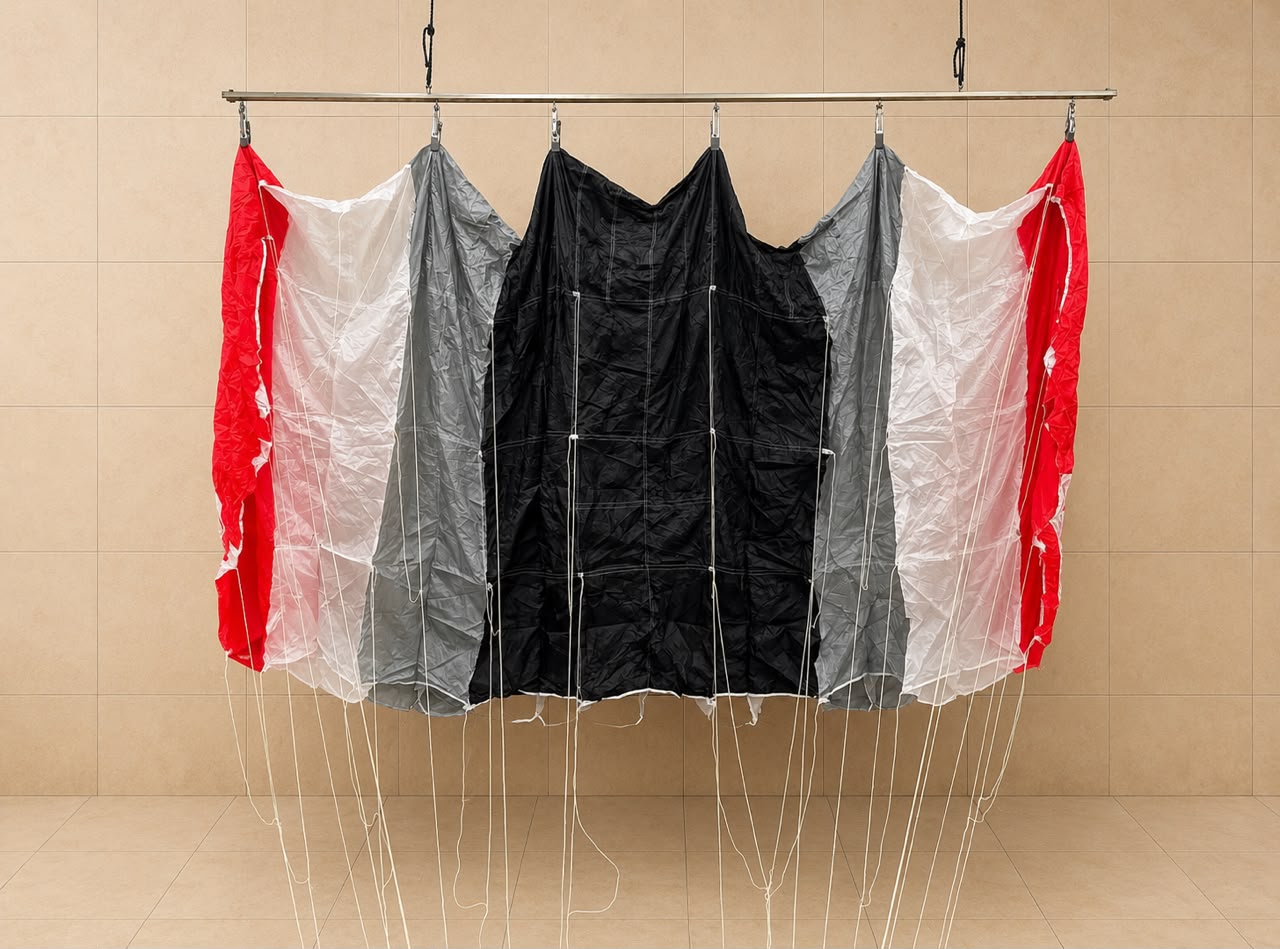

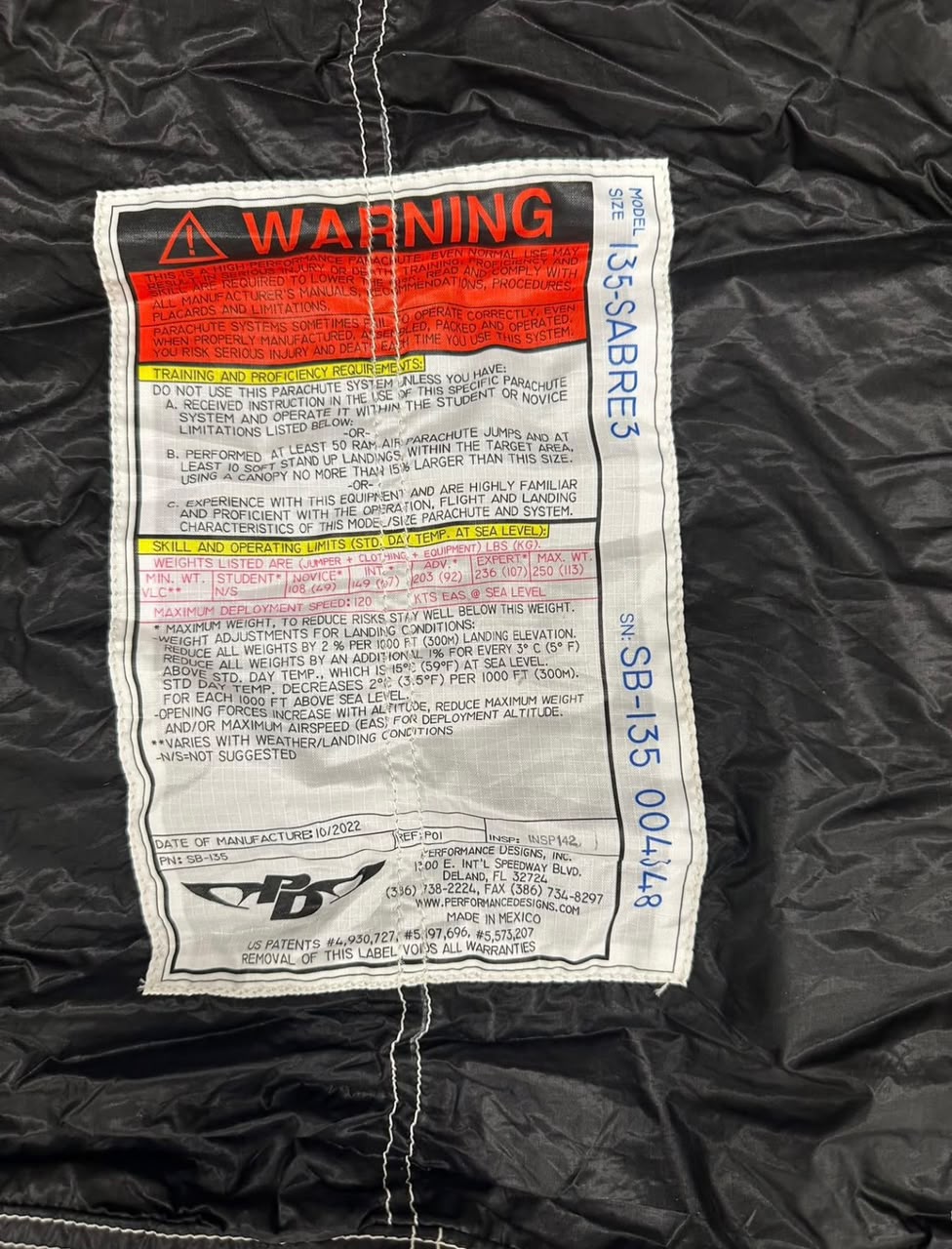

Used PD Sabre 3 135 Main Canopy
€1,855.00
The Used PD Sabre 3 135 Main Canopy is a Performance Designs main parachute intended for jumpers who want a responsive, versatile 9-cell wing capable of serving both recreational flying and more advanced canopy progression. Performance Designs currently offers the Sabre3 in sizes ranging from 89 to 230 square feet, with the 135 positioned in the middle of the smaller-size range. PD describes the Sabre3 as a dynamic wing with crisp and predictable control response, a long recovery arc, manageable front-riser pressure, strong rear-riser performance, powerful bottom-end flare, a relatively steep glide, and redesigned openings.
Because this example is used, model characteristics should be considered alongside its actual condition. Fabric condition, line wear, line trim, slider condition, stitching, reinforcement tapes, connector links, brake lines, deployment history, repairs, storage history, and pack volume all matter. Performance Designs currently supports replacement line sets for the Sabre3 135 in both 750 Vectran and 700 HMA configurations, which is useful when assessing a canopy approaching reline condition.
Used PD Sabre 3 135 Main Canopy – Technical Main-Canopy Overview
Sabre3 135 Design, Flight Characteristics, Wing Loading, Used Condition, and Skydiving Context
Parachute Jump Australia
The phrase parachute jump australia relates to recreational skydiving operations where main-canopy selection should always account for local rules, drop-zone policy, jumper experience, and equipment suitability.
Skydive Byron Bay
skydive byron bay represents another operational context where a main canopy should be matched to the jumper rather than selected simply because a particular size is available.
Weight Limit Skydiving
The phrase weight limit skydiving matters because the 135 sq ft size does not define performance by itself. Exit weight determines wing loading, and Performance Designs specifically warns that the Sabre3 becomes progressively more aggressive at higher wing loadings and smaller sizes.
Skydiving Downsizing Chart
A skydiving downsizing chart can provide general progression context, but it should never replace coaching or model-specific recommendations. PD states that the Sabre3 demands respect, particularly when selected for less experienced jumpers.
Canopy Flight
canopy flight is where the Sabre3’s design becomes most distinctive. PD describes immediate, crisp, predictable control response and a broad operating range, allowing the wing to feel comparatively manageable at conservative loading while becoming significantly more dynamic when flown aggressively.
Long Recovery Arc
The Sabre3 is officially characterized by a long recovery arc. This means the wing maintains dive energy longer than flatter, more conservative canopy designs, which makes size, loading, and experience particularly important.
Front-Riser Performance
Performance Designs describes the front risers as progressive and manageable. This characteristic supports deliberate canopy-piloting progression while still demanding appropriate supervision and experience.
Landing Flight Risers
The phrase landing flight risers relates directly to the Sabre3’s rear-riser performance. PD specifically highlights its strong rear-riser characteristics, which form part of the wing’s broader performance envelope.
Powerful Flare
The Sabre3 is also known for a powerful bottom-end flare. However, landing performance depends heavily on wing loading, technique, atmospheric conditions, line trim, and available airspeed.
Steep Glide
PD identifies the Sabre3 as having a steep glide relative to more conservative designs. This contributes to its dynamic flight character and should be understood before downsizing or transitioning from a flatter canopy.
Refined Openings
Opening behavior was substantially refined from the previous generation. PD emphasizes redesigned openings, while its canopy-comparison material notes that deployment behavior can still vary with size, wing loading, deployment speed, packing method, field elevation, and other system components.
Tracking Jump
A tracking jump places additional importance on clean separation and stable deployment body position. Even a canopy known for refined openings can behave differently if deployment conditions are poor.
Wingsuit Sport
The phrase wingsuit sport introduces different deployment requirements. The Sabre3 is not simply interchangeable with every wingsuit-oriented canopy, and suitability should be considered with experience and manufacturer guidance.
Vector Wingsuit
A vector wingsuit search concerns freefall equipment rather than this canopy model. The canopy and wingsuit should always be evaluated as separate but interacting parts of the complete system.
Wingsuit
A wingsuit changes the airflow and deployment environment around the jumper. Main-canopy selection should therefore reflect actual jump discipline.
Gliding Suit Wingsuit
The phrase gliding suit wingsuit similarly concerns freefall aerodynamics rather than the Sabre3’s own canopy design.
Skydiving Gliding Suit
A skydiving gliding suit should not be confused with the inflated wing after deployment. These pieces of equipment perform entirely different functions.
Indoor Wingsuit
indoor wingsuit activity takes place in specialized facilities and does not use an operational main parachute in the same way as outdoor skydiving.
Wing Suits for Sale
The phrase wing suits for sale represents a different equipment category and should not be treated as Sabre3 specification terminology.
Price of Wingsuit
The price of wingsuit equipment has no direct relationship to the value or condition of a used main canopy.
Tandem Wingsuit
The phrase tandem wingsuit relates to specialized freefall concepts and does not describe the intended role of this canopy.
Parachute Rig
A parachute rig must be compatible with the canopy’s packed volume and intended main-container size. Container compatibility should be confirmed through the harness-container manufacturer or an appropriately qualified rigger.
Skydiving Rig
A complete skydiving rig integrates the main canopy with the container, risers, deployment bag, pilot chute, bridle, reserve system, harness, and often an automatic activation device.
Container Skydive
The phrase container skydive highlights an important buying issue: a 135 sq ft canopy should not be selected merely because it can physically be placed in a particular main container.
Parts of a Parachute
The parts of a parachute relevant to used-condition assessment include the canopy fabric, suspension lines, cascades, slider, brake lines, connector links, risers, pilot chute, deployment bag, and associated stitching and reinforcement.
Linewear
linewear is especially important when buying used. Performance Designs continues to supply replacement line sets for the 135, including Vectran and HMA options, demonstrating that line condition is a normal maintenance consideration throughout ownership.
Line Trim
Line condition involves more than visible wear. Stretch, shrinkage, and trim changes can influence openings, glide, recovery behavior, toggle response, and flare performance.
Skydiving Rigging
skydiving rigging is central to used-canopy evaluation. A qualified rigger should inspect seams, panels, line attachment points, slider components, connector hardware, brake lines, and any previous repairs.
Freefly PUD Handle
A freefly pud handle belongs to the deployment system rather than the canopy itself. Deployment-handle configuration should remain compatible with the intended container and jump discipline.
Hook Blade Knife
A hook blade knife is emergency equipment carried separately from the main canopy.
Hook Knife Skydiving
The phrase hook knife skydiving refers to emergency cutting equipment used when entanglement or line-related problems occur.
Skydive Hook Knife
A skydive hook knife does not influence the aerodynamic characteristics of the canopy but remains part of many jumpers’ broader emergency equipment setup.
Skydiving Helmet
A skydiving helmet protects the head during freefall, aircraft operations, and landing.
Skydive Helmets
skydive helmets vary considerably in coverage, visibility, ventilation, and accessory compatibility.
Full Face Skydiving Helmet
A full face skydiving helmet provides additional facial coverage and should be selected independently from canopy size.
Sky Diving Helmet
The phrase sky diving helmet refers to protective equipment rather than parachute-system architecture.
Skydiving Helmet Full Face
The phrase skydiving helmet full face relates to enclosed helmet designs and does not determine canopy suitability.
G35 Helmet
The g35 helmet belongs to another part of the personal-equipment system.
Cookie G4 Helmet
The cookie g4 helmet is similarly separate from canopy sizing or wing loading.
Best Skydiving Helmet
The best skydiving helmet depends on fit, visibility, comfort, jump discipline, and applicable certification rather than canopy model.
Skydiving Glasses
skydiving glasses or appropriately designed goggles protect the eyes during freefall.
Can You Wear Glasses While Skydiving
For can you wear glasses while skydiving, many helmets and goggles can accommodate prescription eyewear depending on their design.
Skydiver Goggles
skydiver goggles are a separate protective component and have no direct effect on the canopy’s flight characteristics.
Gear Bag Skydive
A gear bag skydive setup helps protect the complete rig and loose equipment during transportation.
Skydiving Equipment List
A skydiving equipment list may include the complete harness-container system, main canopy, reserve, deployment components, AAD, helmet, altimeter, goggles, jumpsuit, and emergency cutting tool.
Safire 3
The safire 3 is another modern main canopy and should be evaluated according to its own flight characteristics rather than being treated as identical to the Sabre3.
Fluid Wings
fluid wings represents another canopy manufacturer and therefore another design family.
Base Jumping
base jumping uses specialized systems and operating procedures. A conventional skydiving main canopy should not automatically be treated as suitable BASE equipment.
Base Canopy
A base canopy is specifically designed around BASE deployment requirements and differs from a conventional sport-skydiving main.
Baseline Jumping
The phrase baseline jumping is sometimes used incorrectly for BASE jumping and is not a technical Sabre3 category.
CRW Skydiving
crw skydiving involves intentional canopy formations and can require discipline-specific equipment considerations.
Skydiving Speed
skydiving speed varies according to body position and jump discipline. Deployment speed can materially affect opening behavior, as PD notes in its own canopy-comparison guidance.
Speed Sky Diving
speed sky diving can involve substantially higher freefall velocities, making discipline-appropriate deployment procedures and equipment selection especially important.
Fly Suits
fly suits influence body drag and freefall control but remain separate from main-canopy design.
Skydiving Tube
A skydiving tube is a specialized freefall prop and requires experience and careful procedures.
Jumper Pilot
The phrase jumper pilot may describe aircraft personnel, while canopy piloting refers specifically to controlling the parachute after deployment.
Parachute Jump Australia and Cairns Skydiving
Both parachute jump australia and cairns skydiving searches reflect drop-zone environments where equipment acceptance, canopy-size policies, and jumper-experience requirements can differ.
Skydive Belize and Skydiving Blue Hole Belize
skydive belize and skydiving blue hole belize relate to destination jumping. Visiting jumpers should confirm equipment requirements with the responsible operator beforehand.
IFly Colorado Springs
ifly colorado springs relates to indoor body-flight training rather than main-canopy use.
Nude Parachute Jump and Skydiving Nude
The phrases nude parachute jump and skydiving nude are unrelated to the engineering or suitability of a used canopy.
Fire Parachute and Cypress Fire Skydiving
The phrases fire parachute and cypress fire skydiving are not Sabre3 technical designations. CYPRES generally refers to automatic activation equipment rather than a main canopy.
New Skydive
A new skydive participant should not select a smaller or more dynamic canopy based simply on availability. PD specifically recommends instructor or coach guidance for first-rig canopy selection.
#Skydiving Latest
The phrase #skydiving latest may relate to current sport trends, but canopy progression should remain based on training, documented experience, and appropriate wing loading rather than trends.
Smallest Canopy
The smallest canopy is not automatically the most advanced or desirable choice. Smaller size combined with greater loading increases speed and responsiveness.
Why the 135 Size Matters
The 135 sits within a range where wing loading can change the Sabre3’s personality substantially. PD explicitly notes that smaller sizes and heavier loading make the canopy faster and more aggressive.
Why Used Condition Matters
A used Sabre3 should be evaluated through fabric condition, line wear, line trim, slider and grommet condition, brake lines, connector links, stitching, repairs, deployment history, and storage history.
Why Flight History Matters
Jump count provides useful context, but it should not be used alone to determine condition. A canopy with fewer jumps but poor storage or significant damage may require more attention than a well-maintained higher-jump example.
Why Precision Matters in Canopy Control
For a performance-oriented main canopy, “precision” means predictable response to control inputs rather than simply flying fast. The Sabre3 is specifically designed around crisp response, rear-riser efficiency, progressive front-riser input, and a powerful flare.
Overall Technical Perspective
The Used PD Sabre 3 135 Main Canopy is best understood as a dynamic 9-cell sport canopy designed for a broad performance range that changes substantially according to size and wing loading. Performance Designs highlights its long recovery arc, manageable front-riser pressure, steep glide, strong rear-riser performance, powerful flare, immediate control response, and refined openings.
For a used 135, the most important assessment factors are actual wing loading, jumper experience, fabric condition, line wear and trim, brake-line condition, slider health, connector hardware, repair history, deployment history, container compatibility, and professional inspection. A properly maintained example can retain much of the responsive flight character for which the design is known, but suitability should always be determined from the individual canopy and jumper combination rather than size alone.
Flight Performance, Opening Characteristics, Handling, Landing Control, and Used Condition
A previously owned high-performance recreational canopy should be evaluated through both its aerodynamic character and its physical condition. Published design characteristics provide a useful starting point, but the behavior of an individual example can also be influenced by fabric condition, suspension-line trim, brake-line condition, slider condition, repairs, loading, atmospheric conditions, and the jumper’s experience. Therefore, evaluating the complete system is considerably more useful than concentrating on one specification. A well-maintained example should provide predictable behavior within its intended operating envelope, while an example with worn components may require professional maintenance before continued service.
Overall Flight Character
This design has a lively and responsive personality compared with more conservative recreational wings.
Its control system provides noticeable feedback, while its aerodynamic profile supports energetic flight characteristics.
As a result, it rewards deliberate, accurate control rather than casual input.
Predictable Handling
Predictability is an important quality in any recreational canopy.
Control inputs should produce familiar responses when loading, trim, and environmental conditions remain comparable.
Unexpected changes in behavior can indicate that equipment condition deserves inspection.
Control Response
Toggle input produces changes in heading, airspeed, and canopy attitude.
A responsive design can provide excellent feedback to an experienced pilot.
However, increasing responsiveness also means that accurate control becomes more important.
Understanding Recovery Characteristics
After a diving input, a canopy requires time and altitude to return toward its normal flight attitude.
Some designs recover rapidly, while others retain diving energy longer.
Understanding this characteristic is important because it influences the overall handling personality.
Front-Control Pressure
Input pressure can change throughout the control range.
Progressive resistance provides physical feedback as the canopy is manipulated.
Actual pressure can vary according to loading, trim, airspeed, and individual canopy condition.
Rear-Control Response
Rear control can provide another method of managing canopy attitude and direction during appropriate phases of flight.
The effectiveness of this input depends on aerodynamic design and available airspeed.
Proper training remains essential before advanced techniques are introduced.
Toggle Range
The usable toggle range contributes significantly to overall handling.
Smooth input allows the jumper to understand how the wing responds through different portions of the control stroke.
Abrupt movements can produce substantially different responses.
Flare Performance
A strong flare is valuable because it converts available airspeed into lift during the final landing phase.
Nevertheless, effective flare performance depends on correct timing, line trim, loading, atmospheric conditions, and technique.
The canopy itself cannot compensate for poor judgment or inadequate training.
Brake-Line Condition
Brake lines experience repeated mechanical movement and handling.
Wear, shrinkage, incorrect length, or damaged stitching can influence control feel.
They should therefore receive appropriate inspection throughout the canopy’s service life.
Opening Characteristics
Deployment behavior is influenced by more than canopy design.
Packing method, deployment airspeed, body position, slider condition, line organization, loading, atmospheric conditions, and equipment configuration can all influence an opening.
Therefore, individual experiences can vary.
Consistent Deployment
A well-maintained system should provide reasonably understandable deployment behavior within its intended operating conditions.
However, no recreational canopy should be expected to produce an identical opening every time.
Minor variation is normal because each deployment occurs under slightly different circumstances.
Heading Performance
Heading during inflation can be influenced by body position, packing symmetry, line organization, and environmental conditions.
Consequently, occasional variation should be evaluated in context.
Persistent unusual behavior deserves professional investigation.
Slider Condition
The slider plays an important role in controlling the deployment sequence.
Its fabric, reinforcement, stitching, and grommets should remain in suitable condition.
Damage or deformation can influence deployment characteristics.
Grommet Inspection
Grommets should remain smooth and properly installed.
Sharp edges can damage suspension lines over time.
Corrosion, distortion, or looseness should receive attention during inspection.
Suspension-Line Condition
Suspension lines are fundamental structural and aerodynamic components.
They should remain free from excessive abrasion, broken fibers, contamination, or significant mechanical damage.
Their condition should be evaluated along the complete length.
Understanding Line Trim
Line dimensions can change gradually through repeated use.
Even when individual lines remain physically intact, trim changes can influence canopy geometry.
Consequently, opening behavior, glide, recovery characteristics, control response, and flare performance can change.
Why Relining Matters
A replacement line set can restore important aspects of canopy geometry when the existing lines have reached an appropriate maintenance threshold.
However, relining should be based on actual condition and professional assessment rather than an arbitrary jump number alone.
Different line materials can wear differently.
Fabric Condition
Fabric provides the aerodynamic surface responsible for maintaining the canopy’s inflated shape.
It should remain free from substantial damage, contamination, or inappropriate repairs.
Previously owned equipment deserves careful panel-by-panel examination.
Porosity Considerations
Material characteristics can change with extended use and environmental exposure.
Storage conditions, contamination, abrasion, and age may all influence fabric behavior.
A professional inspection provides a more meaningful assessment than appearance alone.
Seam Integrity
Structural seams distribute loads throughout the canopy.
Loose stitching, broken threads, distorted seams, or questionable repairs deserve attention.
Load-bearing areas require particularly careful inspection.
Reinforcement Areas
Reinforcement tapes help distribute forces around structurally important locations.
They should remain securely attached and free from significant deterioration.
Attachment points should receive regular inspection.
Previous Repairs
A professionally completed repair does not automatically make a used canopy unsuitable.
However, its location, size, workmanship, and documentation matter.
Unknown or poorly executed repairs deserve additional scrutiny.
Jump History
Total jump count provides useful background information, but it does not tell the complete story.
Two examples with similar jump numbers can have very different conditions because of packing surfaces, storage environments, line maintenance, repairs, and general handling.
Storage History
Storage can have a significant effect on long-term condition.
A clean, dry, temperature-stable environment generally provides better protection than prolonged exposure to moisture, heat, chemicals, or ultraviolet radiation.
Known storage history therefore adds useful context.
Wing Loading
Loading has a major influence on flight personality.
As loading increases, speed, descent characteristics, responsiveness, and landing demands generally increase as well.
Therefore, canopy size should always be considered alongside complete exit weight.
Jumper Experience
Experience is equally important.
A smaller, more responsive wing may require considerably more judgment and control accuracy than a larger, more conservative design.
Progression should therefore be based on demonstrated skills and qualified coaching.
Atmospheric Conditions
Wind, turbulence, temperature, elevation, and density altitude can influence practical behavior.
A familiar canopy can therefore feel different when environmental conditions change substantially.
Conservative decision-making remains important.
Landing Environment
Landing areas are not always perfectly smooth or unrestricted.
Traffic, obstacles, wind changes, and surface conditions can increase workload.
Appropriate canopy selection should account for realistic operating environments rather than ideal conditions alone.
Container Compatibility
Pack volume must remain appropriate for the intended harness-container system.
Physical insertion does not automatically establish correct compatibility.
Manufacturer sizing information and professional rigging judgment should guide installation.
Deployment-System Condition
The pilot chute, bridle, deployment bag, closing components, risers, and associated hardware should be evaluated together with the canopy.
Reliable operation depends on the complete deployment system rather than the fabric wing alone.
Professional Inspection
A qualified professional should inspect previously owned equipment before installation when its condition or history is uncertain.
Photographs and seller descriptions can provide useful preliminary information, but they cannot establish airworthiness.
Overall Performance Assessment
A well-maintained used canopy can retain responsive handling, predictable control characteristics, effective energy management, and strong landing performance. However, these qualities depend on far more than the model name printed on the identification panel.
Fabric integrity, suspension-line condition, line trim, brake configuration, slider health, structural stitching, loading, deployment-system compatibility, repairs, storage history, and jumper experience all influence real-world behavior.
For that reason, the strongest evaluation combines documented history with professional inspection and appropriate sizing. When the equipment remains structurally sound, correctly configured, properly maintained, and matched to a suitably experienced jumper, it can continue providing the dynamic yet predictable recreational flight characteristics expected from a modern performance-oriented main canopy.
Everyday Usability, Canopy Progression, Durability, Maintenance, and Practical Ownership
Owning a previously used main canopy involves more than assessing how it flies during a single jump. Long-term usability depends on predictable deployment behavior, manageable handling, appropriate sizing, consistent maintenance, and a clear understanding of the canopy’s existing condition. Because every used example develops its own service history, two apparently identical wings may behave differently after hundreds of deployments, packing cycles, landings, and periods of storage. Fabric condition, suspension-line geometry, steering components, slider wear, repairs, and previous environmental exposure can all influence the ownership experience. Therefore, a practical evaluation should combine flight characteristics with professional inspection and accurate maintenance records.
Everyday Recreational Use
A responsive recreational wing can support a broad range of ordinary jumping when matched appropriately to the individual.
Its handling should feel consistent enough for the jumper to develop familiarity over repeated flights.
That familiarity becomes particularly valuable when conditions change between jumps.
Building Canopy Familiarity
Understanding a canopy takes time.
A jumper gradually learns its normal opening behavior, control pressure, glide characteristics, descent profile, and landing response.
Consistent equipment allows these observations to become more meaningful.
Appropriate Progression
Progression should be based on demonstrated skill rather than enthusiasm for smaller equipment.
Experience with traffic management, pattern planning, accuracy, variable wind conditions, and emergency procedures provides an important foundation.
Qualified coaching should guide major changes in size or performance category.
Understanding Loading
Loading strongly influences the character of a wing.
Increasing loading generally increases speed and responsiveness while reducing the margin available for correcting certain errors.
Therefore, complete exit weight should always be considered when evaluating suitability.
Avoiding Size-Based Assumptions
Canopy size alone does not determine difficulty.
Planform, trim, loading, control response, recovery characteristics, and jumper experience all matter.
A familiar numerical size can therefore behave very differently across different designs.
Control Familiarity
Predictable controls help the jumper develop a consistent understanding of the wing.
Toggle response should remain familiar across comparable conditions.
A noticeable unexplained change may indicate that equipment condition deserves inspection.
Flight Planning
Good canopy operation begins before the final landing phase.
Altitude awareness, traffic observation, wind assessment, and an appropriate landing pattern all contribute to predictable outcomes.
Planning should remain conservative when conditions become unfamiliar.
Traffic Awareness
Busy landing areas require disciplined observation.
Other canopies may approach from different directions and at different speeds.
Predictable patterns and appropriate separation reduce unnecessary conflicts.
Glide Management
Understanding glide helps with landing-area planning.
Actual glide varies according to loading, control position, atmospheric conditions, and surrounding air movement.
Experience should therefore be developed across appropriate conditions rather than based on one jump.
Descent Characteristics
Descent behavior changes with control input and atmospheric conditions.
A jumper should become familiar with the normal descent profile of the equipment.
Unexpected changes deserve careful consideration.
Landing Consistency
Consistent landings depend on much more than the canopy itself.
Approach planning, airspeed, control timing, surface conditions, wind, loading, and technique all contribute.
Good equipment supports skill but does not replace it.
Maintaining Appropriate Technique
Technique should remain deliberate and repeatable.
Trying to force performance beyond current ability increases unnecessary risk.
Progressive coaching provides a better foundation for developing advanced skills.
Opening Awareness
Deployment should remain an active phase of every jump.
Stable body position, appropriate deployment conditions, and awareness of surrounding traffic remain important.
A familiar canopy does not eliminate the need for disciplined deployment procedures.
Recognizing Opening Changes
A previously owned canopy may develop changes gradually.
Openings that become consistently different from the established pattern can indicate line-trim changes, slider issues, packing differences, or another condition requiring investigation.
Patterns matter more than one isolated event.
Line Condition
Suspension lines experience wear during packing, deployment, flight, and landing.
Abrasion can develop at several locations rather than only at obvious lower sections.
Routine inspection should therefore consider the complete line system.
Line Geometry
Lines can change dimension throughout service.
These changes can alter the aerodynamic geometry of the wing even when the lines still appear visually acceptable.
Professional assessment becomes important when flight behavior begins changing.
Steering-System Maintenance
Steering lines and related components receive repeated handling.
Wear, dimensional changes, and damaged stitching can affect control characteristics.
Their condition should be monitored throughout ownership.
Slider Maintenance
The slider experiences significant mechanical activity during deployment.
Fabric, reinforcement areas, stitching, and grommets should remain structurally sound.
Damaged components deserve professional attention.
Connector Inspection
Connection hardware should remain correctly installed and free from deformation, corrosion, or substantial wear.
Questionable hardware should not be ignored.
Professional inspection can determine whether replacement or servicing is appropriate.
Fabric Durability
Canopy fabric experiences repeated packing, deployment, handling, and environmental exposure.
Careful treatment can help preserve material condition.
Rough packing surfaces and unnecessary contamination should be avoided whenever practical.
Protecting the Canopy During Packing
The packing environment matters.
Dragging fabric across abrasive surfaces can gradually create unnecessary wear.
A clean packing area provides better protection for both fabric and lines.
Avoiding Contamination
Technical fabrics should be protected from oils, fuels, aggressive cleaning products, battery fluids, and other chemicals.
Unknown contamination should receive professional evaluation.
Attempting to remove it with unsuitable chemicals can create additional damage.
Moisture Management
Equipment should not remain unnecessarily damp.
Persistent moisture can contribute to material deterioration and unpleasant storage conditions.
The complete system should be allowed to remain appropriately dry.
Sunlight Exposure
Repeated ultraviolet exposure can degrade textile materials over time.
Normal jumping inevitably involves some sunlight, but unnecessary prolonged exposure should be avoided.
Equipment should not be left outside simply for convenience.
Temperature Protection
Extreme heat can negatively affect technical equipment.
Vehicles can reach substantial temperatures when parked in direct sunlight.
Long-term storage in such environments should therefore be avoided.
Gear Transportation
A suitable protective bag helps keep equipment organized and reduces exposure to dirt and unnecessary abrasion.
Transportation should also prevent heavy objects from crushing or damaging the packed system.
Storage Between Jumping Periods
Longer periods without use deserve additional attention.
A clean, dry, moderate environment provides a better storage location than areas exposed to moisture, extreme heat, or chemicals.
Equipment should remain protected from animals and physical damage.
Maintaining Records
A simple maintenance history becomes increasingly valuable as equipment ages.
Jump estimates, repairs, line replacement, inspections, and significant changes can be recorded.
This information provides useful context during future professional assessments.
Recording Line Replacement
Line replacement represents an important point in the service history.
Recording the approximate jump count and date provides future owners and inspectors with useful information.
Documentation can also simplify resale evaluation.
Repair Documentation
Repairs should be documented whenever possible.
The location, reason, and professional work performed provide valuable historical context.
Transparent repair history is considerably better than unexplained stitching or unidentified alterations.
Periodic Professional Inspection
Professional inspection should not be limited to situations where obvious damage has already developed.
Periodic assessment can identify wear that may be difficult for an owner to recognize.
This is particularly useful with older or heavily used equipment.
Container Fit
Main-container compatibility remains important throughout ownership.
A change to a different harness-container system may require a fresh assessment.
Pack volume and manufacturer recommendations should guide compatibility decisions.
Avoiding Improvised Modifications
Structural or aerodynamic modifications should never be improvised.
Changing line configuration, control geometry, slider components, or structural elements can influence behavior significantly.
Appropriate professional guidance is essential.
Preparing for Resale
Accurate records improve the transparency of a used canopy.
Prospective owners benefit from knowing approximate jump numbers, line history, repairs, storage conditions, and significant incidents.
Clear information supports better decisions.
Evaluating Remaining Value
Remaining value should not be determined from appearance alone.
A clean canopy with worn lines or questionable repairs may require immediate maintenance, while a cosmetically older example with documented care may remain in better practical condition.
Professional assessment provides the strongest basis for comparison.
Overall Ownership Perspective
Long-term ownership is most successful when performance progression and equipment preservation are treated as connected responsibilities. A responsive canopy can provide enjoyable, predictable flight characteristics, but those qualities depend on maintaining its structural and aerodynamic condition.
Appropriate loading, disciplined progression, traffic awareness, controlled landing techniques, healthy suspension lines, correct steering geometry, sound fabric, reliable slider components, compatible installation, and professional maintenance all contribute to the complete experience.
With accurate records, careful storage, clean packing practices, appropriate transportation, regular inspection, and qualified servicing whenever deterioration develops, a previously owned main canopy can continue delivering dependable recreational usability while allowing its owner to make informed decisions about maintenance, progression, future relining, and eventual replacement.
Long-Term Care, Storage, Inspection, Service Life, and Ownership Value
Long-term ownership of a previously used main canopy depends on consistent care, accurate documentation, suitable storage, and timely professional inspection. A canopy is repeatedly exposed to packing, deployment forces, flight loads, landing environments, handling, and transportation. Consequently, gradual wear should be expected even when the equipment is treated carefully. The objective of good maintenance is not to keep the canopy looking permanently new, but to preserve its structural integrity, aerodynamic consistency, and dependable operation for as long as its condition remains acceptable. Understanding how different components age also makes it easier to recognize when inspection, repair, or replacement becomes appropriate.
Establishing a Maintenance Routine
A sensible maintenance routine should be straightforward and repeatable.
Owners should regularly observe fabric, suspension lines, steering components, slider condition, connector hardware, stitching, and attachment areas.
Changes noticed early can be evaluated before they become more significant.
Understanding Normal Wear
Repeated use naturally produces some wear.
Lines pass through slider grommets, fabric is folded during packing, components experience deployment loads, and exterior surfaces contact packing areas.
Normal wear should still be monitored because gradual deterioration can eventually require maintenance.
Fabric Preservation
The fabric forms the aerodynamic surface of the wing and deserves careful treatment.
It should be protected from unnecessary abrasion, contamination, prolonged sunlight, and inappropriate cleaning products.
Good packing habits contribute significantly to material preservation.
Inspecting Fabric Panels
Fabric panels can be visually checked for tears, abrasions, unusual discoloration, damaged stitching, or questionable repairs.
Small changes should not automatically be ignored.
Professional assessment can determine whether a particular condition affects continued service.
Seam Condition
Structural seams distribute forces throughout the wing.
Stitching should remain consistent and securely attached.
Broken threads, pulled seams, or unusual distortion should receive attention.
Reinforcement Areas
Reinforcement tapes support high-load areas of the structure.
They should remain securely attached and free from significant deterioration.
Line attachment locations deserve particularly careful observation.
Suspension-Line Wear
Suspension lines experience repeated mechanical loading.
Wear may develop around attachment points, cascades, slider contact areas, and lower connections.
Inspection should therefore consider the complete line system rather than only easily visible sections.
Understanding Line Aging
Lines can change dimension as they accumulate use.
These changes may influence canopy geometry even when obvious physical damage is absent.
Opening characteristics, control response, glide, and landing behavior can therefore gradually change.
Recognizing Possible Trim Changes
A consistent change in familiar flight characteristics can justify professional inspection.
Changes in opening behavior, control feel, or general flight attitude may have several causes.
Line geometry is one factor that should be considered.
Steering-Line Maintenance
Steering components receive substantial repeated handling.
Their condition can influence control response and landing performance.
Wear, damaged stitching, or dimensional changes should receive appropriate attention.
Slider Inspection
The slider is repeatedly loaded during deployment.
Its fabric, reinforcement areas, stitching, and grommets should remain structurally sound.
Damage should be assessed before continued use.
Grommet Condition
Grommets should remain smooth and properly installed.
Sharp edges can gradually damage lines.
Deformation, corrosion, looseness, or rough surfaces deserve attention.
Connector Hardware
Connection hardware should remain correctly installed and structurally sound.
Corrosion, deformation, unusual movement, or damaged components should be professionally evaluated.
Hardware condition forms an important part of overall system integrity.
Deployment Component Care
The main canopy works as part of a larger deployment system.
The pilot chute, bridle, deployment bag, closing components, risers, and associated hardware also experience wear.
These items should be included in periodic inspections.
Pilot Chute Condition
Repeated deployments can gradually affect pilot chute fabric, mesh, stitching, and related components.
Its condition should therefore be monitored rather than assumed acceptable indefinitely.
Professional assessment can identify when maintenance becomes necessary.
Bridle Inspection
The bridle experiences repeated deployment loads and handling.
Abrasion, damaged stitching, contamination, or unusual wear deserves attention.
It should remain correctly integrated with the deployment system.
Deployment Bag Condition
The deployment bag should remain structurally sound.
Stitching, fabric, attachment points, and line-stow areas can all experience wear.
A damaged bag may require repair or replacement.
Packing Environment
Where the canopy is packed can influence long-term condition.
Clean packing surfaces reduce unnecessary abrasion and contamination.
Rough concrete, dirt, gravel, and other abrasive environments should be avoided whenever practical.
Packing Technique and Equipment Care
Consistent packing helps organize the system while reducing unnecessary handling.
Fabric should not be dragged aggressively across surfaces.
Lines should remain organized and free from avoidable twists or contamination.
Moisture Protection
Equipment should not remain damp unnecessarily.
Moisture can create unfavorable storage conditions and may contribute to deterioration.
The canopy and surrounding equipment should remain appropriately dry.
Chemical Protection
Technical fabrics should be kept away from aggressive chemicals.
Fuel, solvents, battery fluids, oils, and unsuitable cleaning products can damage materials.
Suspected chemical exposure should receive professional assessment.
Sunlight Management
Ultraviolet radiation can gradually degrade textile materials.
Normal operational exposure cannot be eliminated completely, but prolonged unnecessary exposure should be avoided.
Equipment should not remain in direct sunlight simply for storage convenience.
Temperature Management
Extreme heat can accelerate material deterioration.
Closed vehicles can reach particularly high temperatures.
A moderate indoor environment generally provides more appropriate long-term storage.
Transportation Protection
A protective equipment bag can reduce exposure to dirt, abrasion, and accidental damage.
Heavy objects should not be placed carelessly on top of the packed system.
Transportation should protect both the canopy and the complete harness-container assembly.
Storage Between Jumping Periods
Long periods without use deserve thoughtful storage.
A clean, dry, temperature-stable location provides better protection than a damp garage, hot vehicle, or area containing chemicals.
The equipment should also remain protected from pests and physical damage.
Maintaining a Jump Estimate
Keeping an approximate record of canopy jumps provides useful maintenance context.
Jump count alone does not determine condition, but it helps professionals understand the equipment’s service history.
Accurate estimates are preferable to unsupported guesses.
Recording Line Changes
Line replacement should be documented.
The replacement date, approximate canopy jump count, and new line-set information can provide valuable context later.
These records become particularly useful during resale.
Documenting Repairs
Professional repairs should also be recorded.
Information about the damaged area and work performed helps future inspectors understand what they are examining.
Transparent repair history improves equipment evaluation.
Tracking Significant Events
Unusual deployments, substantial contamination, water exposure, or other significant events should be documented when relevant.
Such information can help professionals determine whether additional inspection is necessary.
Professional Inspection
A professional inspection provides a level of assessment that ordinary visual checking cannot replace.
An appropriately qualified person can evaluate structural areas, line condition, repairs, hardware, and overall compatibility.
Inspection becomes particularly important before purchasing unfamiliar used equipment.
Avoiding Unnecessary Modifications
Canopy components should not be altered casually.
Changes involving suspension lines, steering geometry, slider configuration, structural stitching, or other aerodynamic components can influence behavior.
Appropriate technical guidance should always be obtained.
Container Compatibility Over Time
Changing to a different harness-container system may require compatibility to be checked again.
Pack volume and container specifications matter.
The fact that a canopy worked in one system does not automatically establish suitability for another.
Understanding Service Life
There is no useful universal jump number that determines the exact end of service life for every canopy.
Fabric condition, line history, environmental exposure, repairs, packing surfaces, maintenance, and individual use patterns all matter.
Actual condition should therefore guide decisions.
Recognizing When Replacement May Be Appropriate
Eventually, repair or continued maintenance may become less practical.
Significant structural deterioration, extensive damage, repeated repair requirements, or other professional findings may influence replacement decisions.
Safety and suitability should take priority over preserving equipment simply because it remains usable in appearance.
Preserving Resale Value
Good maintenance can also support resale value.
Accurate jump estimates, documented line replacement, transparent repair history, clean storage, and professional inspection provide prospective owners with useful information.
Documentation often matters more than cosmetic appearance alone.
Overall Long-Term Ownership Assessment.
A previously owned main canopy can provide substantial continued service when it receives appropriate care and remains structurally suitable. Long-term reliability comes from preserving the complete system rather than concentrating on one component.
Fabric condition, suspension-line health, steering geometry, slider integrity, connector hardware, deployment components, structural stitching, storage environment, packing practices, container compatibility, and documented maintenance all contribute to overall condition.
Through clean packing practices, careful transportation, controlled storage, protection from chemicals and excessive heat, accurate service records, periodic professional inspection, timely line maintenance, and appropriate repair when required, the canopy can retain dependable aerodynamic characteristics and practical recreational value throughout its useful service life.
Be the first to review “Used PD Sabre 3 135 Main Canopy”
Related products

used products

used products
used products

used products

used products

used products
used products
used products
Reviews
There are no reviews yet.