




Sigma (Pre-Owned) DOM: 05/07


€2,000.00
Product Description
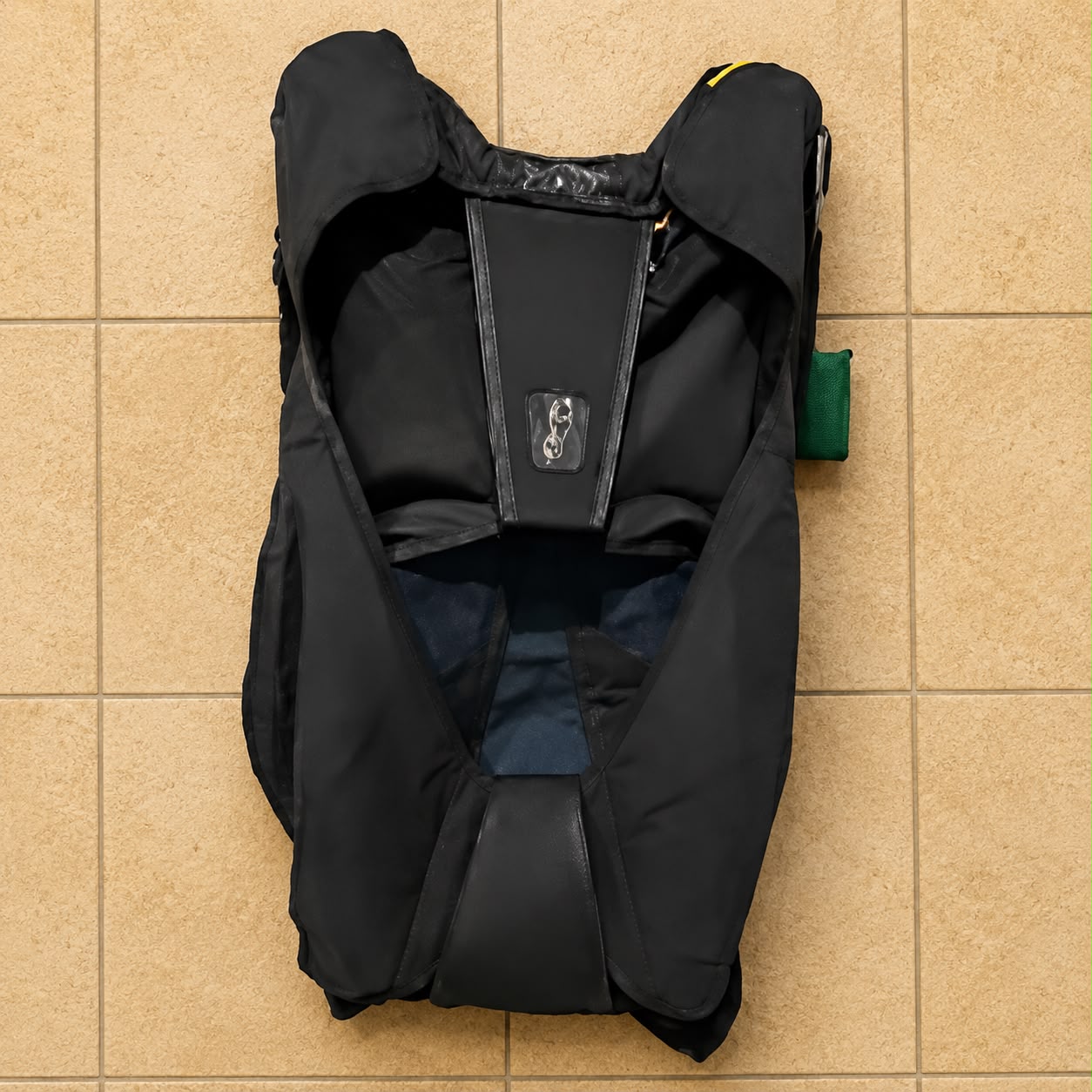
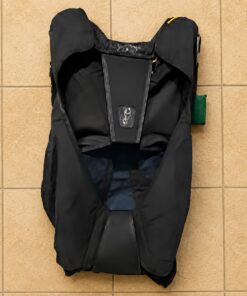
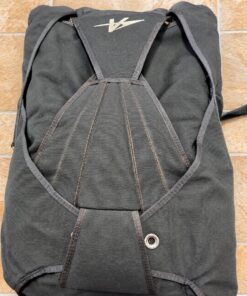
Rig looks in great shape, has about 700-800 jumps. The harness have some normal wear, but
there is no significant sun damage.
The main disk cover flap is not magnetic. The drogue pouch was replaced recently (owner
made).
The wear on the chafing type 12 looks good.
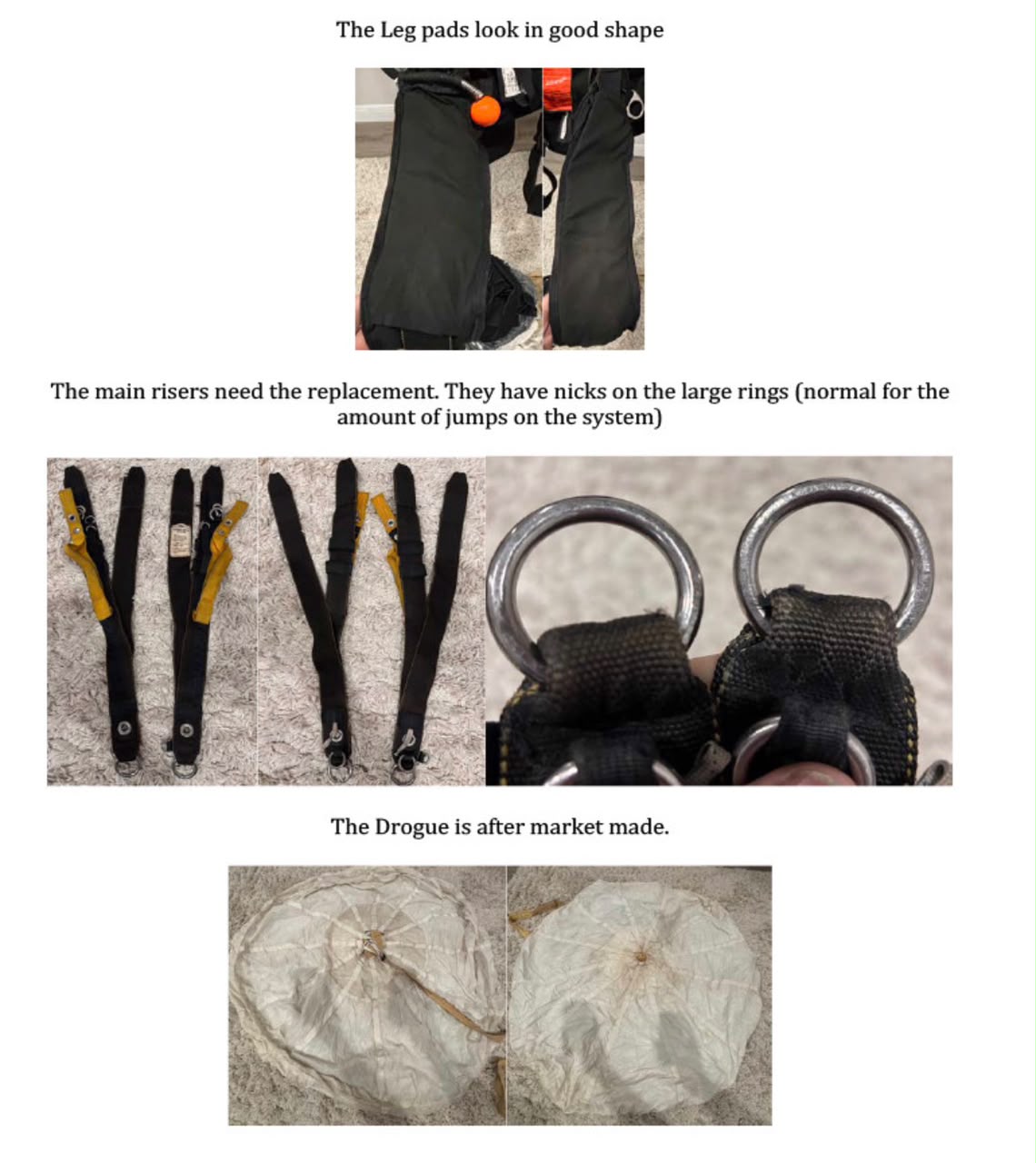
The Leg pads look in good shape
The main risers need the replacement. They have nicks on the large rings (normal for the
amount of jumps on the system)
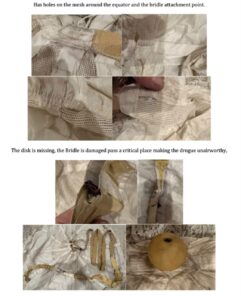
The Drogue is after market made.
Has holes on the mesh around the equator and the bridle attachment point.
The disk is missing, the Bridle is damaged pass a critical place making the drogue unairworthy,
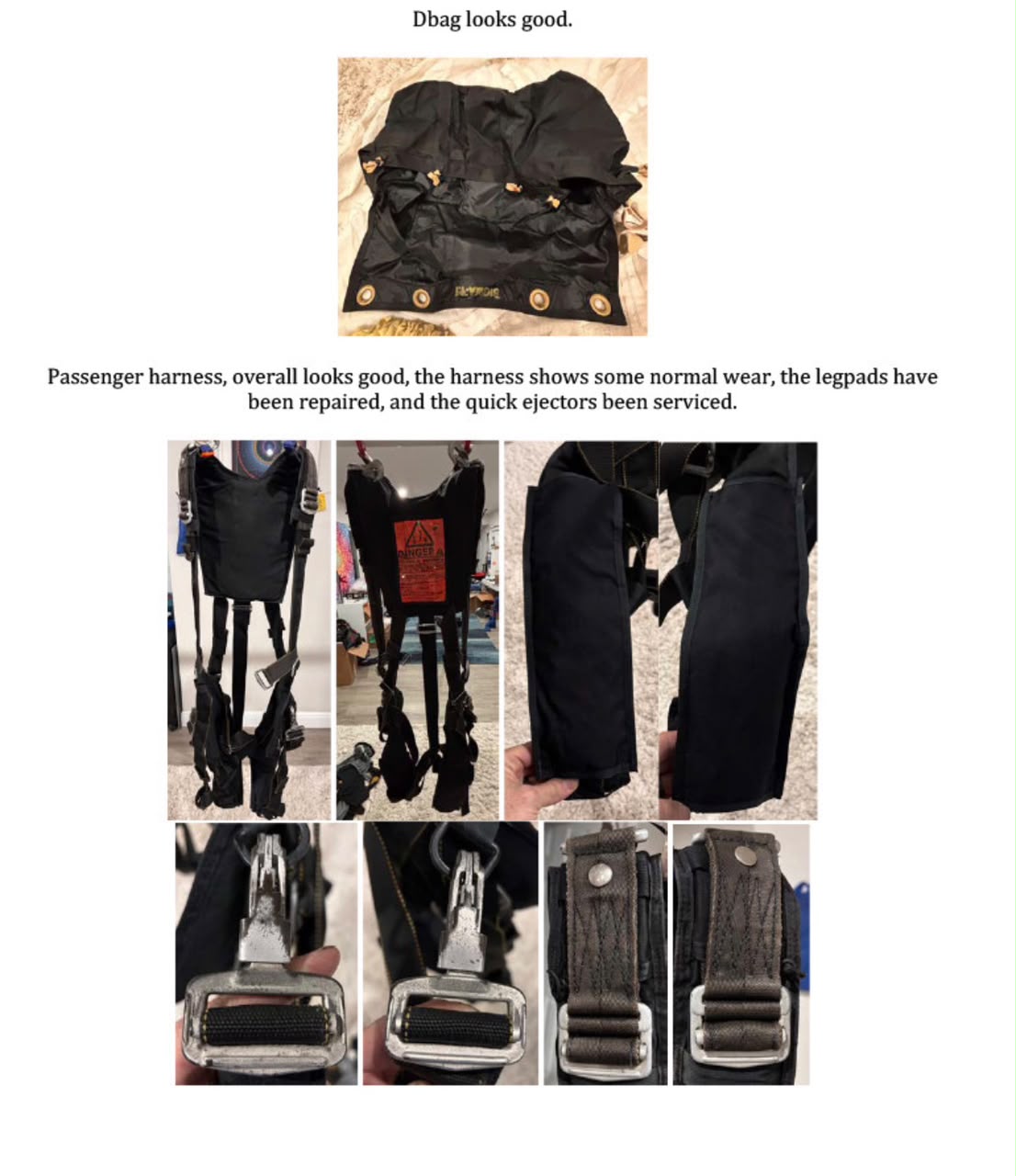
Dbag looks good.
Passenger harness, overall looks good, the harness shows some normal wear, the legpads have
been repaired, and the quick ejectors been serviced.
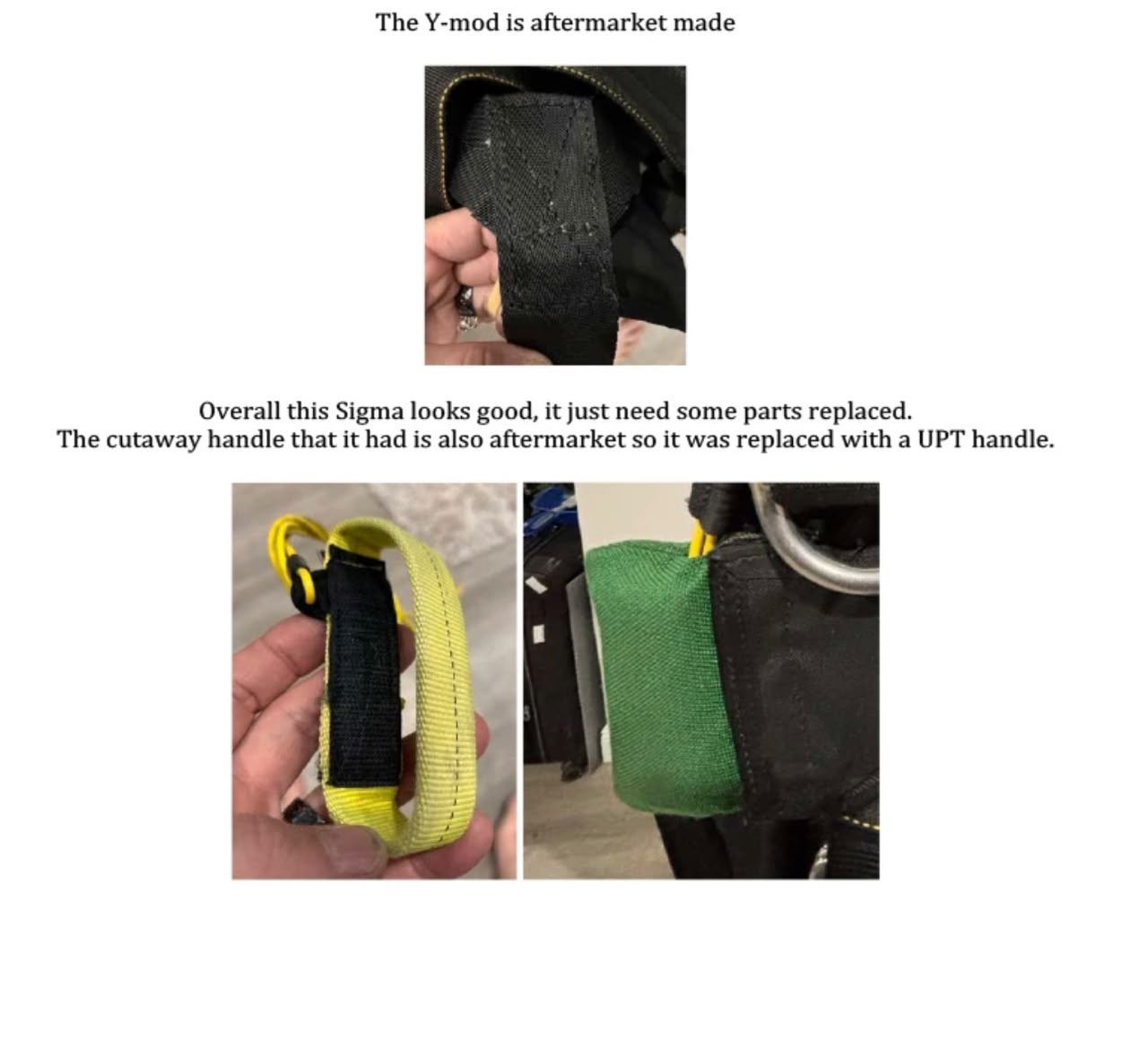
The Y-mod is aftermarket made
Overall this Sigma looks good, it just need some parts replaced.
The cutaway handle that it had is also aftermarket so it was replaced with a UPT handle.
Used Sigma (Pre-Owned) DOM 05/07 – Tandem Parachute Rig Technical
Sigma Tandem System, Condition, Rigging, Canopy Context, and Skydiving Equipment
Parachute Rig
A parachute rig used for tandem operations is life-support equipment whose suitability depends on the complete harness/container, deployment system, risers, reserve installation, passenger harness, and associated hardware. UPT maintains dedicated Sigma owner and operations manuals along with tandem-specific service bulletins, making professional inspection and documentation essential when evaluating a system manufactured in 2007.
Skydiving Rig
A skydiving rig in this age and jump range should be judged through structural condition and service history rather than cosmetic appearance alone Used Sigma DOM: 05/07. The seller reports approximately 700–800 jumps and normal wear without significant sun damage, but it also identifies components requiring replacement before further operational consideration.
Container Skydive
For anyone researching container skydive equipment, this Sigma illustrates why container inspection must include the main closing area, disc cover, drogue pouch, harness webbing, Type 12 chafing areas, leg pads, riser interfaces, handles, and passenger attachment system.
UPT continues to maintain technical documentation and service bulletins covering tandem components, including reserve ripcords, tandem student harness modifications, Skyhook inspection, and historic tandem component service issues.
Parts of a Parachute
The parts of a parachute system extend far beyond the canopy itself. In a tandem configuration, the harness/container, drogue, bridle, deployment bag, risers, reserve system, release handles, passenger harness, and attachment hardware all contribute to serviceability.
For this particular rig, the seller says the deployment bag looks good but identifies significant problems with the drogue and main risers.
Skydiving Rigging
Skydiving rigging is especially important with an older tandem system because load-bearing textile components, metal hardware, handles, risers, and deployment equipment may have different replacement or inspection requirements.
UPT’s service-bulletin archive includes tandem-specific notices dating across several decades, reinforcing the need to establish which bulletins and modifications apply to serial 45721 before operational use.
Linewear
The keyword linewear usually concerns canopy line condition and trim. However, the seller does not identify a main canopy or line set as included with this serial-45721 listing. Therefore, no line condition, canopy jump count, or remaining line life should be claimed without examining the actual canopy documentation.
Landing Flight Risers
The term landing flight risers relates generally to the riser system connecting a deployed canopy to the harness/container. In this specific listing, the main risers require attention: the seller explicitly states they need replacement because nicks are present on the large rings.
Hook Blade Knife
A hook blade knife is an emergency cutting tool frequently discussed within skydiving equipment preparation. It is separate from the structural condition of this used tandem rig and should not be assumed included unless physically listed with the equipment.
Hook Knife Skydiving
Similarly, hook knife skydiving equipment forms part of emergency preparedness rather than the Sigma container specification itself. Equipment selection and placement should follow operator procedures and qualified tandem-instructor requirements.
Skydive Hook Knife
A skydive hook knife does not correct deficiencies in a drogue, bridle, riser, or harness. Those components must meet their own serviceability requirements before the rig is returned to operation.
Weight Limit Skydiving
Weight limit skydiving questions are particularly important for tandem systems, but limits cannot safely be inferred from the container alone.
The actual main canopy, reserve canopy, harness configuration, instructor, passenger, total suspended weight, and operator requirements all matter. Because this listing does not identify a reserve or main canopy, no package-specific weight limit should be published without additional documentation.
Skydiving Downsizing Chart
A skydiving downsizing chart is primarily relevant to sport-canopy progression and should not be applied directly to tandem systems.
UPT’s current Sigma II family, for example, uses clearly defined container and canopy combinations: size 11 is designed around 270–310 sq ft mains with the SR340 reserve, size 12 around the SG340 with SR340 or SR370, and size 13 around SG370 or SG395 with the SR370. Those current Sigma II specifications should not be retroactively applied to this 2007 Sigma without documentation.
Smallest Canopy
The smallest canopy that might physically fit a container is not automatically the correct or approved canopy.
Pack volume, certification, loading, manufacturer compatibility, and tandem-specific requirements must all be considered.
Canopy Flight
Canopy flight characteristics depend primarily on the actual installed main canopy, loading, trim, line condition, environmental conditions, and instructor technique.
Because the seller’s serial-45721 page does not identify a main canopy, this description should not make claims about canopy performance.
CRW Skydiving
CRW skydiving refers to canopy relative work and should not be confused with tandem operational use. A tandem Sigma has a different deployment architecture, workload, and certification context.
Safire 3
Safire 3 refers to a separate sport-canopy product category and should not be treated as an included main canopy for this Sigma unless the actual equipment documentation confirms it.
Fluid Wings
Likewise, fluid wings refers to a separate canopy manufacturer/product ecosystem and does not establish the canopy installed in this tandem rig.
Base Jumping
Base jumping uses equipment and operating procedures that are fundamentally different from tandem skydiving. The Sigma is a tandem skydiving harness/container system and should not be characterized as BASE equipment.
Baseline Jumping
The search phrase baseline jumping is often encountered around BASE-related searches, but it does not define any Sigma feature.
Base Canopy
A base canopy should not be substituted conceptually for a tandem main or reserve. These systems have different design requirements and operational purposes.
Tracking Jump
A tracking jump is a freefall discipline and does not change the inspection requirements for this system. The condition of the drogue, bridle, risers, harness, and reserve system remains independently important.
Skydiving Speed
Skydiving speed varies according to body position, tandem configuration, drogue deployment, altitude, and atmospheric conditions. It should not be inferred from the age or model of the harness/container.
Speed Sky Diving
Likewise, speed sky diving is a specialized discipline unrelated to the technical condition of this used tandem system.
Wingsuit Sport
Wingsuit sport equipment and operating procedures differ significantly from tandem operations.
Wingsuit
A wingsuit should not be treated as part of the Sigma package unless specifically included as separate equipment, which the seller does not indicate.
Vector Wingsuit
The phrase vector wingsuit may appear in searches related to sport-container compatibility, but it does not establish compatibility or use for this tandem system.
Gliding Suit Wingsuit
A gliding suit wingsuit is a freefall garment rather than part of the tandem harness/container.
Skydiving Gliding Suit
Likewise, a skydiving gliding suit represents a different equipment category.
Wing Suits for Sale
The phrase wing suits for sale is commercial search terminology unrelated to the condition or configuration of serial 45721.
Price of Wingsuit
Price of wingsuit searches similarly have no bearing on the rig’s inspection requirements.
Tandem Wingsuit
A tandem wingsuit should not be inferred as a standard Sigma application. Tandem operations must remain within manufacturer, instructor-rating, and operator procedures.
Indoor Wingsuit
Indoor wingsuit training refers to specialized tunnel activity and does not replace actual tandem equipment training or rigging inspection.
Fly Suits
Fly suits are clothing items and should remain separate from the technical description of a tandem harness/container.
Skydiving Helmet
A skydiving helmet is personal protective equipment rather than part of the Sigma rig itself.
Skydive Helmets
Skydive helmets vary according to discipline, communication requirements, fit, and operator rules.
Sky Helmet Skydiving
The search phrase sky helmet skydiving refers to helmet selection rather than parachute-system engineering.
Full Face Skydiving Helmet
A full face skydiving helmet can provide facial coverage and eye protection, but it should not be presented as included unless specifically documented.
Skydiving Helmet Full Face
The alternative term skydiving helmet full face concerns the same separate protective-equipment category.
G35 Helmet
A g35 helmet is a helmet search term rather than part of this tandem-system specification.
Cookie G4 Helmet
Similarly, cookie g4 helmet relates to separate personal protective equipment.
Best Skydiving Helmet
The best skydiving helmet depends on fit, discipline, visibility, communication requirements, and drop-zone procedures rather than which tandem container is used.
Skydiving Glasses
Skydiving glasses may be used depending on helmet configuration, vision requirements, and operator procedures.
Skydiver Goggles
Skydiver goggles provide eye protection and remain separate from the harness/container.
Can You Wear Glasses While Skydiving
The question can you wear glasses while skydiving concerns personal protective equipment and operational accommodation rather than the Sigma’s technical configuration.
Gear Bag Skydive
A gear bag skydive setup can protect the rig during storage and transport, but a bag cannot compensate for damaged or unairworthy internal components.
Skydiving Equipment List
A broader skydiving equipment list for professional tandem operations may include the rig, approved main and reserve canopies, AAD, passenger harness, helmet or eye protection where required, suitable clothing, emergency cutting equipment, and documentation. Exact requirements depend on the operator and jurisdiction.
Fire Parachute
The phrase fire parachute does not identify a component of this Sigma system.
Cypress Fire Skydiving
The phrase cypress fire skydiving appears to mix AAD-related terminology. No AAD model or status is identified on the current listing for serial 45721, so none should be claimed.
Freefly Pud Handle
A freefly pud handle relates to sport-rig deployment systems and is not the same as the Sigma tandem drogue-release architecture.
Jumper Pilot
A jumper pilot refers to aircraft operations rather than the parachute rig itself. Tandem-aircraft procedures remain a separate operational consideration.
Parachute Jump Australia
Parachute jump australia is a location-oriented tandem-skydiving search. Any use of an older tandem system in Australia would depend on applicable national rules, drop-zone procedures, instructor qualifications, and equipment acceptance.
Skydive Byron Bay
Skydive Byron Bay is destination-oriented terminology rather than a feature of the equipment.
Cairns Skydiving
Similarly, cairns skydiving concerns a location or operator search rather than the Sigma’s technical specification.
Skydive Belize
Skydive Belize is another destination-oriented search.
Skydiving Blue Hole Belize
The phrase skydiving blue hole belize relates to destination activity rather than equipment certification or serviceability.
iFLY Colorado Springs
iFLY Colorado Springs concerns indoor body-flight training, not tandem parachute-system maintenance.
Nude Parachute Jump
A nude parachute jump is unrelated to the engineering or maintenance of this system.
Skydiving Nude
Likewise, skydiving nude has no bearing on the rig’s technical condition.
Skydiving Website
A skydiving website can provide general industry information, but manufacturer manuals, service bulletins, equipment records, and qualified rigging inspection should control decisions involving tandem life-support equipment. UPT currently provides Sigma manuals and service bulletins through its official technical resources.
New Skydive
The phrase new skydive is general discovery terminology and does not establish whether a pre-owned system is airworthy.
#Skydiving Latest
#skydiving latest content may help users discover industry developments, but it should not replace technical documentation.
Skydiving Tube
A skydiving tube is specialty freefall equipment and has no direct connection to this tandem-system configuration.
Why This Particular Used System Needs Careful Inspection
The seller’s description is unusually clear about the most important maintenance concerns. Serial 45721 is reported to have approximately 700–800 jumps, normal harness wear, good leg pads, and no significant sun damage. However, the main risers need replacement, and the aftermarket drogue is explicitly described as unairworthy because of damaged mesh, a missing disc, and bridle damage. The passenger harness has repaired leg pads and serviced quick ejectors, while the Y-mod is aftermarket.
UPT maintains extensive tandem-specific technical material, including Sigma manuals and service bulletins covering reserve ripcords, student-harness modifications, Skyhook inspection, tandem component lifetime recommendations, and other structural issues. That documentation should be reviewed against this specific serial number before any return to service.
Overall Technical Perspective
The Used Sigma serial 45721, DOM 05/07, represents a well-used professional tandem harness/container with a reported 700–800-jump history. Its harness and leg-pad condition are described positively, but several identified service items prevent it from being responsibly characterized as immediately operational.
Most importantly, the current listing does not document the reserve canopy claimed in your title, nor does it identify a main canopy or AAD. Those components should therefore be described only after their actual data cards, serial numbers, DOMs, pack history, service status, and compatibility have been confirmed.
For a pre-owned tandem system of this age, the strongest product description is one that accurately communicates both its potential and its maintenance requirements: professional rigger inspection, correct replacement of the damaged risers and unairworthy drogue, verification of aftermarket components, confirmation of applicable service bulletins, and independent documentation of any main, reserve, or AAD included with the package.
Construction Quality, Harness Condition, Component Integration, Serviceability, and Practical Evaluation
A pre-owned tandem parachute system requires a different evaluation process from ordinary sporting equipment because every structural component contributes to a life-support function. Age, appearance, and previous usage provide useful background, but none can establish serviceability independently. Harness webbing, container fabric, stitching, metal hardware, deployment components, passenger attachment points, and any installed emergency equipment must work together within approved limits. Consequently, a professional inspection remains the most important step before an older system returns to operational use.
Understanding the Age of the System
Manufacture date provides an important starting point when assessing older equipment.
However, chronological age alone does not reveal how the system has been treated. Two examples produced during the same period may have dramatically different conditions because of jump frequency, storage environment, sunlight exposure, moisture, contamination, repairs, and maintenance.
Therefore, physical condition and documented history should always be considered alongside age.
Evaluating Previous Usage
Reported jump numbers help establish approximate operational history.
Repeated deployments, packing cycles, aircraft movement, landings, transportation, and daily handling gradually expose components to mechanical stress.
Nevertheless, jump numbers should not automatically be converted into remaining service life.
Actual wear must be examined directly because operational environments differ significantly.
Harness Construction
The harness carries substantial loads and deserves particularly careful inspection.
Load-bearing webbing should remain free from serious cuts, burns, chemical contamination, excessive abrasion, or damaged fibers.
Areas passing through metal hardware can experience concentrated friction over time.
Consequently, these contact zones deserve additional attention during professional inspection.
Container Fabric
The container protects and organizes important deployment components.
Its fabric should be inspected for tears, excessive abrasion, damaged reinforcement areas, weakened stitching, and contamination.
Some cosmetic fading or superficial wear can develop through ordinary use, but structural damage represents a different concern.
Appearance should never be used as the sole indicator of material integrity.
Leg-Pad Condition
Leg pads contribute significantly to comfort during aircraft procedures, freefall, deployment, and descent.
They should remain structurally attached and reasonably supportive.
Surface wear may be expected after extended service, although torn covers, deteriorated padding, damaged stitching, or compromised load-bearing material require closer examination.
Previously repaired areas should also be checked for continuing integrity.
Shoulder and Back Areas
Shoulder and back sections experience repeated contact during fitting and operation.
These areas should remain free from significant structural deterioration.
Because some wear can develop gradually beneath or near padding, professional inspection provides a more reliable assessment than simply examining the most visible exterior surfaces.
Main Closing Area
The primary closing area experiences repeated packing cycles.
Flaps, reinforcement material, stitching, and associated components should maintain their intended shape and condition.
Distortion, excessive wear, damaged attachment points, or unauthorized alterations deserve investigation.
An older design may also differ from later configurations, so current manufacturer documentation should be consulted when evaluating original components.
Deployment-System Condition
Deployment equipment experiences substantial repetitive loading.
Fabric components, attachment points, bridles, pouches, and related hardware should remain within approved specifications.
Damage that appears relatively small can still be significant when it affects a deployment component.
Therefore, any item already identified as requiring replacement should be addressed before operational consideration.
Riser Integrity
Risers are load-bearing components and should receive detailed inspection.
Webbing, stitching, rings, connectors, and other hardware must remain structurally sound.
Nicks, deformation, corrosion, or unusual wear on metal components deserve particular attention because sharp or damaged surfaces can affect surrounding materials.
Replacement should follow approved procedures when required.
Metal Hardware
Hardware throughout the system should remain free from significant corrosion, cracks, sharp edges, deformation, or abnormal wear.
Connectors should move correctly and close securely.
Repeated use can gradually polish contact surfaces, but substantial material damage requires professional assessment.
Hardware should never be modified simply to extend its apparent service life.
Passenger Harness Condition
The passenger harness forms another critical part of the complete tandem assembly.
Its webbing, connectors, adjustment points, stitching, pads, and attachment hardware should receive the same careful inspection applied to the primary harness.
Adjustment mechanisms should move correctly while maintaining secure positioning once configured.
Any previous repair should be documented whenever possible.
Adjustment Range
Tandem equipment must accommodate different body dimensions within approved operating limits.
Adjustment hardware should therefore remain smooth, predictable, and secure.
Binding, damaged webbing, distorted connectors, or excessive looseness can interfere with correct fitting.
Importantly, physical adjustability does not establish whether a particular passenger falls within approved operating limits.
Reserve Compatibility
Any reserve supplied with an older harness/container must be identified precisely.
The model, size, serial number, manufacture date, certification information, packing history, repairs, and current inspection status should be verified from documentation.
A canopy should never be assumed compatible simply because it physically fits inside the container.
Manufacturer approval and qualified rigging assessment are essential.
Reserve Condition
The emergency canopy requires independent evaluation regardless of whether it has previously been deployed.
Fabric, lines, attachment points, slider, deployment bag, pilot chute, and associated components should be inspected according to applicable requirements.
A low deployment count does not remove the effects of age, repeated packing, environmental exposure, or storage.
Packing Records
Accurate packing records help establish maintenance history.
Dates, signatures, inspections, repairs, and deployment information provide valuable evidence about previous care.
However, paperwork should correspond with the physical equipment.
Missing information or unexplained inconsistencies should be investigated before operational use.
Electronic Safety Equipment
If an electronic activation system is installed, it should be evaluated independently.
Manufacture date, serial number, maintenance status, installation configuration, remaining approved service life, and manufacturer requirements all matter.
A functioning display alone does not prove complete serviceability.
Documentation should therefore accompany the physical inspection.
Previous Repairs
Repairs are not automatically negative when they have been completed correctly by qualified personnel.
However, their location, materials, workmanship, and documentation should be examined.
Repairs to load-bearing components deserve particularly careful assessment.
Undocumented alterations create additional uncertainty because their origin and compliance may be difficult to establish.
Aftermarket Components
Non-original components require careful verification.
An aftermarket part may be suitable only when it meets applicable manufacturer, regulatory, and technical requirements.
Compatibility should never be assumed from appearance.
When the status of a modified component cannot be established confidently, professional guidance should determine whether replacement with an approved component is appropriate.
Sunlight Exposure
Ultraviolet radiation can gradually affect textile materials.
Limited visible fading can be encouraging, but appearance cannot quantify material strength.
Storage history therefore remains important.
Equipment kept away from prolonged direct sunlight generally experiences a more favorable environment than equipment repeatedly left exposed outdoors.
Moisture Exposure
Moisture presents another long-term concern.
Persistent dampness can affect textile materials, metal hardware, and electronic components.
A system exposed to rain or high humidity should be dried appropriately before enclosed storage.
Unknown water exposure, particularly contamination involving saltwater or chemicals, deserves professional evaluation.
Storage Environment
A clean, dry, temperature-controlled environment provides better long-term protection.
Excessive heat, direct sunlight, fuels, solvents, batteries, sharp objects, and aggressive chemicals should remain separated from the system.
Heavy equipment should not be stored on top of the packed assembly.
Proper storage helps preserve both textile and mechanical components.
Transportation Protection
Transportation introduces additional opportunities for damage.
A protective bag can reduce abrasion and contamination, while separating tools and heavy accessories prevents unnecessary impacts.
Particular care should be given to exposed hardware and deployment components.
After substantial impact or unusual handling, inspection should occur before further use.
Why Professional Evaluation Matters
Tandem equipment carries two people and operates as an integrated life-support system. Consequently, inspection standards should remain conservative.
Qualified personnel can evaluate structural wear, verify component compatibility, review maintenance history, identify applicable technical notices, and determine whether repairs or replacements are required.
This process is substantially more reliable than judging condition from photographs or age alone.
Overall Practical Assessment
An older tandem harness/container can retain useful service potential when its structural components remain within approved limits and its maintenance history can be established. However, continued service depends on much more than cosmetic condition.
Harness integrity, stitching, hardware, risers, deployment components, passenger equipment, reserve compatibility, emergency equipment, previous repairs, and modifications all require verification. Any known defects should be resolved before the system is considered for operational use. Ultimately, careful documentation, manufacturer guidance, professional inspection, appropriate replacement of worn components, and conservative maintenance provide the strongest foundation for evaluating long-term reliability.
Maintenance, Inspection, Storage, Service Records, and Long-Term Reliability
Long-term reliability in a pre-owned tandem parachute system depends on disciplined maintenance, accurate records, proper storage, and qualified professional inspection. Life-support equipment should never be judged only by age, appearance, or jump count. Harness webbing, stitching, risers, deployment components, hardware, passenger equipment, emergency components, and any installed electronics can deteriorate at different rates. For that reason, preventive care should focus on finding changes early, documenting service history clearly, and removing questionable components from use until they have been properly assessed.
Routine Condition Checks
A regular visual check should form part of normal equipment care.
Inspect accessible areas for fraying, abrasion, loose stitching, damaged hardware, contamination, unusual deformation, or obvious environmental deterioration.
The purpose is not to replace a professional inspection but to identify changes between formal inspections.
Any new structural concern should be documented and reviewed before the system is used again.
Harness Webbing
Load-bearing webbing deserves particular attention.
Repeated use can produce wear around adjustment points, hardware interfaces, and areas exposed to friction.
Minor surface fuzzing may differ greatly from structural fiber damage, so questionable areas should not be judged casually.
Cuts, burns, contamination, deep abrasion, or unusual thinning require qualified evaluation.
Stitching Inspection
Structural stitching should remain intact and consistent.
Broken threads, opened seams, heavy abrasion, or distorted stitch patterns can indicate developing problems.
Repairs involving load-bearing stitching should only be carried out by appropriately qualified personnel using approved materials and methods.
Unrecorded stitching repairs should be investigated carefully.
Container Fabric
The container experiences repeated packing, handling, and transport.
Its fabric should remain free from major tears, excessive abrasion, failed reinforcement areas, or contamination.
Closing flaps and surrounding structural areas deserve particular attention because repeated packing cycles place them under regular mechanical stress.
Hardware Condition
Metal hardware should be inspected for corrosion, deformation, cracks, sharp edges, deep nicks, or abnormal wear.
Even a small damaged edge can become important if it contacts load-bearing webbing.
Hardware should move as intended and should never be filed, reshaped, or otherwise modified simply to extend its service life.
Riser Inspection
Risers are critical load-bearing components.
Webbing, stitching, rings, and attachment hardware should remain structurally sound.
Any known damage to ring surfaces or webbing should be treated conservatively.
Where replacement has been recommended, the risers should remain out of operational use until properly replaced.
Deployment Components
Deployment bags, bridles, pouches, handles, attachment points, and related components all experience repeated loading.
Damage to these parts should be treated seriously because their correct function is essential to deployment.
A component already identified as damaged or unsuitable should not be retained in service simply because the rest of the system appears to be in good condition.
Drogue System Condition
The drogue system requires particularly careful assessment in tandem equipment.
Fabric, mesh, bridle material, attachment areas, hardware, and release components should remain within approved specifications.
Holes, torn mesh, missing components, or excessive bridle damage require replacement or approved repair before the system can be considered serviceable.
Passenger Harness Maintenance
The passenger harness should receive the same level of inspection as the main harness/container.
Webbing, connectors, pads, adjustment points, and stitching should remain structurally sound.
Because adjustment hardware is used repeatedly, it should be checked for smooth movement and secure locking.
Previous repairs should be documented whenever possible.
Reserve System Records
Any reserve installed with the system should have complete and legible records.
Important information includes model, size, serial number, manufacture date, inspection history, packing dates, repairs, and deployment history.
Documentation should match the physical canopy and installation.
Missing or contradictory information should be resolved before operational use.
Reserve Inspection
A reserve canopy requires regular professional inspection regardless of whether it has ever been used.
Fabric, lines, slider, stitching, reinforcement areas, deployment bag, pilot chute, and attachment components all remain subject to aging and packing stress.
Current repack and inspection requirements should always be satisfied.
Electronic Safety Equipment
If an electronic safety device is installed, its condition should be checked independently.
Serial number, manufacture date, maintenance status, approved service life, installation condition, and manufacturer requirements all matter.
A powered display alone does not prove full serviceability.
Records should accompany the physical unit.
Service History
A clear service history is extremely valuable with older tandem equipment.
Professional inspections, component replacements, repairs, modifications, reserve packs, and other maintenance events should be recorded.
This makes it easier to understand what work has already been completed and what may still require attention.
Repair Documentation
Repairs should be documented whenever possible.
The record should identify the component, repair date, nature of the work, and qualified person who completed it.
Professional repairs can remain serviceable for many years when performed correctly.
Undocumented alterations create uncertainty and should receive careful scrutiny.
Aftermarket Components
Non-original components require verification.
An aftermarket item is not automatically unsafe, but compatibility must be established through appropriate technical documentation and professional judgment.
Materials, dimensions, attachment method, and approval status all matter.
When compatibility cannot be established confidently, replacement with an approved component is the more conservative approach.
Moisture Protection
Moisture can affect textile materials, hardware, and electronic components.
Wet equipment should not remain sealed inside a gear bag for prolonged periods.
After exposure to rain or heavy humidity, the system should be dried appropriately.
Saltwater, fuel, solvents, or chemical contamination requires professional evaluation because damage may not always be visible.
Sunlight Exposure
Ultraviolet radiation gradually affects textile materials.
Equipment should therefore be protected from unnecessary direct sunlight when not in use.
Limited visible fading may be encouraging, but appearance alone cannot determine remaining material strength.
Known storage history provides useful additional context.
Temperature Control
Long-term storage should avoid excessive heat and rapid temperature changes.
Closed vehicles, hot storage rooms, or prolonged direct sunlight can create unfavorable conditions.
A clean, dry, temperature-stable storage environment is preferable.
Extreme conditions can accelerate deterioration of textiles, rubber components, and electronics.
Gear Bag Storage
A suitable gear bag helps protect the system from abrasion, dirt, and accidental contact with sharp objects.
However, the bag itself should remain clean and dry.
Heavy metal tools, batteries, liquids, and chemicals should not be stored directly against the harness/container.
Transportation Protection
During transport, the system should be protected from crushing, impact, contamination, and hardware damage.
A secure gear bag or protective container can reduce these risks.
After significant impact or unusual handling, the equipment should be inspected before being returned to service.
Tracking Known Wear
Known wear areas should be monitored over time.
Photographs and written inspection notes can help identify whether abrasion or material damage is progressing.
This is especially useful for older systems with established wear around common contact points.
Progressive deterioration should be addressed rather than simply observed indefinitely.
Manufacturer Documentation
Technical manuals, service bulletins, approved component lists, and maintenance instructions should remain the primary reference for system care.
Older equipment may be affected by service notices issued after its original manufacture date.
A professional inspection should therefore include a review of current applicable documentation.
Professional Rigger Oversight
Qualified rigging oversight remains essential.
A professional can evaluate structural condition, identify hidden wear, verify component compatibility, review records, and determine whether repairs or replacements are necessary.
This is especially important when the system has known damage, undocumented modifications, or incomplete service history.
Long-Term Serviceability
Chronological age alone does not determine whether a system remains serviceable.
Usage, maintenance, repairs, storage, environmental exposure, and manufacturer requirements all contribute.
However, older life-support equipment deserves conservative evaluation because cumulative wear can be significant even when individual defects appear minor.
Overall Maintenance Perspective
The strongest long-term maintenance strategy is preventive, documented, and conservative. Harness webbing, container fabric, stitching, hardware, risers, deployment components, passenger equipment, reserve components, and electronic safety equipment should all be treated as parts of one integrated life-support system.
When damage is identified, the appropriate response is not to work around it but to resolve it before further use. Clean storage, accurate records, regular inspection, timely replacement of worn parts, manufacturer guidance, and qualified professional servicing provide the strongest foundation for preserving structural integrity and dependable long-term service.
Operational Readiness, Professional Evaluation, Ownership Considerations, and Continued Service
A pre-owned tandem parachute system reaches meaningful operational value only when its condition, configuration, documentation, and maintenance status have been established. Cosmetic appearance can provide useful clues, yet appearance alone cannot determine whether life-support equipment remains suitable for service. Before continued operation, the complete assembly should be evaluated against applicable manufacturer instructions, technical notices, maintenance requirements, and regulatory standards. This approach is particularly important for equipment with a long service history, previous repairs, replacement components, or known areas requiring attention.
Establishing Operational Readiness
Operational readiness begins with the complete system rather than one individual component.
The harness/container, emergency canopy, deployment equipment, risers, passenger harness, hardware, and any installed electronic equipment should all be identified and inspected.
A component that remains serviceable individually may still be unsuitable if it is incorrectly paired with another part of the system.
For this reason, compatibility verification should form part of the inspection process.
Why Documentation Matters
Documentation provides a historical record that visual inspection cannot reproduce.
Manufacture dates, serial numbers, packing records, repairs, component replacements, modifications, and inspection entries can help establish how the equipment has been maintained throughout its service life.
Whenever documentation and the physical configuration disagree, the discrepancy should be investigated before operational use.
Component Identification
Every major life-support component should be positively identified.
Labels, serial numbers, manufacture information, certification markings, and data cards provide important reference points.
An emergency canopy, for example, should not be described only by an estimated size.
Its exact model and documented history matter when determining compatibility and current condition.
Evaluating Older Equipment
Age deserves consideration, although it should not be used as the only measure of condition.
An older system that received careful maintenance and favorable storage may differ significantly from equipment exposed to harsh environments.
Nevertheless, cumulative service history becomes increasingly important with age.
Professional evaluation should therefore remain conservative.
Known Maintenance Requirements
Any component already identified as requiring replacement or repair should be treated as an unresolved service item.
A defect should not be minimized simply because other portions of the system remain in good condition.
Critical components must satisfy their applicable requirements before the complete assembly can reasonably be considered operational.
Replacement Components
Replacement parts should meet the correct technical specifications.
Physical similarity does not automatically establish suitability.
Materials, dimensions, construction methods, hardware, attachment configuration, and manufacturer requirements may all influence compatibility.
Consequently, critical replacements should be selected and installed under appropriate technical guidance.
Assessing Previous Modifications
Older equipment may have received modifications during its service life.
Some modifications may have been professionally completed in accordance with approved instructions, while others may have uncertain origins.
Each alteration should therefore be identified and documented.
Unknown or questionable modifications deserve professional examination before continued use.
Harness Fit and Adjustment
Harness adjustment systems should operate smoothly and maintain their selected positions securely.
Webbing should move through appropriate hardware without binding, twisting, or showing abnormal deterioration.
Correct fit remains an operational matter for qualified tandem personnel.
The mere ability to adjust a harness around a person does not establish that the complete configuration is suitable.
Passenger Equipment
Passenger-related components deserve equal attention because they form part of the load-bearing system.
Connectors, webbing, adjustment hardware, padding, and stitching should remain serviceable.
Repeated adjustment can produce localized wear, making these areas particularly important during routine inspection.
Emergency-System Readiness
The emergency system should have current documentation and inspection status before operational use.
Its canopy, deployment components, pilot chute, bag, lines, and associated hardware should remain compatible with the harness/container.
Required packing and inspection intervals should be determined by applicable rules and qualified personnel.
Electronic Equipment Status
Installed electronic safety equipment should have its own verified maintenance record.
The physical unit should match the documentation, while service-life requirements and manufacturer instructions should be reviewed.
Electronic functionality should never be assumed solely from an external display or successful startup sequence.
Pre-Operational Professional Inspection
A comprehensive inspection before returning a used system to service provides an opportunity to establish a reliable baseline.
The examination can identify structural wear, previous repairs, questionable hardware, compatibility issues, missing records, and outstanding maintenance.
This baseline can then support future inspections and maintenance decisions.
Monitoring After Return to Service
Once professionally approved for continued operation, condition should continue to be monitored.
Wear does not stop simply because an inspection has been completed.
Frequently handled areas, load-bearing interfaces, deployment components, and adjustment hardware deserve ongoing attention.
Any meaningful change should be recorded and investigated.
Recognizing Abnormal Wear
Not all wear progresses at the same rate.
A small area that remains unchanged over many inspections may differ significantly from damage that expands rapidly.
Photographic records can help identify progression.
However, photographs should support rather than replace professional physical examination.
Environmental Considerations
Operational environments influence maintenance requirements.
Dust, sand, humidity, salt, heat, and prolonged sunlight can affect textile materials, metal hardware, and electronic components.
Equipment used in demanding environments may therefore require more frequent inspection and cleaning.
Storage conditions between operations are equally important.
Clean Storage
A clean, dry storage area helps protect the complete assembly.
Direct sunlight, excessive heat, fuels, solvents, batteries, and sharp objects should be kept away.
The equipment should not remain compressed beneath heavy objects unnecessarily.
Protective storage should also allow any residual moisture to be addressed before long-term enclosure.
Handling During Transportation
Repeated transportation can create wear even when the system is not being operated.
Dragging a gear bag, stacking heavy equipment on top of it, or allowing exposed hardware to strike hard surfaces can gradually produce damage.
Careful handling reduces unnecessary deterioration and protects sensitive components.
Training and Familiarity
Professional operators should remain familiar with the exact equipment configuration they use.
Different generations of equipment can contain meaningful design differences.
Previous experience with a newer or similar-looking system should not replace knowledge of the specific configuration, applicable documentation, and current operating requirements.
Service Records Over Time
A continuing maintenance log can make long-term ownership considerably easier to manage.
Inspection dates, component replacements, repairs, unusual events, and professional servicing can all be recorded.
When the system changes hands, these records also provide the next qualified inspector with useful historical information.
When Equipment Should Remain Out of Service
Structural damage, questionable load-bearing components, unresolved deployment-system defects, missing critical documentation, incompatible components, or uncertainty regarding emergency equipment are all reasons to suspend operational use.
Returning equipment to service should occur only after the relevant concern has been properly resolved.
Importance of Conservative Decisions
Life-support equipment benefits from conservative maintenance decisions.
Extending the use of a questionable component to avoid replacement offers little advantage compared with the potential consequences of failure.
When qualified inspection identifies a replacement requirement, addressing it promptly protects both system integrity and operational confidence.
Long-Term Ownership Perspective
A pre-owned tandem system can remain useful when it receives systematic care, appropriate replacement parts, accurate documentation, and regular professional oversight.
However, older equipment should not be evaluated solely on purchase price or external appearance.
Expected maintenance, replacement requirements, documentation quality, and remaining serviceability all contribute to its practical value.
Final Technical Assessment
Continued service depends on the condition of the complete assembly rather than any isolated feature. Structural webbing, stitching, hardware, deployment components, risers, passenger equipment, emergency components, and electronic safety equipment must work within the intended configuration.
For an older pre-owned system, the strongest approach combines professional inspection, complete component identification, current documentation, resolution of known defects, careful environmental protection, and ongoing maintenance records. When these requirements are satisfied and qualified personnel confirm compliance with applicable manufacturer and regulatory requirements, the equipment can be evaluated responsibly for continued professional service.
Pre-Owned Equipment Evaluation, Professional Inspection, Lifecycle Planning, and Responsible Ownership
Evaluating a pre-owned tandem parachute system requires more than reviewing its manufacture date or external appearance. The equipment should be approached as a complete life-support assembly with a history that may include repeated operational cycles, packing, transportation, repairs, component replacements, environmental exposure, and long-term storage. Consequently, a responsible evaluation combines physical inspection, documentation review, component identification, and professional assessment. This process helps determine present condition while also establishing what maintenance may be required throughout future service.
Building a Complete Condition Profile
A useful condition profile begins by identifying every major component.
The harness/container, passenger equipment, emergency system, deployment components, risers, hardware, handles, and any electronic devices should be documented individually.
Serial numbers and manufacture information should be recorded where available.
This creates a reliable reference for later inspections and helps prevent components from being confused after servicing.
Why Appearance Is Not Enough
Clean equipment can still contain aging or damaged components.
Conversely, superficial cosmetic wear does not automatically indicate structural failure.
The distinction between cosmetic and structural deterioration requires technical knowledge, particularly around load-bearing webbing, stitching, hardware interfaces, and deployment components.
Therefore, photographs and visual presentation should be considered supplementary information rather than proof of serviceability.
Understanding Usage History
Operational history provides important context.
Repeated use exposes the system to opening loads, aircraft movement, packing cycles, adjustment, transportation, and environmental conditions.
However, a total usage figure cannot describe how demanding those cycles were.
Maintenance quality and operating environment can produce substantial differences between two systems with similar histories.
Inspecting High-Wear Areas
Certain areas naturally deserve closer attention because they experience frequent movement or friction.
Webbing passing through hardware, adjustment points, riser interfaces, closing areas, deployment components, and passenger attachment zones may develop wear faster than protected surfaces.
Monitoring these areas over time helps identify progressive deterioration before it becomes more serious.
Structural Webbing Assessment
Load-bearing webbing should retain its structural integrity.
Cuts, burns, chemical exposure, significant abrasion, broken fibers, or unusual thinning require professional attention.
Material that appears slightly fuzzy may require a different assessment from webbing with deeper structural damage.
Because these distinctions can be difficult to judge visually, qualified inspection remains important.
Stitching and Reinforcement
Structural stitching and reinforcement panels distribute loads throughout the system.
They should remain intact and correctly positioned.
Loose threads, opened seams, damaged reinforcement material, or previous repair work should be examined carefully.
Any repair involving critical structural stitching should follow appropriate technical procedures.
Hardware Contact Surfaces
Metal components frequently interact directly with textile materials.
Their surfaces should remain free from sharp edges, serious corrosion, cracks, or significant deformation.
A damaged metal surface can create secondary wear on surrounding webbing.
Consequently, hardware and textile condition should be assessed together rather than independently.
Deployment-System Reliability
Deployment components require conservative evaluation because they perform specific mechanical functions.
Bags, bridles, pouches, handles, attachment areas, and associated hardware should remain within approved condition limits.
When a component has already been identified as damaged or unsuitable, replacement should occur before further operational consideration.
Emergency Component Verification
Emergency equipment should be positively identified and documented.
Model information, serial numbers, manufacture dates, packing records, inspection history, and repairs should correspond with the physical components.
An emergency component should never be assumed suitable merely because it fits physically within the container.
Compatibility should be verified professionally.
Passenger-System Inspection
Passenger equipment deserves the same level of attention as the primary assembly.
Webbing, stitching, connectors, adjustment hardware, and padding should remain serviceable.
Because the system is repeatedly adjusted for different individuals, movable components can experience concentrated wear.
Smooth adjustment and secure retention are therefore important inspection considerations.
Reviewing Previous Repairs
Repairs can provide valuable service life when completed correctly.
The key considerations are workmanship, materials, approval, and documentation.
A professionally completed repair should ideally have a traceable history.
Unidentified repairs or alterations require additional investigation because their technical basis may not be immediately apparent.
Evaluating Modified Components
Older equipment sometimes accumulates modifications over years of service.
Some may reflect approved updates, while others may have been installed independently.
Each modification should therefore be identified and compared with applicable technical information.
When compatibility remains uncertain, professional evaluation should determine whether the component can remain installed.
Establishing a Service Baseline
Once an initial inspection has been completed, the findings can form a service baseline.
Photographs, written notes, component identification, and professional inspection records can document the equipment’s starting condition.
Future inspections can then compare known wear areas against this baseline.
This makes progressive deterioration easier to recognize.
Planning Future Maintenance
Maintenance should be proactive rather than reactive.
Known wear items can be monitored, while scheduled inspections can be recorded in advance.
Components approaching manufacturer-defined limits should be addressed before those limits are exceeded.
Planning also reduces the likelihood that necessary servicing will be postponed during periods of frequent operation.
Environmental Protection
Textile equipment benefits from a clean and stable environment.
Persistent humidity, excessive heat, direct sunlight, fuels, solvents, and aggressive chemicals should be avoided.
Environmental protection matters during both storage and transportation.
Repeated exposure to unfavorable conditions can gradually reduce material condition even when obvious damage is not immediately visible.
Protecting Against Ultraviolet Exposure
Direct sunlight can contribute to textile degradation over time.
Equipment should therefore remain shaded whenever prolonged exposure serves no operational purpose.
Color fading can provide one indication of exposure, although a lack of fading does not guarantee that material strength remains unchanged.
Professional assessment remains the appropriate standard.
Managing Moisture
Moisture should be addressed before equipment is placed into prolonged enclosed storage.
A damp protective bag can maintain an unfavorable environment around textile and metal components.
If exposure involves saltwater or an unknown substance, professional inspection becomes particularly important because contamination may have effects that are not immediately visible.
Transportation and Handling
Careful transportation helps preserve condition.
Protective luggage should prevent crushing, abrasion, and contact with sharp or heavy objects.
Tools, liquids, and batteries should remain separated from life-support components.
After unusual impact, crushing, or contamination, the equipment should be examined before operational use resumes.
Record Keeping
A detailed service record becomes increasingly valuable as equipment ages.
Inspection dates, repairs, replacement parts, component changes, unusual incidents, and professional servicing can all be documented.
Good records also help future qualified personnel understand the system without relying entirely on verbal history.
Periodic Professional Review
Routine owner observations are useful, but they do not replace professional rigging inspection.
Qualified personnel can examine structural areas, interpret wear patterns, verify component compatibility, and review technical requirements.
Periodic professional assessment becomes particularly important when the equipment has a long operational history or contains repaired and replacement components.
Determining Continued Serviceability
Continued serviceability should be based on current physical condition and applicable requirements rather than assumptions about how many years a system “should” last.
Different components can age at different rates.
A system may therefore require replacement of individual parts while other major components remain acceptable.
This component-by-component approach provides a more meaningful assessment.
Responsible Long-Term Ownership
Responsible ownership requires willingness to remove questionable equipment from operation when necessary.
A known defect should not be accepted simply because the system previously functioned without incident.
Similarly, maintenance should not be postponed merely to extend the use of an aging component.
Conservative decisions are appropriate for life-support equipment.
Final Lifecycle Perspective
A pre-owned tandem system can retain meaningful service potential when its condition is documented, its components remain compatible, and required maintenance is completed professionally. Its practical lifecycle depends on structural integrity, environmental history, repair quality, component condition, documentation, and continuing inspection.
The strongest long-term approach combines accurate records, clean storage, careful transportation, regular condition monitoring, timely component replacement, current technical documentation, and qualified professional oversight. When uncertainty develops around a structural or emergency component, operational use should stop until the issue has been properly evaluated. This disciplined approach protects the integrity of the complete system while supporting responsible decisions about maintenance, continued service, and eventual retirement.
Be the first to review “Sigma (Pre-Owned) DOM: 05/07”
Related products

used products


used products
used products

used products

used products

used products

used products
used products
Reviews
There are no reviews yet.