
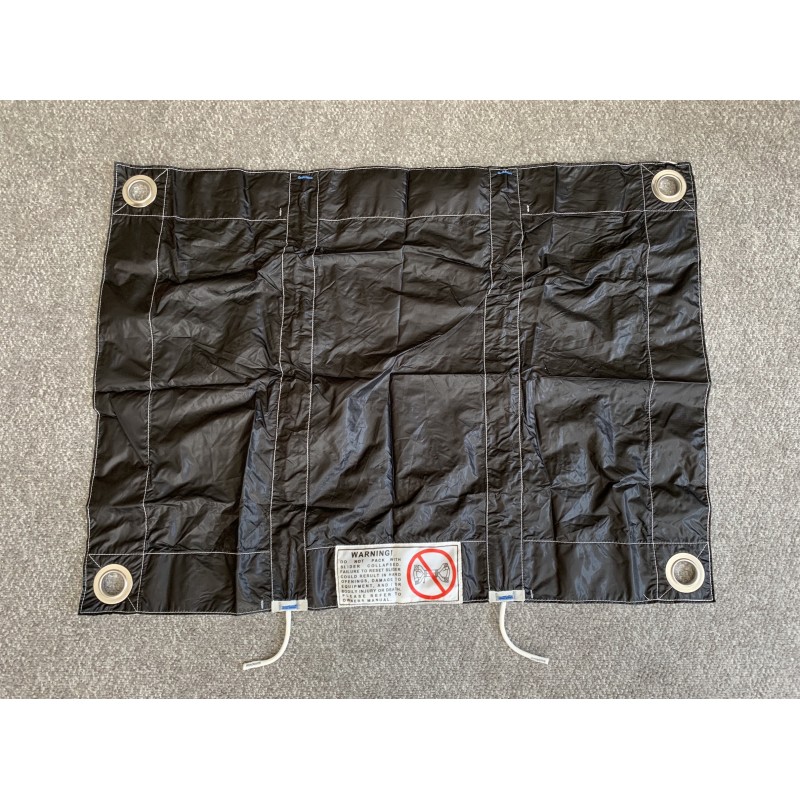
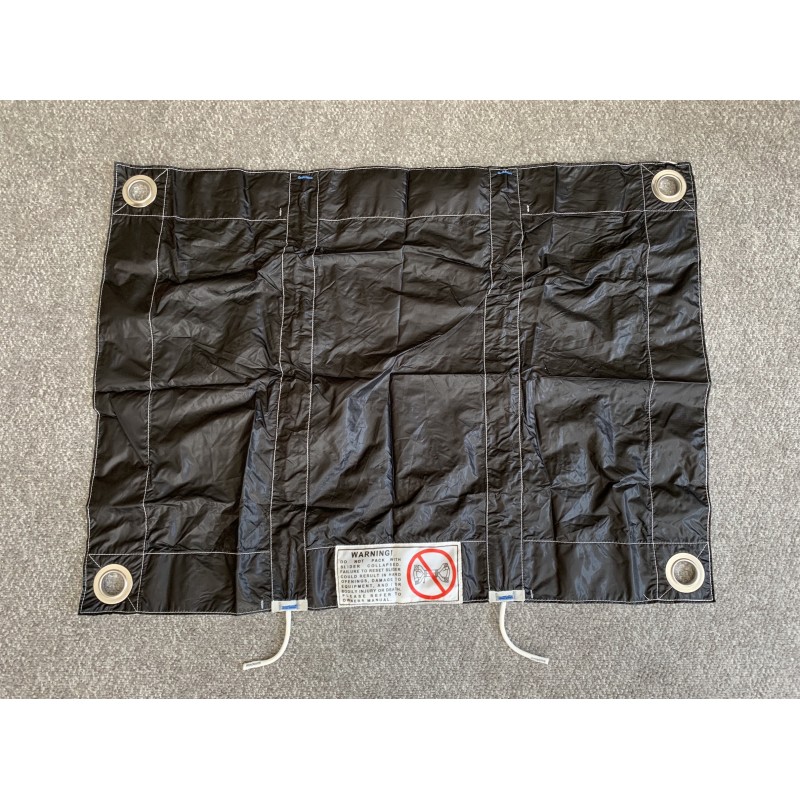
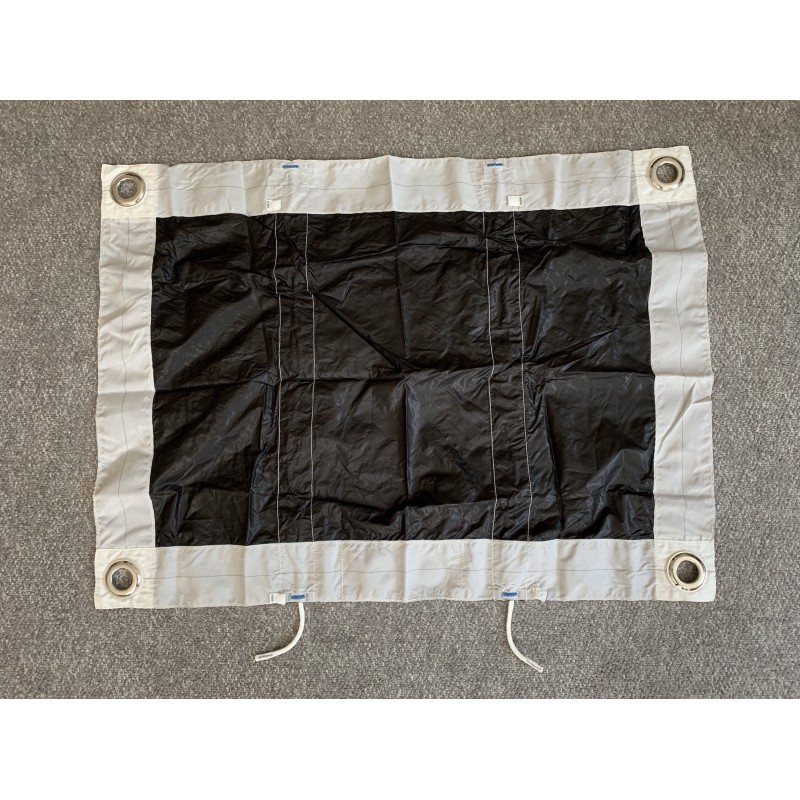


PD Main Canopy Slider

€100.00
The PD Main Canopy Slider is a safety-critical component designed to control the rate and sequence of main-canopy inflation within a compatible Performance Designs parachute system. During deployment, the slider initially remains near the canopy while the suspension lines spread beneath it. As the canopy progresses through the snivel and inflation phases, the slider descends along the lines toward the risers. Performance Designs describes canopy deployment as a sequence involving snatch, snivel, and inflation, with full inflation generally occurring as the slider descends.
Because Performance Designs manufactures numerous main canopies with different sizes, line types, performance levels, and deployment characteristics, there is no single generic slider that should automatically be assumed correct for every PD canopy. PD publishes separate procedures for measuring flat and domed sliders and recommends referring to manufacturer information when determining component requirements.
PD Main Canopy Slider – Technical Replacement Slider Guide for Performance Designs Canopies
PD Main Canopy Slider Engineering, Deployment Control, Compatibility, and Skydiving Equipment Context
PD Main Canopy Slider Engineering
The slider forms part of the canopy’s deployment-control architecture.
Its dimensions, fabric construction, grommets, reinforcement, shape, and relationship with the suspension lines influence how the canopy transitions from packed configuration to full inflation.
Performance Designs currently maintains dedicated technical instructions for both Measuring Slider Flat and Measuring Slider Dome, demonstrating that slider dimensions and construction form part of model-specific canopy maintenance rather than being generic accessories.
A replacement slider should therefore match the exact canopy model, size, and manufacturer specification.
Deployment Sequence and Slider Function
Performance Designs describes an opening through three broad phases: snatch, snivel, and inflation. During the snivel portion, the canopy has begun decelerating the jumper but is not yet fully inflated, and the slider remains high on the suspension lines. Inflation then progresses as the slider descends.
This makes the slider important to opening behavior.
However, opening quality does not depend on the slider alone. PD notes that canopy size, wing loading, deployment speed, field elevation, packing method, and other equipment components can influence deployment time and altitude loss.
Parachute Rig
A parachute rig operates as an integrated system rather than a collection of interchangeable components.
The slider works with the main canopy, suspension lines, risers, deployment bag, pilot chute, bridle, harness-container, and other components.
Therefore, a slider should never be selected solely because its dimensions appear similar to another one.
Performance Designs specifically recommends consulting container manufacturers for container-sizing questions because equipment combinations vary significantly. The same compatibility-first principle applies when maintaining the canopy and its components.
Skydiving Rigging
Professional skydiving rigging becomes particularly important when replacing a slider.
The rigger or qualified canopy technician should verify the canopy model, size, slider dimensions, grommet condition, line arrangement, and surrounding components.
Performance Designs’ maintenance department states that trained inspectors begin canopy inspections with the lines and slider before examining every skin of the canopy.
That inspection order reflects how important these components are to the complete deployment system.
Linewear
linewear should always be considered alongside slider condition.
The slider travels along the suspension lines during deployment, creating repeated interaction between the slider grommets and the line groups.
Performance Designs identifies Dacron, Microline, Vectran, and HMA as four primary line families used on its canopies. Different line types have different characteristics and maintenance considerations.
When a slider is replaced, the lines should also be inspected rather than assuming that installing a new slider resolves all deployment-related wear.
Parts of a Parachute
People researching parts of a parachute should understand that the slider is one component within the complete main canopy assembly.
The canopy also includes fabric cells, suspension lines, stabilizers, control lines, slider stops, connection links, and risers.
Each component influences another.
For this reason, maintenance should consider the complete assembly rather than replacing isolated pieces without examining the surrounding equipment.
Canopy Flight
The slider’s primary function occurs during deployment rather than ordinary canopy flight.
Once the canopy has inflated and the slider has descended, the canopy enters its normal flight phase.
Nevertheless, a properly configured opening system helps provide the transition into stable flight.
Performance Designs maintains a broad current main-canopy range including the Sabre3, Pulse, Spectre, Storm, Valkyrie, Stiletto, and Katana, each with distinct flight and opening characteristics.
Landing Flight Risers
The term landing flight risers concerns components located below the suspension lines.
Risers connect the canopy’s line groups to the harness-container system.
During deployment, the slider travels down toward the risers before remaining at the lower end of the suspension lines.
However, risers and sliders are separate components and should not be treated as interchangeable elements.
The phrase landing flight risers may appear repeatedly in equipment searches, but slider selection should always remain canopy-specific.
Skydiving Downsizing Chart
A skydiving downsizing chart relates to canopy progression and should not be confused with slider selection.
Installing a different slider does not make a smaller or more aggressive canopy appropriate for a jumper.
Performance Designs advises users to choose canopy size considering physical size and weight, experience, currency, and preferred style, with help from instructors and qualified experts.
Slider maintenance and canopy progression are therefore separate decisions.
Smallest Canopy
The smallest canopy is not automatically the most appropriate canopy.
High-performance designs require greater skill and operate differently from larger, more conservative equipment.
A replacement slider should restore the canopy to its intended configuration rather than be used as a shortcut for changing opening characteristics on unsuitable equipment.
Sabre 3
The safire 3 keyword refers to a different manufacturer’s product, while Performance Designs currently markets the Sabre3 as one of its principal modern nine-cell canopies.
The Sabre3 is designed around dynamic flight, responsive handling, and a broad performance envelope.
Its slider requirements should be sourced from Performance Designs rather than inferred from another manufacturer’s canopy.
Fluid Wings
fluid wings refers to a separate canopy manufacturer.
Components from different manufacturers should never be assumed interchangeable merely because dimensions appear similar.
The correct slider should match the exact canopy design and approved technical specification.
CRW Skydiving
crw skydiving involves canopy-relative work and can involve equipment specifically configured for that discipline.
Performance Designs currently offers the CF Storm, which uses a mesh slider and is designed for competition-oriented canopy-relative work.
This is an excellent example of why slider construction cannot be generalized across every canopy.
A mesh slider intended for specialized sub-terminal applications is not automatically appropriate for an ordinary sport canopy.
Base Jumping
base jumping uses parachute systems developed for a very different deployment environment.
Performance Designs’ Proxy, for example, is specifically positioned as a wingsuit BASE canopy and uses a large-hole mesh slider.
This equipment should not be confused with ordinary sport-skydiving main-canopy slider requirements.
Baseline Jumping
The phrase baseline jumping is often used imprecisely around fixed-object parachuting.
Regardless of terminology, BASE-specific equipment and aircraft-skydiving equipment should remain separated according to manufacturer purpose and configuration.
Base Canopy
A base canopy may use different slider materials or operational configurations from an ordinary sport main canopy.
For example, specialized BASE systems can be operated with different slider configurations depending on the application. Performance Designs explicitly describes such functionality for its Proxy.
Those practices should not be transferred casually to ordinary sport parachutes.
Wingsuit Sport
wingsuit sport places particular importance on stable deployment equipment and appropriate canopy choice.
Performance Designs identifies its Spectre as popular among everyday wingsuiters because of its soft, on-heading openings and long snivel.
However, even within wingsuit use, the correct slider remains canopy-specific.
Wingsuit
A wingsuit changes the aerodynamic environment before deployment.
That does not mean the jumper should independently alter slider size or design in an attempt to compensate.
Canopy, pilot chute, deployment bag, bridle, slider, and lines should remain within manufacturer-supported configurations.
Vector Wingsuit
The term vector wingsuit relates to broader equipment research rather than PD slider specifications.
Harness-container equipment, bodyflight suits, and main canopy components should each be evaluated according to their respective manufacturers.
Gliding Suit Wingsuit
A gliding suit wingsuit affects freefall bodyflight rather than the internal construction of a main canopy slider.
Skydiving Gliding Suit
Likewise, skydiving gliding suit terminology belongs to freefall apparel and should not be used to determine slider dimensions.
Fly Suits
fly suits describe another category of bodyflight equipment.
They do not establish canopy-slider compatibility.
Wing Suits for Sale
The phrase wing suits for sale reflects purchasing intent for specialized apparel.
Slider purchasing should instead begin with the exact canopy model and size.
Price of Wingsuit
The price of wingsuit has no direct technical relationship to replacement-slider specifications.
Tandem Wingsuit
A tandem wingsuit search should also remain separate from sport-canopy slider selection.
Tandem parachutes use equipment engineered around substantially different loading and operational requirements.
Tracking Jump
A tracking jump changes freefall orientation and horizontal movement before deployment.
However, slider configuration remains determined by the approved canopy system rather than the freefall discipline alone.
Skydiving Speed
skydiving speed can influence opening characteristics because deployment speed is one factor affecting canopy inflation.
Performance Designs explicitly includes deployment speed among the factors that can change opening time and altitude loss.
This is another reason slider performance should be viewed as part of a complete deployment system.
Speed Sky Diving
speed sky diving involves unusually high freefall speeds and specialized operating considerations.
A slider should never be modified experimentally to compensate for inappropriate deployment conditions.
Skydiving Tube
A skydiving tube is a freefall accessory and has no direct role in determining slider compatibility.
Parachute Jump Australia
The phrase parachute jump australia represents destination-based search intent rather than a technical slider specification.
Regardless of country, manufacturer documentation and applicable rigging regulations should control replacement decisions.
Skydive Byron Bay
skydive byron bay refers to a particular skydiving destination or operation.
A drop zone may use multiple canopy manufacturers and equipment configurations, so operator location does not determine slider type.
Cairns Skydiving
Likewise, cairns skydiving represents location-based activity rather than PD component compatibility.
Skydive Belize
skydive belize is another destination search and has no direct connection with PD slider measurements.
Skydiving Blue Hole Belize
The same applies to skydiving blue hole belize.
Weight Limit Skydiving
weight limit skydiving concerns jumper weight, wing loading, equipment limitations, and operator requirements.
A replacement slider does not change the approved loading limitations of a main canopy.
Skydiving Helmet
A skydiving helmet provides head protection and is independent of canopy-slider selection.
Skydive Helmets
skydive helmets likewise belong to another equipment category.
Sky Helmet Skydiving
The phrase sky helmet skydiving does not describe any slider characteristic.
Sky Diving Helmet
A sky diving helmet remains separate from main-canopy deployment components.
Full Face Skydiving Helmet
A full face skydiving helmet provides head and facial protection but has no technical relationship with slider dimensions.
Skydiving Helmet Full Face
Likewise, skydiving helmet full face is unrelated to slider compatibility.
G35 Helmet
The g35 helmet belongs to helmet-related equipment searches rather than canopy maintenance.
Best Skydiving Helmet
The best skydiving helmet depends on fit, discipline, comfort, and applicable certification, but it does not influence which slider a canopy requires.
Cookie G4 Helmet
The cookie g4 helmet is another separate equipment product.
Skydiving Glasses
skydiving glasses provide eye protection and do not form part of the deployment system.
Skydiver Goggles
The same applies to skydiver goggles.
Can You Wear Glasses While Skydiving
The question can you wear glasses while skydiving concerns eye protection and passenger or jumper comfort rather than slider engineering.
Hook Blade Knife
A hook blade knife is specialist emergency equipment and should not be presented as part of a slider assembly.
Hook Knife Skydiving
hook knife skydiving refers to emergency cutting tools used by trained parachutists in specific circumstances.
Skydive Hook Knife
A skydive hook knife similarly belongs to the wider emergency-equipment category.
Container Skydive
The term container skydive refers to the harness-container system.
The main canopy and slider must pack appropriately within the chosen container configuration.
Performance Designs advises users to rely on the container manufacturer’s sizing guidance when determining canopy-container compatibility.
Freefly PUD Handle
A freefly pud handle forms part of the main deployment initiation system.
It performs a different function from the slider, which acts later in the deployment sequence.
Gear Bag Skydive
A gear bag skydive setup helps protect equipment during transportation.
A replacement slider should remain protected from contamination, sharp objects, chemicals, and unnecessary abrasion before installation.
Skydiving Equipment List
A skydiving equipment list can include the harness-container, main canopy, reserve, pilot chute, deployment bag, slider, lines, handles, altimeter, helmet, and eye protection.
The slider is only one safety-critical element in that larger system.
Indoor Wingsuit
indoor wingsuit activities take place in controlled bodyflight environments and do not use a main canopy slider during normal tunnel operation.
iFLY Colorado Springs
ifly colorado springs similarly refers to indoor bodyflight rather than parachute deployment equipment.
Jumper Pilot
A jumper pilot forms part of aircraft parachuting operations.
Pilot responsibilities and parachute maintenance responsibilities remain distinct professional functions.
Nude Parachute Jump
A nude parachute jump is an unusual activity query and has no technical effect on slider specifications.
Skydiving Nude
Likewise, skydiving nude does not influence slider compatibility.
Fire Parachute
The phrase fire parachute is ambiguous and should not be treated as a PD slider specification.
Cypress Fire Skydiving
The term cypress fire skydiving is similarly ambiguous and should be verified independently rather than incorporated into slider technical data.
New Skydive
The phrase new skydive represents general discovery intent.
Newness alone does not determine whether a particular slider is correct for a canopy.
#Skydiving Latest
#skydiving latest relates to online trends rather than maintenance specifications.
Manufacturer documentation should always take priority when dealing with safety-critical equipment.
Skydiving Website
A general skydiving website can provide useful education, but Performance Designs’ official manuals and technical instructions are the appropriate reference for measuring and maintaining PD sliders.
Overall PD Main Canopy Slider Perspective
The PD Main Canopy Slider should be treated as a canopy-specific deployment-control component, not as a generic square of fabric with grommets.
Performance Designs’ current technical resources include separate instructions for measuring flat and domed sliders, while its maintenance department explicitly begins canopy inspections with the lines and slider.
The slider’s role occurs primarily during the snivel and inflation phases of deployment, and PD emphasizes that opening characteristics depend on several interacting variables, including canopy size, wing loading, deployment speed, elevation, packing method, and other system components.
For a buyer or owner, the correct approach is therefore to identify the exact canopy model and size, confirm the proper slider specification with Performance Designs or a qualified rigger, inspect the lines and surrounding components, and avoid experimental changes intended to alter opening behavior. Correct compatibility, professional inspection, proper maintenance, and manufacturer-supported configuration provide the strongest foundation for reliable long-term service.
Engineering Quality, Deployment Control, Durability, and Practical Reliability
The PD Main Canopy Slider is a critical deployment-control component designed to help regulate how a compatible Performance Designs canopy transitions from packed configuration to full inflation. Its practical value depends on far more than fabric shape or grommet appearance. Dimensions, fabric condition, grommet integrity, reinforcement, suspension-line interaction, packing quality, canopy model, and overall system configuration all influence how the component performs. Therefore, a slider should be evaluated as part of the complete deployment system rather than as an isolated accessory. Correct specification, professional installation, regular inspection, and disciplined maintenance remain essential throughout its service life.
Engineering Quality and Construction
A properly manufactured slider relies on accurate dimensions and consistent construction.
The fabric panels, reinforcement areas, grommets, stitching, and edge finishing must work together under repeated aerodynamic and mechanical loading.
Even minor changes in shape or structural integrity can influence how the component moves along the suspension lines.
For this reason, replacement should never be based solely on approximate size. The correct design must correspond to the exact canopy configuration and manufacturer requirements.
Deployment Control
The slider helps moderate the inflation sequence by remaining near the canopy during the early stages of opening.
As the canopy begins to inflate, the slider gradually descends along the suspension lines.
This controlled movement helps prevent the canopy from expanding too rapidly.
Its contribution is therefore closely linked to the complete opening sequence.
However, the slider does not work independently. Packing, line condition, deployment speed, canopy design, and environmental conditions all influence the final result.
Importance of Correct Dimensions
Slider dimensions are directly related to deployment behavior.
A component that is too large, too small, incorrectly shaped, or otherwise incompatible may change how quickly it descends.
That can alter the opening sequence in undesirable ways.
Therefore, exact dimensions should be verified against manufacturer information rather than estimated from another canopy.
A visually similar component should never be assumed interchangeable.
Fabric Condition
The fabric should remain free from significant tears, burns, punctures, contamination, or structural distortion.
Because the component experiences repeated airflow and mechanical loading, deterioration can gradually develop over many cycles.
Minor cosmetic marks do not necessarily affect performance, but unusual damage should be professionally evaluated.
Fabric that has stretched, become distorted, or suffered chemical contamination may no longer behave as intended.
Grommet Integrity
The grommets are among the most important structural elements.
They guide the suspension lines during deployment and must remain smooth, secure, and free from sharp damage.
A rough or damaged surface can increase line abrasion.
Cracking, deformation, looseness, corrosion, or sharp edges should therefore receive immediate attention.
Routine inspection should include both the visible outer surface and the areas where the grommets contact the surrounding reinforcement.
Grommet-to-Line Interaction
Repeated movement between the grommets and suspension lines creates normal friction.
Over time, this interaction can contribute to wear on both components.
That is why slider and line condition should be assessed together.
Replacing only one part while ignoring significant deterioration in the other may leave an unresolved maintenance problem.
Professional inspection can help determine whether line wear remains within acceptable limits.
Reinforcement Areas
Reinforced areas around the grommets help distribute repeated loads.
These sections should remain securely stitched and free from separation, tearing, or unusual distortion.
Because reinforcement is part of the structural architecture, damaged stitching should not be treated as a cosmetic issue.
Repairs should preserve the original material arrangement and construction method.
Improvised sewing can alter structural behavior and should therefore be avoided.
Stitching Quality
Stitching connects the fabric and reinforcement into a stable component.
Broken stitches, pulled threads, separated seams, or visible distortion can indicate developing wear.
Not every loose thread represents a critical defect, but structural stitching deserves professional evaluation when condition becomes uncertain.
Routine inspection should compare both sides of the component rather than focusing only on the most visible surface.
Opening Consistency
A properly specified slider contributes to more predictable openings.
However, opening consistency depends on the entire system.
Canopy condition, line trim, packing, deployment body position, airspeed, pilot chute performance, and environmental conditions all play a role.
Therefore, an unusual opening should not automatically be blamed on the slider.
A systematic inspection should consider all relevant components before any replacement or modification decision is made.
Packing Quality
Correct packing helps the slider begin the deployment sequence in the intended position.
Poor placement, twisting, or inconsistent organization can influence opening behavior even when the component itself is undamaged.
Packing procedures should therefore remain consistent with current manufacturer guidance.
Experience should improve discipline rather than encourage shortcuts.
If something feels different during packing, the reason should be investigated rather than ignored.
Line Condition
Suspension-line condition has a direct relationship with slider performance.
Lines can experience abrasion, dimensional change, contamination, and gradual wear.
A rough grommet or inappropriate slider configuration can accelerate line deterioration.
Conversely, heavily worn lines can also affect how smoothly the component descends.
For this reason, both should be inspected as part of the same maintenance process.
Control Components
The control system sits within the broader canopy architecture and should also remain in suitable condition.
Although control components do not determine slider size directly, deterioration elsewhere can influence the overall behavior of the canopy.
A complete inspection should therefore consider control lines, attachment points, risers, connectors, and surrounding equipment rather than evaluating only the deployment-control component.
Environmental Exposure
Moisture, dirt, sand, dust, chemicals, and ultraviolet exposure can influence long-term condition.
Fabric should be protected from unnecessary sunlight and contamination.
Metal components can also be affected by moisture or corrosive substances.
After exposure to unusual environments, inspection should occur before continued use.
Preventing contamination is generally easier than determining whether material properties have been compromised afterward.
Moisture Management
Wet equipment should not remain packed for extended periods.
Moisture can affect fabric, stitching, grommets, and nearby components.
Drying should occur under suitable conditions without excessive heat.
If exposure involved saltwater, chemicals, or heavily contaminated water, professional evaluation becomes even more important.
A clean, dry storage environment provides the best foundation for preservation.
Heat Protection
Extreme heat should be avoided.
Leaving the equipment inside a closed vehicle exposed to strong sunlight can create damaging temperatures.
Heat may affect synthetic materials and surrounding equipment even when no immediate visible change occurs.
Likewise, artificial heating should not be used casually during drying.
A moderate, controlled environment offers better long-term protection.
Chemical Contamination
Fuel, oils, solvents, cleaning products, and unknown substances can create serious concerns.
Some chemicals may weaken synthetic fabric or affect metal surfaces without obvious immediate damage.
If contamination is suspected, the component should be isolated and professionally assessed.
Simply wiping the visible surface does not necessarily establish that the material remains serviceable.
Routine Inspection
Routine visual inspection is one of the most valuable maintenance practices.
The fabric, grommets, stitching, reinforcement areas, and surrounding line system should all be reviewed.
The objective is to identify meaningful changes from the known serviceable condition.
Any unusual distortion, sharp metal damage, loose hardware, contamination, or structural wear should be investigated before the system returns to use.
Used Component Evaluation
Previously used components require additional caution.
Unknown jump history, storage conditions, repairs, contamination, or installation history can make condition difficult to establish.
A clean appearance alone provides limited information.
Professional inspection helps determine whether the component remains suitable for the intended canopy and whether its dimensions and structural condition are still appropriate.
Professional Installation
Replacement should be carried out by appropriately qualified personnel.
Installation provides an opportunity to confirm the exact canopy model, size, line configuration, hardware condition, and compatibility of the new component.
Professional installation also reduces the likelihood of routing errors or incompatible substitutions.
Safety-critical equipment should never rely on guesswork simply because installation appears mechanically straightforward.
Long-Term Reliability
Long-term reliability depends on the relationship between original engineering and responsible care.
Repeated use naturally creates wear, but regular inspection can identify deterioration before it becomes severe.
Correct storage, careful handling, appropriate packing, environmental protection, and professional servicing all contribute to a longer and more predictable service life.
Overall Performance Perspective
The PD Main Canopy Slider should be treated as a precision deployment-control component whose quality depends on accurate dimensions, sound fabric, smooth grommets, intact reinforcement, correct installation, and healthy interaction with the suspension-line system.
Its purpose is to support controlled canopy inflation within the manufacturer’s intended configuration.
Ultimately, dependable performance comes from correct compatibility, disciplined inspection, proper packing, professional maintenance, and preservation of the complete canopy system rather than focusing on one component in isolation.
Maintenance, Inspection, Storage, Replacement Timing, and Long-Term Care
The PD Main Canopy Slider requires consistent care because its condition can influence the deployment sequence of the complete canopy system. Although its construction may appear straightforward, repeated deployments expose the fabric, reinforcement, stitching, and grommets to airflow, loading, friction, and movement along the suspension lines. Consequently, long-term reliability depends on more than simply checking whether the component still looks intact. Regular inspection, appropriate cleaning, controlled storage, careful transportation, professional maintenance, and attention to changes in opening behavior all contribute to responsible ownership.
Routine Inspection and Preventive Care
Regular inspection provides the foundation for effective maintenance.
The entire component should be examined for changes in fabric condition, stitching, reinforcement, shape, and hardware. Inspection should be performed under adequate lighting so that small areas of wear are easier to identify.
Users should become familiar with the normal appearance of their equipment. Consequently, unusual changes can be recognized earlier.
However, familiarity should never replace professional evaluation when structural condition becomes uncertain.
Checking Fabric Condition
Fabric should remain structurally sound and reasonably consistent across the entire component.
Inspect for tears, punctures, burns, unusual thinning, distortion, excessive abrasion, and contamination. Particular attention should be given to areas surrounding reinforcement and hardware because these locations experience repeated loading.
Small cosmetic marks may not automatically affect serviceability. Nevertheless, structural damage should never be dismissed without appropriate evaluation.
The objective is to preserve the original construction rather than simply maintain a clean appearance.
Inspecting Grommets
Grommets deserve careful attention because they interact directly with suspension lines during deployment.
Their surfaces should remain smooth and free from sharp edges, cracks, significant deformation, looseness, or corrosion.
A damaged surface can increase abrasion on nearby lines.
Therefore, inspection should include both the visible face and the contact area around each opening.
If a defect is suspected, the component should be evaluated professionally rather than polished, reshaped, or repaired using improvised methods.
Monitoring Reinforcement Areas
Reinforcement distributes loads around important structural locations.
These areas should remain properly attached and free from significant distortion.
Look for broken stitching, separation between layers, pulled material, or unusual deformation.
Because deterioration may begin gradually, comparison between corresponding corners can sometimes make abnormalities easier to identify.
Repairs should preserve the approved construction and should not be performed casually with ordinary sewing materials.
Stitching Inspection
Structural stitching should remain secure.
Loose threads, broken stitches, seam separation, and damaged reinforcement patterns may indicate that professional attention is required.
Not every exposed thread represents immediate structural failure, but uncertainty should be resolved through qualified inspection.
Cutting, burning, or pulling loose threads without understanding their function should be avoided.
Maintenance should preserve the original construction rather than improve its appearance cosmetically.
Suspension-Line Interaction
Inspection should extend beyond the component itself.
Because the grommets travel along suspension lines during deployment, both surfaces should be considered together.
Look for unusual abrasion, fuzziness, discoloration, damaged fibers, or concentrated wear around frequently contacted areas.
A perfectly serviceable replacement component cannot compensate for suspension lines that have already deteriorated beyond acceptable limits.
Likewise, new lines should not be exposed to damaged hardware.
Recognizing Gradual Wear
Wear does not always appear suddenly.
Hundreds of repeated operating cycles can create gradual changes that become difficult to notice when the same equipment is used regularly.
Photographs or maintenance records can provide useful historical references.
However, images should supplement rather than replace physical inspection.
When behavior or appearance changes significantly, professional assessment provides a more reliable determination of serviceability.
Opening Behavior as a Maintenance Signal
Changes in opening characteristics can sometimes indicate that inspection is warranted.
An opening that becomes noticeably different should not automatically be blamed on one component because multiple variables influence deployment.
Packing, suspension-line condition, deployment speed, canopy wear, body position, and environmental conditions can all contribute.
Therefore, troubleshooting should remain systematic.
Replacing components without identifying the underlying cause may fail to resolve the actual issue.
Cleaning
Cleaning should remain conservative.
Ordinary dirt should not encourage aggressive washing with household chemicals, solvents, bleach, or strong detergents.
Such products may affect synthetic materials or hardware.
Where cleaning is necessary, manufacturer-approved procedures should be followed.
The objective is preservation rather than achieving a perfectly new appearance.
If contamination involves an unknown chemical, professional assessment may be more appropriate than attempting extensive cleaning.
Chemical Exposure
Chemical contamination deserves particular caution.
Fuel, lubricants, solvents, acids, cleaning agents, and other substances can potentially affect fabric, stitching, coatings, or metal hardware.
Visible removal of the substance does not necessarily establish that no material damage occurred.
Consequently, suspected chemical exposure should be documented and evaluated appropriately.
Keeping technical equipment separated from workshop chemicals is one of the simplest preventive measures.
Moisture Management
Equipment that becomes wet should not remain packed unnecessarily.
Persistent moisture can contribute to contamination and may affect surrounding equipment.
Drying should take place naturally in suitable conditions without extreme heat.
Once completely dry, the component can return to normal protected storage.
Saltwater or heavily contaminated water exposure requires greater caution because residues can remain within fabric and around hardware after drying.
Protection From Sunlight
Extended ultraviolet exposure should be minimized.
Equipment frequently left outdoors between operations can accumulate unnecessary environmental stress.
Moving the system into shade or protected storage when it is not being used can reduce exposure.
Although occasional sunlight is unavoidable during normal operations, long-term storage in direct sunlight should be avoided.
Preventive care is most effective when it becomes routine rather than an occasional response to visible deterioration.
Temperature Control
Extreme temperatures can negatively affect equipment over time.
Closed vehicles exposed to direct sunlight may reach very high internal temperatures.
Similarly, equipment stored in extremely cold environments and then moved quickly into warm humid conditions may develop condensation.
A stable, dry indoor environment generally provides better long-term storage conditions.
Artificial heating should also be avoided when drying wet equipment unless specifically approved.
Correct Storage
Storage should protect the component as part of the complete parachute system.
The area should remain clean, dry, and separated from sharp objects, chemicals, excessive heat, and pests.
Heavy items should not be stacked unnecessarily on top of the equipment.
Good organization also reduces the possibility of components becoming mixed between different systems.
This becomes especially important in professional environments where multiple canopies are maintained.
Transportation Protection
Transportation introduces risks that may not exist during ordinary storage.
Equipment can shift, rub against hard surfaces, or become crushed beneath heavier objects.
A suitable protective bag can reduce these risks.
Liquids, tools, and sharp equipment should remain separated from the parachute system.
After a significant transportation incident, inspection may be appropriate before returning the equipment to service.
Maintenance Records
Accurate records strengthen long-term equipment management.
Useful information can include installation dates, inspections, repairs, unusual opening events, contamination incidents, and component replacements.
Records become particularly valuable when equipment changes owners or moves between professional operators.
A documented history allows future users to understand previous maintenance rather than relying entirely on estimates or memory.
Determining Replacement Timing
Replacement should be based on condition, compatibility, manufacturer criteria, and qualified inspection rather than an arbitrary universal schedule.
Different operating environments produce different wear rates.
A heavily used system exposed to challenging conditions may require attention sooner than equipment experiencing lighter service.
Conversely, low usage does not guarantee perfect condition if storage or contamination has been poor.
Physical condition remains essential.
Professional Assessment.
Professional evaluation becomes necessary whenever structural integrity, dimensions, hardware condition, compatibility, or unusual deployment behavior cannot be confidently assessed.
Qualified personnel can examine the complete system rather than focusing only on the most obvious component.
Uncertain equipment should not remain in operation simply because no complete failure has occurred.
Early assessment can prevent a minor maintenance concern from developing into a larger problem.
Long-Term Care Perspective
Long-term serviceability depends on disciplined maintenance rather than occasional inspection.
Fabric condition, grommet smoothness, reinforcement integrity, stitching, suspension-line interaction, environmental exposure, storage conditions, and maintenance history should all be considered together.
Ultimately, careful ownership helps preserve the component’s intended role within the deployment sequence. By maintaining clean storage, reducing unnecessary environmental exposure, inspecting regularly, documenting significant events, and obtaining professional assistance whenever uncertainty develops, owners can support consistent performance while preserving the integrity of the complete canopy system.
Be the first to review “PD Main Canopy Slider”
Related products
Accessories

Accessories

Accessories

Accessories

Reviews
There are no reviews yet.