
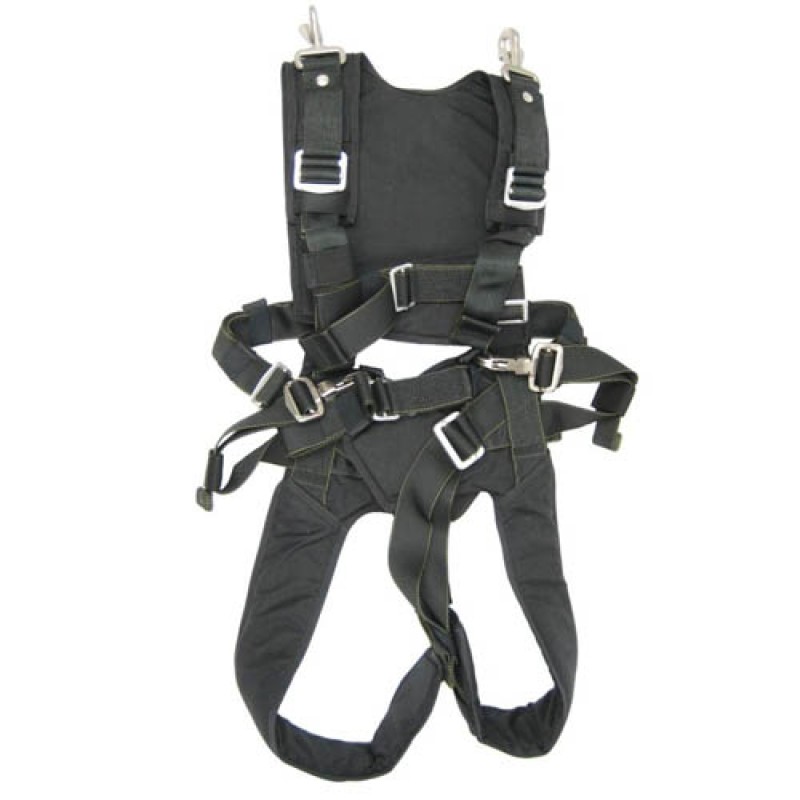

UPT Sigma Tandem Student Passenger Harness

€650.00
The UPT Sigma Tandem Student Passenger Harness is specialized tandem skydiving equipment designed to secure a student passenger to a compatible tandem system under the direct management of a properly trained and qualified tandem instructor. Unlike an independent skydiving rig, the passenger harness forms one component of a complete professional tandem system. Consequently, its condition, correct compatibility, inspection history, approved configuration, and proper fitting are essential considerations.
Built around professional drop-zone requirements, the design emphasizes passenger security, adjustability, structural durability, and dependable attachment to the instructor-managed tandem assembly. It should not be confused with equipment intended for independent sport jumping, BASE jumping, wingsuit flying, canopy progression, or recreational experimentation.
UPT Sigma Tandem Student Passenger Harness – Professional Tandem Skydiving Harness Overview
Tandem Harness Engineering, Skydiving Equipment, Fit, and Professional Use
Parachute Jump Australia, Skydive Byron Bay, and Cairns Skydiving
Searches for parachute jump australia, skydive byron bay, and cairns skydiving frequently come from first-time passengers researching tandem experiences. For commercial operations, passenger equipment must accommodate different body proportions while remaining within the manufacturer’s approved limitations.
The weight limit skydiving operators impose can depend on equipment limitations, passenger proportions, operating procedures, weather, and drop-zone policy. Therefore, passengers should obtain current eligibility requirements directly from their selected professional operator rather than assuming one universal limit.
Skydiving Rigging and the Parachute Rig
Professional skydiving rigging requires specialized knowledge because a complete parachute rig contains multiple safety-critical components.
People researching parts of a parachute or container skydive equipment should recognize that the passenger harness is only part of a much larger tandem system.
Inspection, repair, component replacement, and compatibility decisions must follow manufacturer requirements and applicable aviation regulations. A harness that merely looks serviceable should never be assumed airworthy without appropriate inspection and documented history.
Skydiving Equipment List and Gear Bag Skydive
A professional skydiving equipment list may include the approved parachute system, passenger harness, instructor equipment, appropriate head protection where required, eye protection, communication or operational accessories, and other drop-zone-specific equipment.
A gear bag skydive setup can help protect equipment during controlled transportation and storage. However, organization does not replace inspection. Hardware, webbing, stitching, labels, attachment components, and other safety-critical areas require appropriate checks according to established procedures.
Skydiving Helmet and Eye Protection
Searches for skydiving helmet, skydive helmets, sky helmet skydiving, sky diving helmet, full face skydiving helmet, skydiving helmet full face, g35 helmet, best skydiving helmet, and cookie g4 helmet relate to head protection rather than the passenger harness itself.
Similarly, skydiving glasses, skydiver goggles, and can you wear glasses while skydiving concern eye protection and passenger comfort. Many operators can accommodate prescription glasses, although the exact solution depends on available equipment and operator procedures.
Hook Blade Knife and Emergency Equipment
Terms such as hook blade knife, hook knife skydiving, and skydive hook knife refer to specialist emergency equipment used by appropriately trained skydivers.
Such equipment should not be treated as a passenger-harness feature unless specifically supplied and approved as part of the relevant professional configuration.
Tandem passengers should follow their instructor’s briefing rather than attempting to manage specialist emergency equipment independently.
Canopy Flight and Landing Flight Risers
Canopy flight, landing flight risers, and searches concerning the smallest canopy involve advanced parachute-system considerations.
They should remain separate from passenger-harness selection.
Likewise, a skydiving downsizing chart relates to canopy progression for appropriately trained licensed jumpers. Downsizing decisions involve significant safety considerations and should never be based solely on an online chart or product description.
Tracking Jump and CRW Skydiving
A tracking jump involves a different freefall discipline from ordinary tandem passenger operations.
Similarly, crw skydiving concerns canopy-relative work and requires specialized training, equipment, experience, and procedures.
A tandem passenger harness is not designed to turn a first-time passenger into an independent participant in these disciplines.
Its purpose is to provide an approved passenger interface within a properly operated tandem system.
Wingsuit Sport, Wingsuit, and Vector Wingsuit
Terms such as wingsuit sport, wingsuit, vector wingsuit, gliding suit wingsuit, skydiving gliding suit, fly suits, indoor wingsuit, and wing suits for sale relate to another specialized area of parachuting.
Likewise, price of wingsuit is a purchasing query rather than a passenger-harness specification.
Wingsuit flying requires appropriate experience and training. A tandem wingsuit search should not be interpreted as indicating ordinary compatibility between wingsuit equipment and a standard tandem passenger harness.
BASE Jumping, Baseline Jumping, and Base Canopy
base jumping, baseline jumping, and base canopy searches concern a distinct high-risk discipline involving jumps from fixed objects.
Those terms should not be confused with professional tandem skydiving from aircraft.
Equipment requirements, parachute architecture, operating environments, and training pathways differ substantially.
Consequently, BASE-specific components should never be represented as interchangeable with a tandem passenger system merely because both involve parachutes.
Skydiving Speed and Speed Sky Diving
Searches for skydiving speed and speed sky diving often come from people curious about freefall.
Actual descent characteristics depend on body position, combined mass, equipment configuration, atmospheric conditions, and jump type.
For a tandem passenger, the important consideration is not achieving a particular speed. Instead, the passenger should maintain the position and behavior taught during the professional pre-jump briefing.
Freefly PUD Handle and Specialist Components
A freefly pud handle is associated with particular sport-skydiving equipment configurations rather than normal passenger-harness operation.
Similarly, searches involving safire 3, fluid wings, and specialist canopy equipment refer to separate components or manufacturers.
Compatibility must never be inferred merely because two products belong to the broader parachuting industry.
Linewear and Equipment Condition
The term linewear highlights an important principle: parachuting equipment experiences service-related wear.
Harness webbing, hardware, stitching, attachment areas, and associated components can deteriorate through repeated use, contamination, abrasion, environmental exposure, or improper storage.
Therefore, purchasing used tandem equipment requires considerably more than checking cosmetic appearance.
Service history, identification, manufacturer requirements, inspection status, and component compatibility matter.
Fire Parachute and Cypress Fire Skydiving
Searches such as fire parachute and cypress fire skydiving are ambiguous and should not be treated as specifications of this harness.
Where a search concerns an automatic activation device or another emergency component, it belongs to the complete parachute-system discussion rather than the passenger harness alone.
Safety-critical component selection should always follow manufacturer-approved system requirements.
Skydive Belize and Skydiving Blue Hole Belize
Searches for skydive belize and skydiving blue hole belize reflect destination-based skydiving interest, much like Australian drop-zone searches.
Regardless of destination, customers should verify operator credentials, weather policies, passenger restrictions, equipment standards, and current operational availability directly with the professional provider.
iFLY Colorado Springs and Indoor Training
ifly colorado springs relates to indoor bodyflight rather than parachute deployment.
Wind-tunnel experience can introduce people to controlled bodyflight concepts, but it does not replace the training, equipment, supervision, or procedures required for actual parachuting.
Likewise, indoor wingsuit activities should remain conceptually separate from tandem passenger-harness operation.
Jumper Pilot and Operational Coordination
The term jumper pilot highlights the wider operational environment surrounding aircraft skydiving.
A professional tandem operation depends on coordination between appropriately qualified instructors, pilots, ground personnel, equipment specialists, and other operational staff.
The passenger harness is therefore one element within a broader safety system rather than a standalone recreational product.
Nude Parachute Jump and Skydiving Nude
Searches for nude parachute jump and skydiving nude concern unusual activity rather than equipment specifications.
Professional operators determine acceptable clothing and equipment requirements.
Suitable clothing helps protect the passenger, permits appropriate harness fitting, and reduces unnecessary complications during aircraft movement, freefall, and landing.
Skydiving Website, New Skydive, and #Skydiving Latest
Search terms such as skydiving website, new skydive, and #skydiving latest demonstrate how customers research equipment, destinations, training, and current developments.
For safety-critical equipment, however, manufacturer documentation and qualified professional inspection should take priority over social-media posts or generic online information.
Skydiving Tube and Other Training Equipment
A skydiving tube may appear in specialist flying or training contexts, but it should not be confused with a passenger-harness component.
The same rule applies across the equipment market: every component should be identified by its intended function, approved compatibility, and operating context rather than being grouped together simply because it appears in skydiving searches.
Why the Passenger Harness Matters
The passenger harness performs a fundamentally different role from independent parachute equipment.
Its purpose is to provide a secure, adjustable interface between the student passenger and the approved tandem system under professional instructor control.
Because different passengers have different body proportions, proper fitting and equipment condition are critical.
The system should only be fitted, connected, inspected, and operated according to manufacturer requirements by appropriately trained personnel.
Where and When It Should Be Used
The harness belongs in properly conducted tandem skydiving operations using compatible approved equipment.
It is particularly relevant to professional drop zones, tandem instructors, training organizations, and operators maintaining appropriately inspected tandem equipment.
It is not general-purpose climbing equipment, fall-arrest equipment, an independent parachute harness, or a substitute for BASE or sport-skydiving equipment.
Overall Professional Perspective
The UPT Sigma Tandem Student Passenger Harness should be evaluated as a safety-critical professional tandem component, not simply as another piece of sporting apparel.
Its real value comes from appropriate fit range, structural condition, verified compatibility, service history, professional inspection, and correct integration into the complete approved tandem system.
For buyers, equipment managers, and drop-zone operators, those considerations matter far more than appearance alone. Manufacturer documentation, traceable history, appropriate inspection, correct storage, and qualified professional use should therefore remain central throughout its service life.
Engineering Quality, Fit, Comfort, Reliability, and Practical Use
The UPT Sigma Tandem Student Passenger Harness is designed around one central requirement: providing a secure and dependable interface between a student passenger and a properly operated tandem system. Its practical value therefore depends on much more than appearance. Webbing quality, hardware condition, stitching integrity, adjustment range, passenger fit, attachment security, inspection history, and professional handling all contribute to overall reliability. Because the harness forms part of a safety-critical system, every aspect of its condition should be evaluated through documented procedures rather than casual visual judgment.
Engineering Quality and Structural Integrity
The harness must maintain structural integrity throughout repeated professional use.
Major load-bearing areas depend on correctly manufactured webbing, reinforced stitching, approved hardware, and secure attachment points. These components are intended to work together as one system rather than as independent parts.
A harness that appears cosmetically clean may still require closer inspection if it has an unknown service history.
For this reason, professional evaluation should consider identification labels, wear patterns, stitching condition, hardware function, contamination, and any evidence of unauthorized modification.
Webbing Condition
The webbing forms one of the most important structural elements.
It should remain free from significant cuts, fraying, burns, chemical damage, severe abrasion, or other deterioration that could affect strength.
Normal signs of service may appear over time, but meaningful structural wear should never be ignored.
Areas that experience frequent adjustment or contact with hardware deserve particular attention because repeated movement can gradually create visible wear.
Inspection criteria should always follow manufacturer guidance and applicable professional standards.
Hardware Quality
Metal hardware must remain structurally sound and function correctly.
Buckles, connectors, adjustment components, and other load-bearing hardware should not show cracking, severe corrosion, deformation, or abnormal movement.
Smooth operation matters because hardware that sticks or fails to move as intended may complicate fitting or indicate contamination or damage.
Cosmetic surface marks do not necessarily mean the component is unusable, but structural uncertainty should always receive qualified assessment before further operation.
Stitching and Reinforcement
Stitching holds many of the structural elements together and deserves careful inspection.
Broken stitches, pulled threads, damaged reinforcement areas, or unusual separation between layers may indicate that professional attention is required.
Not every loose surface thread represents a major defect, but safety-critical stitching should never be casually trimmed, repaired, or altered without proper authority.
Repairs must follow approved procedures because incorrect stitching can affect the original load-bearing design.
Passenger Fit
Correct fit is one of the most important practical aspects of a tandem passenger harness.
Passengers vary significantly in height, torso length, shoulder width, leg size, and general body proportions.
Therefore, the harness must provide enough adjustment to accommodate the intended passenger while maintaining secure positioning.
A harness should not be considered properly fitted simply because every strap has been tightened.
Professional fitting requires correct placement of the major harness components around the passenger’s body.
Comfort and Security
Comfort matters because a passenger may wear the harness through aircraft boarding, climb, exit, freefall, canopy descent, and landing.
However, comfort must never compromise security.
An excessively loose fit can create unnecessary movement, while an unnecessarily tight fit can cause discomfort and restrict natural positioning.
The correct setup balances secure adjustment with appropriate passenger comfort.
This is why fitting should remain the responsibility of trained personnel familiar with the specific system.
Adjustment Range
Adjustment hardware allows the same harness to accommodate different passengers within approved limits.
The mechanisms should move smoothly and hold their selected positions securely.
If a strap slips unexpectedly or an adjustment becomes unusually difficult, the component should be inspected.
Forcing damaged or contaminated hardware is not an appropriate solution.
Likewise, modifying straps or hardware to accommodate a passenger outside the intended fit range should never replace adherence to manufacturer limitations.
Passenger Body Position
The harness is designed to maintain an appropriate relationship between the passenger and the instructor-managed system.
Correct body positioning depends on both equipment fit and professional briefing.
The passenger should understand how to position their body during different phases of the operation, but the instructor remains responsible for managing the tandem system.
Equipment fit and passenger instruction therefore work together rather than functioning independently.
Attachment Areas
Attachment interfaces are safety-critical.
They must remain in approved condition and be connected according to established procedures.
These areas should never be altered, substituted, or used with components whose compatibility has not been confirmed.
Repeated use can introduce wear, so professional inspection should pay particular attention to contact surfaces, stitching, hardware, and nearby webbing.
Correct compatibility is more important than visual similarity between components.
Practical Reliability
Reliability depends on consistency.
Adjustment hardware should behave predictably, webbing should remain in good condition, stitching should retain integrity, and attachment components should function as intended.
Unexpected mechanical changes deserve attention.
A harness that suddenly feels different during fitting should not simply be accepted because it was serviceable previously.
Professional operators should treat unusual changes as information requiring inspection rather than as inconveniences to work around.
Cleanliness and Contamination
Commercial passenger equipment can be exposed to sweat, dirt, moisture, dust, aircraft surfaces, and environmental contamination.
Regular cleaning helps maintain hygiene and makes wear easier to identify.
However, cleaning methods must remain compatible with the materials.
Strong chemicals can potentially damage webbing or protective finishes.
Manufacturer-approved cleaning procedures should therefore take priority over ordinary household methods.
Moisture and Environmental Exposure
Moisture can influence both textile and metal components over time.
Equipment should be appropriately dried before long-term storage after exposure to damp conditions.
Extreme heat, direct sunlight, chemical contamination, and unsuitable storage environments should also be avoided.
Environmental preservation is especially important for equipment that may remain unused between operational periods.
A clean, controlled storage environment helps reduce unnecessary deterioration.
Transportation and Storage
The harness should be transported in a way that protects it from crushing, sharp objects, chemicals, moisture, and unnecessary abrasion.
Storage should keep the equipment secure, clean, and reasonably protected from environmental extremes.
It should not be placed under heavy objects that could deform hardware or damage webbing.
A dedicated storage location also makes routine inspection and service tracking easier for professional operators.
Inspection Before Use
A pre-use inspection provides an important opportunity to identify obvious problems.
Visible webbing, stitching, hardware, and attachment areas should be checked according to the operator’s approved procedures.
Equipment that has experienced an unusual event, heavy contamination, substantial impact, or questionable handling deserves additional attention.
Routine inspection does not replace scheduled professional maintenance, but it can identify concerns before the equipment returns to operation.
Service History
Documented history adds significant value to professional equipment.
Records can include acquisition information, inspections, repairs, major incidents, and component replacement.
A known service history provides more useful information than appearance alone.
This becomes especially important when purchasing used equipment.
Unknown history introduces uncertainty, and safety-critical gear should not be assumed operational until its condition and documentation have been appropriately evaluated.
Professional Servicing
Repairs and specialized inspections should be handled by appropriately qualified personnel.
Improvised alterations can compromise the original engineering and make future inspection more difficult.
Replacement hardware, webbing, and structural components should follow manufacturer-approved specifications.
When uncertainty exists about whether a component remains serviceable, professional assessment is preferable to continued use.
Training and Operational Context
The passenger harness is only one component within a professional tandem operation.
Its effectiveness depends on correct fitting, approved system compatibility, trained personnel, proper inspection, suitable operating conditions, and established procedures.
Therefore, even excellent equipment cannot compensate for poor operational discipline.
Strong professional practice integrates equipment quality with training and standardized procedures.
Long-Term Durability
Durability depends on both original construction and ongoing care.
Frequent commercial use can gradually introduce wear, particularly around adjustment areas, hardware interfaces, and repeated contact points.
Routine inspection helps distinguish normal service wear from deterioration that requires attention.
Cleaning, controlled storage, documented servicing, and appropriate handling all contribute to preserving dependable condition over time.
Overall Practical Assessment
The Sigma tandem passenger harness should be evaluated through structural integrity, adjustability, secure fit, hardware condition, documented history, professional inspection, and approved compatibility.
Its value lies in providing a reliable and adjustable passenger interface within a properly managed tandem system.
Ultimately, the most important ownership qualities are not cosmetic appearance or convenience alone. They are predictable function, correct fit, traceable condition, disciplined maintenance, and professional operation. When these principles are maintained, the harness can provide a dependable foundation for properly conducted tandem passenger operations.
Durability, Maintenance, Inspection, Storage, and Long-Term Care
The UPT Sigma Tandem Student Passenger Harness is safety-critical professional equipment, so long-term condition depends on much more than keeping its exterior clean. Webbing integrity, stitching condition, metal hardware, adjustment mechanisms, attachment areas, environmental exposure, service history, storage practices, and professional inspection all influence its continued suitability. Because many forms of deterioration develop gradually, systematic inspection and documentation are particularly important. Preventive care should preserve the manufacturer’s original construction rather than introduce unnecessary modifications. Whenever structural condition is uncertain, the equipment should be removed from service until it has been assessed by appropriately qualified personnel.
Long-Term Durability
Durability begins with the quality and condition of the structural materials.
During repeated professional operation, the harness can experience tension, adjustment, handling, transportation, perspiration, dust, and environmental exposure. Individual effects may appear minor, but repeated cycles can gradually influence material condition.
For this reason, durability should not be judged exclusively by age.
Frequency of use, operating environment, maintenance history, contamination, previous damage, repairs, and storage conditions can all influence how well the equipment ages.
Webbing Preservation
Webbing forms a major part of the load-bearing structure and deserves careful attention.
Areas repeatedly passing through adjustment hardware may experience more surface contact than sections that remain relatively stationary.
Inspectors should watch for significant abrasion, cuts, burns, unusual discoloration, contamination, damaged edges, or other changes specified by the manufacturer.
A minor cosmetic mark and structural deterioration are not necessarily equivalent. However, uncertain damage should receive qualified evaluation rather than being dismissed based solely on appearance.
Stitching Integrity
Structural stitching helps maintain the relationship between important sections of the harness.
Repeated loading, abrasion, contamination, and improper handling can potentially influence stitching condition over time.
Inspection should look for broken threads, unusual separation, damaged reinforcement areas, or other manufacturer-defined concerns.
Loose or damaged structural stitching should never be casually repaired with ordinary sewing materials.
Professional repairs must preserve the original engineering requirements and comply with the applicable maintenance procedures.
Metal Hardware Condition
Metal components should remain clean, structurally sound, and mechanically predictable.
Inspection may identify corrosion, deformation, cracks, unusual surface damage, contamination, or changes in movement.
Hardware that becomes unexpectedly difficult to operate deserves attention.
Applying excessive force is not an appropriate response because stiffness may indicate contamination, damage, or another underlying issue.
If structural integrity cannot be confirmed, the component should receive appropriate technical assessment before the harness returns to operational service.
Adjustment Mechanisms
Adjustment components experience frequent handling because different passengers require different fitting configurations.
Consequently, these areas deserve particular attention during routine inspection.
Straps should move through their intended adjustment path while remaining secure once positioned.
Unexpected slipping, unusual resistance, or visible deterioration should be investigated.
Repeated adjustment also means surrounding webbing can experience concentrated wear, making these locations particularly important during scheduled inspection.
Attachment Areas
Attachment interfaces form some of the most important areas of the complete passenger system.
Their webbing, stitching, and hardware should remain within the manufacturer’s acceptable condition criteria.
These areas should never be modified simply to accommodate another component or alternative configuration.
Compatibility must be established through approved documentation.
Even when two components appear physically capable of connecting, visual compatibility alone cannot establish that the combination is approved for operational use.
Routine Pre-Use Inspection
Regular pre-use inspection provides an opportunity to identify obvious changes before operation.
Accessible webbing, hardware, stitching, adjustment areas, identification information, and attachment components should be examined according to established procedures.
The objective is not to perform a complete technical overhaul before every operation.
Instead, the inspection helps determine whether anything has changed since the equipment was last considered serviceable.
Unexpected findings should be investigated before further use.
Scheduled Professional Inspection
Routine observation cannot replace periodic professional inspection.
A qualified specialist can evaluate areas requiring deeper technical knowledge and determine whether wear remains acceptable.
Inspection requirements should follow manufacturer documentation and applicable regulations rather than an arbitrary schedule created for convenience.
Commercial operators should maintain organized systems for identifying equipment approaching inspection or maintenance requirements.
A clear schedule reduces the possibility that heavily used equipment remains in service without appropriate technical review.
Cleaning After Use
Regular cleaning supports hygiene and makes deterioration easier to identify.
However, cleaning methods must remain compatible with the materials.
Strong detergents, bleach, solvents, and other aggressive chemicals can potentially affect textile fibers, finishes, or markings.
Therefore, household cleaning methods should not automatically be applied.
Manufacturer-approved procedures should determine which products and techniques are suitable.
Equipment should also be appropriately dried before being returned to long-term storage.
Perspiration and Body Contact
Passenger equipment naturally experiences contact with clothing, skin, and perspiration during repeated commercial operation.
This makes cleanliness particularly important.
However, hygiene management should not compromise structural materials.
Cleaning frequency and methods should balance operational hygiene with material preservation.
Areas experiencing frequent body contact deserve regular observation because contamination can sometimes hide developing wear.
A structured cleaning program can help professional operators maintain both presentation and equipment condition.
Moisture Protection
Persistent moisture should be avoided during storage.
Equipment exposed to damp operating conditions should not simply be packed away while wet.
Instead, appropriate drying should occur according to approved procedures.
Storage areas should also be monitored for leaks, excessive humidity, or condensation.
Moisture can affect textile components and contribute to corrosion on certain metal surfaces.
A clean and reasonably controlled environment therefore supports long-term preservation.
Protection From Sunlight and Heat
Prolonged environmental exposure can gradually influence materials.
For that reason, the harness should not be unnecessarily left in direct sunlight or extreme heat for extended periods.
Transportation arrangements should also consider temperature.
Equipment should not be stored casually in locations where severe environmental conditions can develop.
Preventive environmental management is relatively simple compared with determining whether prolonged exposure has caused meaningful deterioration.
Chemical Contamination
Chemical exposure deserves particular attention because damage may not always be immediately obvious.
Fuel, solvents, cleaning chemicals, oils, and other substances can potentially affect materials.
Equipment suspected of significant chemical contamination should receive professional evaluation.
Simply washing the visible area may not establish that structural integrity remains acceptable.
Commercial storage areas should therefore keep safety-critical equipment separated from chemicals and maintenance products that could accidentally spill.
Transportation Protection
Transportation can introduce abrasion, crushing, contamination, and accidental impacts.
A suitable protective arrangement should prevent the harness from being trapped beneath heavy objects or exposed to sharp components.
Metal hardware should not repeatedly strike other sensitive equipment during transport.
Organized packing also makes inventory control easier and reduces the likelihood that components become lost, mixed between systems, or damaged unnecessarily.
Correct Storage
Long-term storage should prioritize cleanliness, security, environmental stability, and organization.
The harness should remain protected from moisture, direct sunlight, excessive heat, chemicals, pests, sharp objects, and unnecessary compression.
Storage should also prevent unauthorized access.
Professional operators benefit from clearly identified storage positions because equipment can then be associated more easily with its documentation, inspection status, and complete system.
Record Keeping
Maintenance records provide information that appearance alone cannot reveal.
Useful documentation may include identification details, acquisition history, inspection dates, repairs, unusual incidents, contamination events, component replacement, and removal from service.
Records become particularly valuable when several similar units are operated commercially.
Clear identification prevents one harness’s maintenance history from being accidentally associated with another.
Traceability also supports better decisions when equipment is transferred or sold.
Used Equipment Assessment
Second-hand safety equipment requires careful evaluation.
A clean appearance cannot confirm how the harness was previously stored, whether it experienced unusual loading, whether unauthorized repairs were performed, or whether significant contamination occurred.
Documentation and professional inspection therefore become especially important.
Unknown history should be treated as uncertainty rather than automatically interpreted as evidence of poor condition.
Nevertheless, uncertainty must be resolved before operational use.
Repairs and Replacement
Repairs should preserve the approved design rather than simply restore cosmetic appearance.
Structural stitching, webbing replacement, hardware replacement, and other specialized work require appropriate materials, procedures, and authorization.
Improvised repairs can introduce hidden weaknesses and make future inspection more difficult.
Likewise, replacement components should be confirmed as suitable for the specific system instead of being selected solely because they appear physically compatible.
Removing Equipment From Service
Professional operators should have clear procedures for equipment that raises concern.
If significant damage, questionable contamination, unexplained structural change, or uncertain serviceability is identified, continued use should not become the method for determining whether the equipment is safe.
The appropriate response is to isolate the equipment and obtain qualified assessment.
This conservative approach protects passengers, instructors, and the integrity of the operation.
Long-Term Care Perspective
The Sigma passenger harness can provide dependable professional service when its original construction is supported by disciplined care.
Webbing preservation, stitching inspection, hardware monitoring, appropriate cleaning, environmental protection, controlled transportation, secure storage, accurate records, and qualified servicing all contribute to long-term reliability.
Ultimately, maintenance should never be reduced to appearance alone. The objective is to preserve structural integrity, traceable condition, predictable adjustment, approved compatibility, and professional serviceability throughout the equipment’s operational life.
Professional Usability, Passenger Comfort, Operational Reliability, and Ownership Value
The UPT Sigma Tandem Student Passenger Harness is designed for a professional environment where equipment condition, passenger comfort, instructor control, operational consistency, and documented maintenance all matter. Unlike ordinary sporting accessories, a passenger harness forms part of a safety-critical system. Consequently, its long-term value should not be measured simply by appearance, purchase cost, or how quickly it can be adjusted. A professional operator should consider fit versatility, material condition, inspection requirements, handling convenience, passenger experience, storage practices, service history, and compatibility with the approved complete system.
Professional Operational Usability
Everyday usability becomes especially important in a busy commercial operation.
Different passengers may have considerably different body proportions, so equipment needs to accommodate appropriate variations while remaining within manufacturer-defined limits. Adjustment mechanisms should operate predictably, and instructors should be able to confirm that the harness has been fitted correctly before proceeding.
However, speed should never become more important than accuracy.
Even during a busy operating day, established fitting and inspection procedures should be followed consistently for every passenger.
Passenger Comfort
For many customers, the harness may be one of the first pieces of professional parachuting equipment they have ever worn.
Comfort therefore influences the overall experience.
The equipment should sit appropriately around the body without creating unnecessary pressure caused by poor positioning. At the same time, comfort cannot be achieved by simply leaving structural areas excessively loose.
A correct professional fit balances passenger comfort with the secure positioning required by the approved system.
Accommodating Different Body Types
Human body proportions vary significantly.
Two people with similar body weight can have very different torso lengths, shoulder widths, leg proportions, and general builds.
Therefore, body weight alone does not determine whether a particular configuration provides an appropriate fit.
Trained personnel should consider the passenger as a whole and remain within the equipment manufacturer’s limitations.
When an acceptable fit cannot be achieved, operational convenience should never override the established limitations.
Adjustment Convenience
A professionally maintained harness should allow intended adjustments to be made smoothly.
Webbing should travel through adjustment hardware as designed while remaining secure once positioned.
Repeated commercial use can introduce wear or contamination around frequently adjusted areas.
Consequently, unexpected slipping, stiffness, or unusual resistance deserves attention.
Forcing an adjustment mechanism is not an appropriate solution.
A change in normal behavior may provide an early indication that cleaning, inspection, or professional servicing is required.
Pre-Operation Preparation
Good preparation begins before the passenger puts on the equipment.
Professional operators benefit from having equipment organized, identified, inspected, and associated with current service records.
This reduces unnecessary confusion during busy periods.
Preparation should also include checking for obvious contamination, unusual wear, damaged hardware, or other changes.
An organized workflow improves efficiency without eliminating essential inspection steps.
Passenger Briefing
Equipment performs most effectively when passengers understand what is expected of them.
A professional briefing should explain relevant body positioning and what the passenger should expect during the experience.
Information should be communicated clearly without overwhelming a first-time participant with unnecessary technical detail.
The instructor remains responsible for managing the system.
Therefore, the passenger should be given the information necessary to cooperate effectively rather than being expected to understand specialist equipment operation.
Instructor Interaction
The relationship between the passenger and instructor is central to the complete tandem experience.
The harness provides the physical interface that allows the passenger to be integrated into the approved system.
However, equipment alone cannot replace professional competence.
Instructor qualification, standardized procedures, appropriate judgment, equipment inspection, environmental assessment, and passenger communication remain essential.
High-quality equipment delivers its greatest value when it operates within a disciplined professional environment.
Comfort During Aircraft Movement
Before the airborne portion begins, passengers may spend time walking, boarding, sitting, and moving within an aircraft environment.
Harness positioning should therefore remain appropriate throughout normal pre-operation movement.
The passenger should follow instructor directions when entering, sitting, moving, or preparing for exit.
If substantial discomfort or unexpected movement is reported, the fit should be reassessed rather than simply assuming the sensation is normal.
Secure Attachment Interfaces
Attachment areas are among the most important parts of the overall configuration.
Their condition should remain predictable and consistent with manufacturer requirements.
Hardware, structural webbing, and nearby stitching deserve appropriate inspection because repeated professional operation can introduce gradual wear.
Components should never be substituted merely because they appear physically capable of connecting.
Approved compatibility must take priority over convenience.
Reliability Through Repeated Use
Commercial equipment may experience considerably more frequent use than privately owned recreational equipment.
Repeated adjustment, passenger contact, transportation, environmental exposure, and handling can gradually affect its condition.
Reliability therefore depends on systematic care.
Professional operators should recognize normal characteristics of their equipment so that changes are identified quickly.
A sudden difference in adjustment, hardware movement, stitching condition, or webbing appearance should be treated as information requiring evaluation.
Hygiene in Commercial Operation
Passenger-facing equipment requires appropriate hygiene management.
Repeated contact with clothing, skin, perspiration, dust, and environmental contamination can affect cleanliness.
However, aggressive cleaning should not compromise structural materials.
Cleaning procedures should therefore follow manufacturer guidance.
A clean harness improves the passenger experience and makes inspection easier because dirt is less likely to conceal abrasion, discoloration, damaged stitching, or other developing concerns.
Weather and Environmental Exposure
Professional operations can expose equipment to sunlight, dust, moisture, changing temperatures, and other environmental conditions.
Unnecessary exposure should be minimized.
If equipment becomes damp, appropriate drying should occur before long-term storage.
Likewise, prolonged exposure to extreme heat or direct sunlight should be avoided.
Environmental protection is particularly important because deterioration can accumulate gradually rather than becoming immediately obvious after a single operating day.
Efficient Equipment Rotation
Operations maintaining several units benefit from organized equipment rotation and identification.
Each harness should remain associated with its own records so that inspection dates, repairs, unusual events, and service history can be tracked accurately.
Equipment should not become interchangeable from an administrative perspective simply because several units look identical.
Individual identification supports traceability and helps prevent maintenance information from being assigned to the wrong unit.
Storage Between Operating Days
At the end of operations, equipment should not simply be placed wherever space is available.
A dedicated storage environment helps protect it from moisture, chemicals, sharp objects, excessive heat, direct sunlight, pests, and unnecessary compression.
Hardware should not be positioned in a way that damages nearby textile components.
Organized storage also allows operators to identify missing or isolated equipment before the next operating period begins.
Transportation Between Locations
When equipment is moved between operational locations, protection remains important.
Transport arrangements should minimize crushing, abrasion, contamination, and uncontrolled movement.
Heavy equipment should not be placed directly on top of sensitive components.
Likewise, sharp objects and chemicals should remain separated.
After an unusual transportation event, additional inspection may be appropriate before the equipment returns to professional operation.
Purchasing Considerations
A professional buyer should evaluate more than initial price.
Condition, identification, documentation, service history, approved compatibility, previous repairs, and manufacturer support can substantially influence actual ownership value.
These considerations become even more important when evaluating previously used equipment.
A low purchase price may provide little value if substantial uncertainty exists regarding history or serviceability.
Professional inspection can therefore be an important part of the purchasing process.
Long-Term Ownership Cost.
Ownership cost includes more than acquisition.
Cleaning, inspection, approved repairs, replacement components, appropriate storage, record management, and eventual retirement should all be considered.
Well-organized preventive care may help identify developing concerns before they become more significant.
However, financial considerations should never determine whether questionable safety-critical equipment remains operational.
Serviceability must remain the primary requirement.
When Equipment Should Be Removed From Operation
Any significant uncertainty concerning structural condition deserves appropriate attention.
Suspected damage, unusual contamination, questionable hardware, damaged structural stitching, unexplained deterioration, or uncertain service history may justify removing the equipment from operation until qualified assessment occurs.
Continuing to use questionable equipment merely to complete a busy operating schedule is not appropriate.
A clear isolation procedure helps prevent accidentally returning questionable equipment to service.
Overall Professional Ownership Perspective
The Sigma passenger harness provides its greatest value when treated as a professionally managed component rather than an ordinary accessory.
Adjustability, passenger comfort, structural integrity, predictable hardware, traceable history, cleanliness, organized storage, and professional inspection all contribute to its practical usefulness.
Ultimately, dependable operation results from the relationship between sound equipment and disciplined professional practice. Appropriate fitting, systematic inspection, careful transportation, documented maintenance, controlled storage, approved compatibility, and qualified servicing help preserve the harness’s condition while supporting a consistent passenger experience throughout its authorized service life.
Be the first to review “UPT Sigma Tandem Student Passenger Harness”
Related products

Accessories
Accessories


Accessories


Accessories

Reviews
There are no reviews yet.