
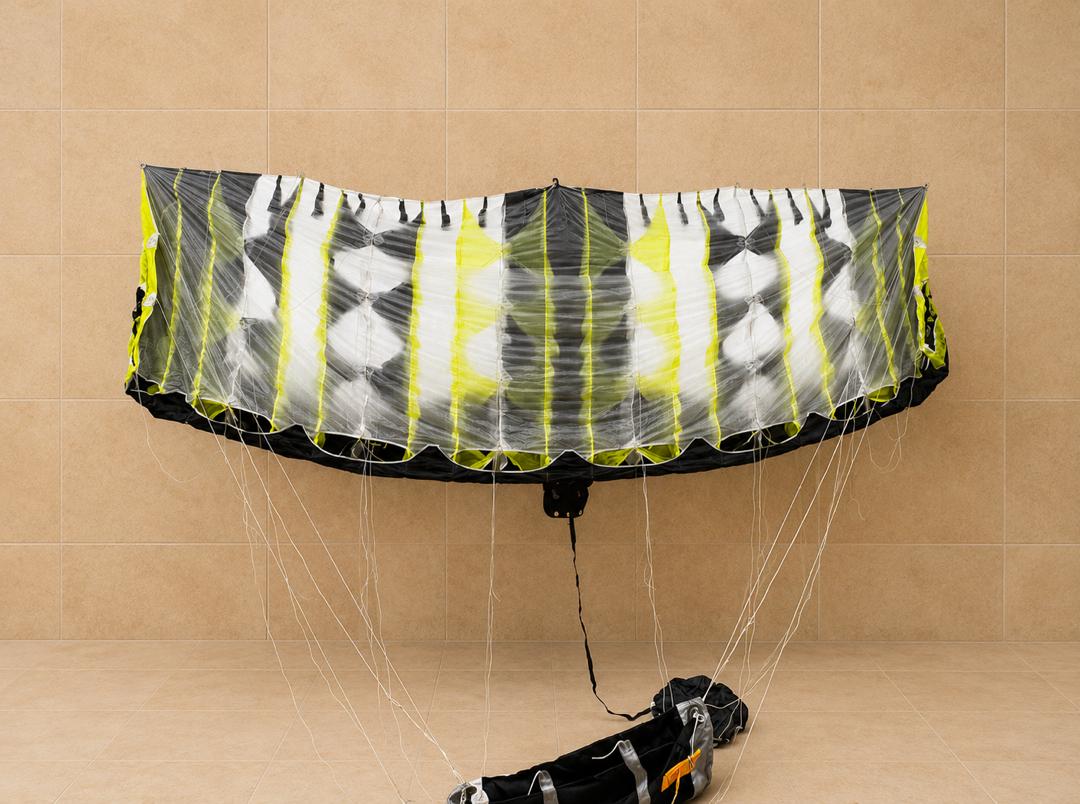

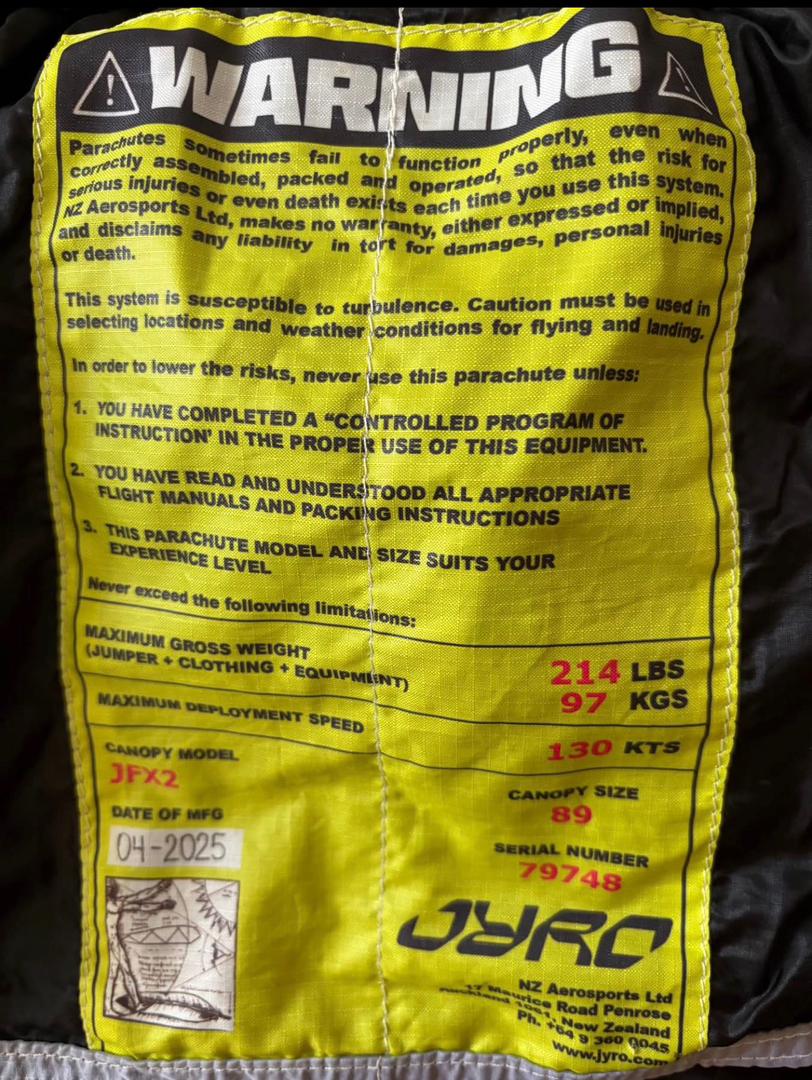
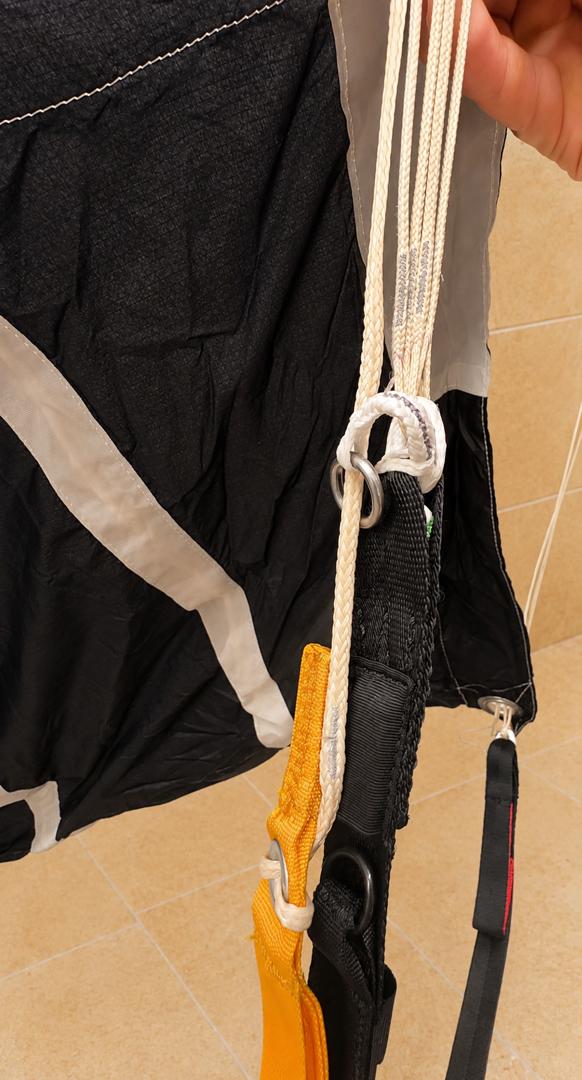



Used Jyro JFX2 89 Canopy

€1,650.00
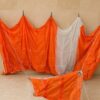
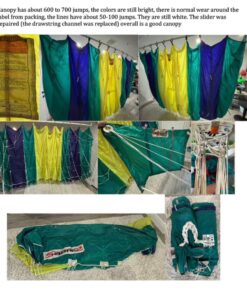
The Used JYRO JFX2 89 Canopy is a high-performance 7-cell crossbraced main canopy built for experienced skydivers who want responsive handling, strong energy retention, smooth openings, and precise canopy control. Its advanced construction combines zero-porosity fabric, reinforced internal structure, Powerband shaping, sail-loaded ribs, and low-stretch lines for consistent aerodynamic performance. Because this is used life-support equipment, the fabric, ribs, crossbraces, slider, suspension lines, steering lines, attachment points, repairs, connectors, and overall trim should be inspected by a qualified rigger before installation or use.
Used JYRO JFX2 89 Canopy — Crossbraced 7-Cell High-Performance Main Canopy with Powerband, Sail-Loaded Ribs, Vectran Lines, and Swoop-Oriented Flight Characteristics
Used JYRO JFX2 89 Construction, Crossbraced Performance, Wing Loading, Openings, Line Condition, and Canopy-Flight Precision
The Used JYRO JFX2 89 Canopy is a high-performance crossbraced main canopy designed for experienced pilots progressing into or already established within performance canopy flight. JYRO currently describes the JFX2 as its entry-level swoop wing, but “entry-level” in this context refers specifically to the crossbraced and high-performance category—not beginner skydiving. The manufacturer recommends approximately 1.6–2.2 wing loading for the current JFX2 and offers sizes from 69 to 119 sq ft, including the 89 sq ft version.
The JFX2 uses a 21-chamber, 7-cell crossbraced architecture. Its modern construction includes JYRO’s Powerband shaping technology, mini-ribs, a closed center chamber, and strategically positioned sail-loaded ribs. Most of the canopy is made from J-ZP zero-porosity fabric, while S-PU sail material is incorporated into loaded rib areas to increase structural performance without converting the entire wing to sail fabric.
Standard lines are Vectran 500, while JYRO also offers black Vectran 400 for pilots prioritizing reduced line drag at the expense of more frequent relining. Because this example is used, its exact line material, jump number, DOM, line cycles, trim, repair history, fabric condition, slider configuration, and previous use should be independently verified before it is placed into service.
Parachute Jump Australia
A parachute jump Australia search may lead experienced jumpers to drop zones where high-performance canopy flight is practiced. Local drop-zone rules, canopy-flight policies, landing areas, coaching requirements, and equipment regulations should always be confirmed before flying a small crossbraced canopy.
Skydive Byron Bay
Skydive Byron Bay represents the type of active drop-zone environment where canopy traffic management matters significantly.
A JFX2 89 should only be flown by a pilot whose training, currency, canopy experience, and wing loading are appropriate for a crossbraced canopy.
Weight Limit Skydiving
Weight limit skydiving becomes especially important when evaluating an 89 sq ft main.
Total exit weight determines wing loading, and wing loading strongly affects speed, descent rate, recovery characteristics, control response, and landing energy.
JYRO currently recommends approximately 1.6–2.2 for the JFX2.
Cairns Skydiving
Cairns skydiving may involve different weather, density altitude, wind, and landing-area considerations than another location.
A high-performance canopy should always be evaluated in the actual operating environment rather than by size alone.
Skydiving Helmet
A skydiving helmet remains an important piece of personal equipment, but it does not influence whether the JFX2 89 is an appropriate canopy.
Canopy suitability depends primarily on pilot experience, loading, currency, and professional assessment.
Skydive Helmets
Skydive helmets protect the head during freefall and canopy operations, while the main wing requires separate maintenance and suitability assessment.
Hook Blade Knife
A hook blade knife may form part of emergency skydiving equipment.
It does not affect normal JFX2 flight performance.
Tracking Jump
A tracking jump involves horizontal freefall movement and requires appropriate deployment separation.
The JFX2 does not remove the need for disciplined tracking, deployment planning, and canopy traffic awareness.
Parachute Rig
A parachute rig must be properly matched to the canopy’s actual pack volume.
JYRO states that pack-volume charts are only guides because packing technique, canopy age, and container construction all influence fit.
A qualified rigger should verify whether an 89 sq ft JFX2 fits the intended harness/container correctly.
Linewear
Linewear is one of the most important inspection points on a used performance canopy.
Vectran should be checked for abrasion, broken fibers, excessive fuzzing, damaged stitching, uneven line lengths, and trim changes.
A canopy can remain visually attractive while the line set has already moved significantly out of trim.
Base Jumping
Base jumping requires dedicated BASE equipment and specialized procedures.
A JFX2 sport-skydiving canopy should not be treated as a dedicated BASE canopy.
Sky Helmet Skydiving
A sky helmet skydiving search concerns protective headgear rather than canopy construction.
Wingsuit Sport
Wingsuit sport requires careful deployment equipment selection.
The JFX2 is not marketed by JYRO as its wingsuit-specific canopy; the company identifies the Kraken as its dedicated wingsuiting design.
Vector Wingsuit
A vector wingsuit search concerns a different part of the skydiving equipment ecosystem.
Canopy choice for wingsuit operations should be made with experienced coaches and riggers.
Full Face Skydiving Helmet
A full face skydiving helmet provides facial protection and wind shielding but does not change the canopy’s loading or handling characteristics.
Skydiving Downsizing Chart
A skydiving downsizing chart should never be treated as automatic permission to transition to an 89 sq ft crossbraced canopy.
JYRO’s earlier published guidance stated that pilots transitioning to a JFX2 were commonly around 1,000+ jumps, with some highly prepared pilots potentially transitioning at roughly 700–800+ jumps after substantial canopy-specific training.
Actual progression should be based on current professional coaching rather than jump count alone.
Landing Flight Risers
Landing flight risers form part of the suspension and control interface between the canopy and harness.
Risers should be inspected together with lines, links, guide rings, toggles, and brake settings.
Fire Parachute
The phrase fire parachute does not describe the JFX2 89 or its intended application.
Cypress Fire Skydiving
Cypress fire skydiving appears to combine terminology associated with skydiving safety equipment.
An automatic activation device belongs to the reserve system and operates independently from the main canopy.
Skydiving Rigging
Skydiving rigging is particularly important with a used crossbraced canopy.
A qualified rigger should inspect fabric, ribs, crossbraces, attachment points, lines, slider, links, steering system, repairs, and overall compatibility before the canopy is jumped.
Baseline Jumping
Baseline jumping is unrelated to the normal sport-skydiving application of this canopy.
Sky Diving Helmet
A sky diving helmet is separate safety equipment and does not determine canopy suitability.
Hook Knife Skydiving
A hook knife skydiving accessory is emergency equipment rather than a flight-performance component.
Landing Flight Risers
The repeated landing flight risers phrase reinforces the importance of inspecting risers and canopy attachment hardware as one complete suspension system.
Skydiving Glasses
Skydiving glasses provide wind and eye protection during freefall.
They should be compatible with the jumper’s helmet and general equipment configuration.
Nude Parachute Jump
A nude parachute jump is unrelated to the design, condition, or performance characteristics of this canopy.
iFLY Colorado Springs
iFLY Colorado Springs provides indoor body-flight training.
Wind-tunnel ability can improve freefall skills, but it does not replace canopy-flight experience or high-performance canopy coaching.
Skydive Hook Knife
A skydive hook knife is emergency equipment and does not influence ordinary flight characteristics.
Skydiving Helmet Full Face
A skydiving helmet full face search concerns protective equipment rather than canopy sizing or loading.
Skydiving Blue Hole Belize
Skydiving Blue Hole Belize represents destination skydiving, where organizer requirements and local equipment policies should be confirmed before bringing specialized high-performance equipment.
Smallest Canopy
The smallest canopy should never be considered automatically better.
An 89 sq ft canopy can generate substantial speed and energy, particularly when loaded within high-performance ranges.
Canopy size should always match demonstrated ability.
Skydiving Speed
Skydiving speed under a canopy is influenced by wing loading, trim, control input, atmospheric conditions, and wing design.
A crossbraced JFX2 is specifically designed to retain energy and provide performance beyond conventional recreational nine-cell canopies.
Wing Suits for Sale
Wing suits for sale relates to separate specialist equipment.
Wingsuit and canopy choices should be considered independently.
Skydiving Nude
Skydiving nude has no technical relationship to the JFX2 89.
Parts of a Parachute
The parts of a parachute relevant to this canopy include top and bottom skins, ribs, crossbraces, suspension lines, steering lines, slider, reinforcement tapes, attachment points, links, risers, and deployment components.
Every part deserves attention when assessing used life-support equipment.
Container Skydive
A container skydive system must accommodate the canopy correctly.
JYRO’s own pack-volume guidance warns that age, packing method, and container design all affect fit.
G35 Helmet
A G35 helmet belongs to the protective-equipment category and is independent of the canopy.
Best Skydiving Helmet
The best skydiving helmet depends on fit, visibility, certification, discipline, and comfort.
Canopy selection requires different criteria.
Skydive Belize
Skydive Belize is a destination-related search term rather than a canopy specification.
Freefly Pud Handle
A freefly pud handle is part of certain pilot-chute deployment configurations.
Its compatibility depends on the harness/container system rather than the canopy itself.
Gliding Suit Wingsuit
A gliding suit wingsuit changes freefall aerodynamics and deployment conditions.
Canopy selection for wingsuiting should be made conservatively with appropriate coaching.
Jumper Pilot
A jumper pilot transports skydivers to altitude, while the skydiver becomes responsible for deployment and canopy operation after exit.
CRW Skydiving
CRW skydiving requires discipline-specific equipment and training.
A JFX2 should not be assumed appropriate for canopy-relative work simply because it is a highly maneuverable parachute.
Gear Bag Skydive
A gear bag skydive setup should protect the canopy from sharp objects, moisture, dirt, sunlight, oils, and excessive compression during transportation.
Skydiving Equipment List
A skydiving equipment list may include the harness/container, main canopy, reserve, deployment system, activation device where required, helmet, altimeter, goggles, and suitable clothing.
A high-performance main should only be one component within a correctly configured system.
Indoor Wingsuit
Indoor wingsuit training does not provide the same canopy-flight experience as actual skydiving.
Can You Wear Glasses While Skydiving
For can you wear glasses while skydiving, compatible goggles or full-face helmets can often accommodate prescription eyewear.
This issue is independent of main-canopy selection.
Wingsuit
A wingsuit requires specialized training and careful deployment planning.
The JFX2 is primarily positioned as a crossbraced performance and swoop-oriented canopy rather than JYRO’s dedicated wingsuit design.
Skydiving Website
A reliable skydiving website can provide equipment information, but safety-critical decisions should prioritize manufacturer documentation and qualified riggers or canopy coaches.
Cookie G4 Helmet
The Cookie G4 helmet belongs to the full-face skydiving helmet category and is separate from canopy aerodynamics.
Base Canopy
A base canopy is specifically designed for BASE environments.
The JFX2 belongs to the sport-skydiving high-performance category.
New Skydive
A new skydive participant should not treat a small crossbraced wing as normal beginner equipment.
JYRO explicitly positions other canopy models for new skydivers while classifying the JFX2 as a high-performance entry-level swoop wing.
#Skydiving Latest
#skydiving latest may surface current community discussions and equipment trends, but manufacturer guidance and professional instruction remain more important for safety-critical decisions.
Canopy Flight
Canopy flight is where the JFX2’s engineering becomes most apparent.
JYRO describes it as providing crossbraced performance with comparatively accessible handling, smooth openings, powerful flight, and swoop-oriented performance.
Skydiver Goggles
Skydiver goggles protect the eyes during freefall and do not change canopy performance.
Speed Sky Diving
Speed sky diving refers primarily to a freefall discipline and should not be confused with canopy speed.
Fly Suits
Fly suits affect freefall body-flight characteristics rather than the canopy’s aerodynamic design.
Skydiving Rig
A skydiving rig containing an 89 sq ft crossbraced wing must be configured correctly.
Container volume, deployment bag, pilot chute, risers, connectors, and reserve compatibility should all be checked professionally.
Safire 3
The Safire 3 belongs to a different canopy category.
It should not be treated as aerodynamically equivalent to a crossbraced JFX2 simply because both are sport parachutes.
Skydiving Gliding Suit
A skydiving gliding suit is a wingsuit and requires discipline-specific training.
Fluid Wings
Fluid Wings produces other performance canopy designs.
Each canopy should be evaluated individually according to construction, progression requirements, wing loading, and handling.
Price of Wingsuit
The price of wingsuit has no relationship to the condition or fair value of a used JFX2 89.
A used canopy’s value depends on DOM, jump count, line cycles, fabric condition, repairs, configuration, and service history.
Tandem Wingsuit
A tandem wingsuit is unrelated to the intended flight application of this canopy.
Skydiving Tube
A skydiving tube may be used in freefall demonstrations or formations but is unrelated to canopy construction.
Why the Crossbraced Design Matters
The JFX2 uses a 21-chamber, 7-cell crossbraced structure.
Crossbracing helps maintain the wing’s aerodynamic shape under high loading while reducing distortion compared with simpler canopy structures.
This supports greater performance and energy retention, but it also means the canopy belongs in the hands of experienced pilots.
Why the Powerband Matters
JYRO’s Powerband technology is designed to improve control over the upper-surface shape, particularly near the leading edge where aerodynamic lift is generated.
The manufacturer describes it as a way to enhance aerodynamic accuracy and performance while reducing unnecessary distortion.
Why the Closed Center Chamber Matters
The closed center chamber is a long-standing JYRO design feature intended to help control distortion and soften opening behavior in crossbraced designs.
JYRO identifies this architecture as one of the developments that helped make crossbraced canopy openings more manageable.
How Good Are the Openings?
JYRO characterizes the JFX2 as having smooth, relatively gentle openings for a crossbraced wing.
However, actual opening behavior depends on packing, body position, deployment speed, slider configuration, line trim, and canopy condition.
A used example should therefore be evaluated on its real maintenance history rather than reputation alone.
Why J-ZP and S-PU Fabrics Matter
The majority of the canopy uses J-ZP zero-porosity material for durability and consistent performance.
High-performance S-PU sail fabric is placed strategically in heavily loaded rib areas to provide additional structural support without making the complete canopy a sail-fabric wing.
Line Performance
Standard Vectran 500 lines provide a balance of durability and low stretch.
JYRO also offers Vectran 400 where reduced drag is prioritized, although the manufacturer notes that the lighter option requires more frequent relining.
For a used 89, the exact installed line type should be confirmed.
Why the 89 Size Matters
The 89 sq ft size is part of JYRO’s normal JFX2 range and remains represented in the manufacturer’s current stock and demo fleets.
However, 89 sq ft should never be evaluated in isolation.
At 1.6 wing loading, the exit weight would be roughly 142 lb; at 2.0 it would be approximately 178 lb; and at 2.2 it would be approximately 196 lb.
Those numerical examples illustrate why exit weight dramatically changes how the same canopy size performs.
How Good Is the Flight Precision?
The combination of crossbracing, Powerband shaping, sail-loaded ribs, high-performance lines, and compact 89 sq ft area gives the canopy a highly responsive aerodynamic platform.
However, precision comes with reduced tolerance for pilot error compared with recreational wings.
Control inputs, harness movement, approach planning, and traffic awareness therefore require advanced canopy-flight competence.
Where the JFX2 89 Works Best
The canopy is intended for experienced sport jumpers progressing into crossbraced and swoop-oriented canopy flight.
JYRO describes the JFX2 as suitable as a first crossbraced wing for appropriately trained pilots and also useful to experienced swoopers.
When a Used JFX2 Makes Sense
A used JFX2 can make sense when the buyer already has appropriate canopy experience and wants an established crossbraced wing without purchasing new equipment.
However, used status places greater importance on inspection.
Jump count, line cycles, trim, fabric condition, slider wear, connector condition, repairs, water exposure, UV exposure, and storage history should all be considered.
Important Used-Canopy Inspection Information
Before purchase or use, the canopy should be inspected for damage to the top and bottom skins, ribs, crossbraces, reinforcement tapes, seams, attachment points, slider, grommets, line set, steering lines, and connector system.
Previous repairs should be identified and evaluated.
The identification label and manufacture date should also be checked.
Why Rigger Inspection Is Essential
A parachute is life-support equipment, and a crossbraced 89 sq ft canopy operates in a demanding performance range.
A qualified rigger should confirm airworthiness, line trim, slider condition, repairs, container compatibility, and installation before the canopy is returned to service.
A seller’s description or photographs cannot replace that inspection.
Overall, a properly inspected Used JYRO JFX2 89 Canopy can provide a sophisticated 7-cell crossbraced platform with Powerband shaping, sail-loaded ribs, J-ZP construction, Vectran lines, smooth opening characteristics, and powerful performance. Its suitability, however, depends on verified condition, appropriate wing loading, substantial canopy experience, current training, and professional inspection—not simply the reputation of the model.
Opening Behavior, Flight Response, Line Condition, Structural Inspection, and Used-Canopy Reliability
Opening Behavior
Opening quality is one of the first things that should be evaluated on a used high-performance canopy.
A healthy canopy should inflate in a controlled and repeatable way when it is packed correctly and deployed within its intended operating envelope.
However, opening behavior depends on more than the wing itself.
Body position, packing technique, slider condition, deployment speed, pilot-chute performance, line trim, and canopy age can all influence the result.
For that reason, one unusual opening should not be used alone to judge the complete condition of the canopy.
Why Line Trim Matters
Line trim determines the aerodynamic attitude of the wing.
Even when the fabric is in excellent condition, a worn or shrunken line set can change the way the canopy opens, glides, turns, and flares.
Some line materials can move out of trim gradually without showing dramatic visible damage.
That is why measurement is more reliable than appearance alone.
A qualified rigger should compare the line set with the correct trim specifications when condition is uncertain.
Main Line Inspection
The suspension lines should be checked for abrasion, fuzzing, broken fibers, discoloration, damaged stitching, and unusual wear.
Areas near the slider, cascades, attachment points, and lower line sections deserve particular attention.
Minor surface wear may be acceptable, but concentrated damage should not be ignored.
Any questionable line should be evaluated professionally before the canopy returns to service.
Steering Line Condition
Steering lines experience regular friction and control movement.
Their condition directly affects turning response and flare performance.
They should remain symmetrical and free from severe wear.
If one side appears shorter, more worn, or differently tensioned than the other, the complete control system should be inspected.
Uneven steering lines can create handling differences that become more noticeable on a highly responsive wing.
Slider Condition
The slider controls part of the inflation sequence and should remain structurally sound.
The fabric, tapes, grommets, stitching, and overall shape should all be inspected.
Damaged or rough grommets can accelerate line wear.
If the slider has been modified, replaced, or altered from its original configuration, compatibility should be verified before use.
A worn slider can affect opening behavior even when the canopy itself remains in good condition.
Fabric Condition
The canopy fabric should be inspected across the top skin, bottom skin, ribs, and internal structure.
Look for tears, abrasion, stretched areas, discoloration, damaged stitching, and previous repairs.
A used performance wing can remain visually clean while still carrying hidden wear from repeated high-load operation.
The condition of the internal reinforcement structure is therefore just as important as the visible outer surfaces.
Rib and Crossbrace Inspection
Internal ribs and crossbraces maintain the aerodynamic shape of the canopy.
Damage to these structures can affect both strength and flight behavior.
Because many internal areas are difficult to inspect casually, a professional inspection becomes especially valuable on a used crossbraced wing.
Any unusual deformation, stitching damage, or evidence of previous internal repair should be examined closely.
Attachment Points
Line attachment points carry substantial load during opening and flight.
They should remain securely sewn and free from tearing, distortion, or reinforcement damage.
Even small defects in these areas deserve attention because the loads are concentrated.
If any attachment point appears stretched or damaged, the canopy should not be treated as ready for use until it has been inspected professionally.
Seam Integrity
Seams help the wing maintain its intended shape.
Loose, broken, or pulled stitching can reduce structural reliability.
High-load areas should be inspected more carefully than purely cosmetic zones.
Professional repair work may be perfectly acceptable, but the location and quality of every visible repair should be evaluated.
Improvised stitching or unknown repair history is a warning sign.
Opening Symmetry
A canopy should generally inflate with reasonably predictable symmetry.
Persistent off-heading behavior, uneven inflation, or repeated unusual movement may indicate line-trim changes, packing issues, slider problems, or canopy asymmetry.
Environmental turbulence should also be considered.
However, repeated irregular behavior under normal conditions should not be ignored.
Flight Response
A small crossbraced canopy can respond quickly to control input.
That responsiveness is part of its performance character, but it also means mechanical inconsistencies can become easier to notice.
If the wing suddenly feels different from previous jumps, the line set, steering system, and overall trim should be checked.
Changes should not automatically be blamed on pilot technique.
Harness Input Sensitivity
High-performance wings can respond strongly to harness movement.
This can make the canopy feel highly connected and precise.
However, it also reduces tolerance for inconsistent body position.
A used wing should still respond symmetrically.
If harness input produces noticeably different behavior from one side to the other, the system should be inspected.
Glide Characteristics
Glide performance is influenced by trim, loading, atmospheric conditions, and control input.
A canopy that has moved significantly out of trim may not glide the way it did when new.
A noticeable long-term change in glide can therefore be a useful indicator that maintenance is needed.
Line measurement should be considered if behavior changes gradually without another obvious cause.
Recovery Behavior
After a control input, the wing returns toward normal flight over time.
The length and character of that recovery depend on canopy design, loading, and pilot input.
A used example may behave differently if the line set has changed or the canopy has been modified.
Any noticeable difference from expected behavior should be evaluated before more demanding use.
Flare Performance
Flare quality depends on airspeed, line trim, steering-line length, wing loading, and technique.
A well-maintained canopy should provide a consistent and progressive control range.
If flare performance appears weaker than expected, brake-line length and overall trim should be checked.
Mechanical changes should be ruled out before technique alone is blamed.
Wing Loading Review
Wing loading should be calculated using total exit weight rather than body weight alone.
On a small performance canopy, even modest changes in loading can significantly alter speed, responsiveness, descent rate, and landing energy.
Progression should therefore be based on demonstrated competence and qualified coaching rather than canopy size alone.
Currency and Experience
A jumper who has previously flown a high-performance canopy may still need a conservative approach after a long break.
Currency affects judgment, traffic awareness, timing, and emergency response.
Equipment suitability should reflect present ability, not only historical jump numbers.
A small crossbraced wing leaves less margin for delayed decisions.
Container Compatibility
The canopy must fit the harness/container correctly.
Pack volume can vary with canopy age, fabric condition, packing technique, and container design.
The wing should not be forced into a container simply because another canopy of similar area fitted previously.
A qualified rigger should confirm compatibility.
Deployment Bag Condition
The deployment bag should be structurally sound and appropriate for the container.
Damaged fabric, stitching, grommets, or locking components can influence deployment.
The complete deployment system should be inspected together rather than focusing only on the main canopy.
Pilot-Chute Condition
The pilot chute plays a major role in initiating deployment.
A worn, damaged, or poorly matched pilot chute can create deployment problems that may be mistaken for canopy behavior.
Mesh, fabric, bridle connection, and overall condition should be checked routinely.
Bridle Inspection
The bridle should remain free from cuts, burns, damaged stitching, and excessive wear.
Its attachment points should be secure.
Any significant deterioration should be corrected before use.
A compromised bridle can affect deployment reliability regardless of how good the canopy itself is.
Connector Condition
Soft links or metal connectors should be installed correctly and inspected for wear.
Protective covers should sit properly where applicable.
Any uncertainty about connector condition or installation should be resolved by a qualified rigger.
Riser Condition
Risers should be checked for webbing wear, damaged stitching, distorted hardware, and guide-ring condition.
The control system should move freely.
A worn riser can create problems that may be incorrectly attributed to the canopy.
Water Exposure
Any known water exposure should be documented.
Fresh water, salt water, and chemically contaminated water can affect equipment differently.
Salt or chemical contamination deserves particular attention.
A canopy with uncertain exposure history should be inspected professionally before being considered serviceable.
Ultraviolet Exposure
Ultraviolet radiation can gradually weaken textile materials.
The canopy should not be left exposed to direct sunlight longer than necessary.
Normal jumping creates unavoidable exposure, but prolonged storage in bright sunlight can accelerate material aging.
Chemical Contamination
Fuel, solvents, acids, cleaning products, and other chemicals can damage parachute materials.
Suspected chemical exposure should never be treated as a cosmetic issue.
The canopy should be removed from service until its condition has been properly assessed.
Storage History
Storage conditions can be as important as jump count.
A lower-jump canopy stored poorly may be in worse condition than a higher-jump example kept dry and protected.
The wing should ideally have been stored away from heat, moisture, sunlight, chemicals, and sharp objects.
Previous Repairs
All visible repairs should be identified.
Professional repairs do not automatically reduce serviceability, but their location and quality matter.
The seller should provide as much history as possible.
Unknown or poorly executed work should be treated cautiously.
Jump Count
Jump count can help estimate wear but should not be used as the only measure of condition.
A canopy with fewer jumps may still be damaged by poor storage, hard use, or contamination.
Physical inspection and line condition usually provide more useful information than jump count alone.
Pre-Jump Inspection
Before use, the canopy and deployment system should be checked for visible damage, correct assembly, line continuity, slider position, connector security, and brake configuration.
Any uncertainty should be resolved before the rig is closed.
Post-Jump Inspection
After an unusual opening, hard landing, obstacle contact, water exposure, or other abnormal event, the canopy should be checked before the next pack job.
Small damage can become more serious if ignored.
Professional Rigger Evaluation
Professional inspection is especially important when dealing with a used small crossbraced canopy.
A qualified rigger can assess line trim, fabric condition, crossbraces, slider, connectors, previous repairs, and rig compatibility.
Photos and seller descriptions cannot replace hands-on inspection.
Long-Term Reliability
Long-term reliability depends on structural condition, line trim, sound stitching, healthy attachment points, suitable deployment components, proper storage, and regular professional inspection.
A used high-performance canopy should never be evaluated only by appearance or reputation.
When the wing is inspected carefully, maintained correctly, installed in a compatible system, and used by a suitably trained and current pilot, it can continue to provide predictable openings, responsive flight characteristics, stable control feel, and dependable performance over its remaining service life.
Flight Consistency, Control Response, Packing Condition, Line Management, and Long-Term Canopy Care
Flight Consistency
A used high-performance canopy should behave predictably when its structure, line trim, slider, and deployment components remain within serviceable limits.
Consistency matters because small changes in trim or line condition can become noticeable on a highly responsive wing.
If the canopy begins opening differently, turning unevenly, or feeling unusual in full flight, the complete system should be inspected rather than assuming the change is normal wear.
Opening Direction
Opening direction can be influenced by body position, packing technique, deployment speed, slider movement, and line symmetry.
Occasional variation can happen, but repeated strong off-heading behavior deserves attention.
If the issue persists across multiple carefully packed jumps, line trim, slider condition, and canopy symmetry should be examined by a qualified rigger.
Inflation Sequence
The canopy should progress through deployment in a controlled manner.
Uneven inflation, hesitation, or aggressive expansion may indicate a packing issue, slider problem, line-trim change, or structural concern.
A used canopy should not be assumed to open exactly like a new one because line condition and fabric age can influence inflation behavior.
Packing Condition
Packing provides an important opportunity to inspect the wing.
During each pack job, the jumper can observe the fabric, lines, slider, reinforcement tapes, and steering system.
Anything unusual should be investigated before the canopy is returned to the container.
A difficult or inconsistent pack job can sometimes reveal changes in fabric behavior or line organization.
Fabric Handling
Healthy fabric should remain structurally sound without obvious tears, abrasion, unusual softness, or extensive discoloration.
High-performance zero-porosity materials can remain serviceable for many jumps, but long-term condition still depends on storage, sunlight exposure, contamination, and handling.
Visible cleanliness should never be treated as proof that the fabric has no structural concerns.
Internal Structure
The ribs and crossbraces help maintain the wing’s aerodynamic shape.
Damage inside the canopy can be harder to detect during ordinary visual inspection.
For this reason, periodic professional inspection is especially valuable on a used crossbraced wing.
Loose stitching, tears, or deformation inside the structure should be treated seriously.
Leading Edge Condition
The leading edge controls how air enters the cells.
It should remain free from major tears, damaged seams, or distorted reinforcement.
Damage in this area can influence inflation and aerodynamic shape.
If the nose appears asymmetrical or unusually worn, the canopy should be inspected before further use.
Trailing Edge Condition
The trailing edge carries important control loads and plays a major role in flare response.
It should remain free from tears, excessive wear, or broken stitching.
Damage near the steering attachment area can directly affect control behavior.
Any repair in this region should be checked for quality and structural suitability.
Steering Line Symmetry
Steering lines should remain reasonably symmetrical.
A noticeable difference in length or condition can affect turning and flare response.
If one side feels different during control input, both steering lines and the rest of the suspension system should be checked.
Uneven shrinkage or wear should not be ignored.
Brake Setting Condition
The brake setting should remain correct for the installed line configuration.
Incorrect brake-line length can affect full-flight behavior, openings, and flare range.
After a line replacement or significant maintenance, brake settings should be confirmed by a qualified rigger.
Improvised changes can create unpredictable handling.
Line Shrinkage
Line shrinkage can occur gradually.
Because the change may be distributed unevenly across different line groups, the canopy can slowly move away from its intended trim.
This may alter pitch, glide, recovery behavior, and openings.
Visual inspection alone cannot always detect this condition.
Measured trim is therefore important when performance begins to change.
Line Replacement Planning
A line set should be replaced according to actual wear and trim condition rather than jump count alone.
Heavy fuzzing, broken fibers, significant shrinkage, or repeated changes in flight behavior may indicate that replacement is approaching.
A new line set should always match the correct canopy size and approved configuration.
Slider Inspection
The slider should move freely and remain structurally intact.
Fabric, tapes, grommets, and stitching should all be checked.
Damaged grommets can accelerate line wear.
If the slider has been modified or replaced, its compatibility should be verified before use.
Grommet Condition
Each slider grommet should remain smooth and free from sharp edges.
Cracked or damaged grommets can cut or abrade suspension lines.
Even small rough areas can create progressive wear over repeated deployments.
Questionable grommets should be evaluated immediately.
Harness Input Response
A crossbraced canopy can respond strongly to harness movement.
This responsiveness can provide precise control, but it also makes asymmetry easier to notice.
If one side responds significantly differently from the other under similar input, the system should be inspected.
Line trim, harness position, and canopy structure should all be considered.
Toggle Response
Toggle input should feel progressive and reasonably symmetrical.
The canopy should not suddenly feel dramatically heavier or lighter on one side.
If control pressure changes, steering-line wear, trim, and attachment points should be checked.
Persistent changes should not be treated as a normal characteristic of an aging wing.
Glide Consistency
Glide depends on loading, trim, atmospheric conditions, and control position.
A gradual change in glide can indicate line shrinkage or altered trim.
Repeated observation across similar conditions is more useful than judging one jump.
If the canopy consistently feels steeper or flatter than before, maintenance should be considered.
Recovery Characteristics
After a turn or other control input, the canopy should recover in a familiar and predictable way.
Changes in recovery behavior can result from trim changes, loading, or line condition.
A used canopy should not be assumed to retain exactly the same response indefinitely.
Any substantial change deserves investigation.
Flare Response
Flare performance depends on airspeed, steering-line length, trim, loading, and pilot timing.
A healthy wing should provide a consistent progression of control pressure.
If bottom-end flare begins to feel weaker or delayed, brake-line length and overall trim should be checked.
Mechanical factors should be ruled out before technique alone is blamed.
Landing Consistency
Consistent landings depend on current skill, canopy condition, wind, density altitude, traffic, and judgment.
A small high-performance canopy can amplify errors.
Therefore, changes in landing behavior should be considered carefully.
If the wing suddenly feels less predictable, maintenance and line trim should be reviewed.
Wing Loading Review
Wing loading should be recalculated whenever body weight, equipment weight, or canopy size changes.
Small differences can significantly affect speed and responsiveness on a compact wing.
Progression decisions should reflect current ability and coaching rather than simply previous experience.
Currency
A jumper returning after a long break should consider current skill level carefully.
Canopy currency affects visual timing, traffic management, flare judgment, and emergency response.
Previous experience does not automatically guarantee present readiness.
A conservative approach is appropriate after significant time away.
Container Fit
The canopy should fit the intended harness/container properly.
An overly tight or overly loose fit can create packing or deployment concerns.
Pack volume should be evaluated by a qualified rigger rather than estimated only from canopy area.
Deployment Bag Condition
The deployment bag should remain intact and appropriately sized.
Damaged stitching, fabric, grommets, or locking components can affect deployment.
The bag should be inspected as part of the complete main deployment system.
Pilot-Chute Condition
Pilot-chute fabric, mesh, stitching, bridle connection, and overall condition should be checked regularly.
A worn or poorly matched pilot chute can influence extraction and opening behavior.
Deployment problems should not automatically be blamed on the canopy.
Bridle Inspection
The bridle should remain free from burns, cuts, fraying, and damaged stitching.
Connection points should be secure.
Any significant wear should be addressed before the system is used again.
Riser Inspection
Risers should remain structurally sound.
Webbing, stitching, guide rings, connectors, and hardware should all be inspected.
Wear in the riser system can affect control reliability even when the canopy remains in excellent condition.
Connector Inspection
Soft links or metal connectors should be installed correctly and inspected for wear.
Protective covers should remain properly positioned where applicable.
Any questionable installation should be reviewed by a qualified rigger.
Storage Conditions
The canopy should be stored clean, dry, and protected from sunlight, chemicals, moisture, and excessive heat.
Good storage practices can significantly influence service life.
Long periods in poor conditions can damage materials even when jump count remains low.
UV Protection
Ultraviolet exposure gradually weakens textile materials.
The canopy should not be left spread out in direct sunlight unnecessarily.
Normal operational exposure is unavoidable, but long-term storage in bright sunlight should be avoided.
Moisture Management
If the canopy becomes wet, it should be dried thoroughly before long-term storage.
Saltwater or contaminated-water exposure deserves particular attention.
The canopy should not simply be packed away damp and ignored.
Chemical Exposure
Fuel, solvents, acids, cleaning chemicals, and similar substances can damage canopy materials.
Suspected contamination should be treated seriously.
The canopy should be removed from service until it has been professionally assessed.
Repair History
Previous repairs should be documented where possible.
A professionally completed repair may be fully acceptable, but location, quality, and extent matter.
Unknown or poorly executed work should be treated cautiously.
Maintenance Records
Keeping records of jump count, inspections, repairs, line changes, and significant incidents improves long-term ownership.
Good documentation also helps a future buyer understand the history of the canopy.
Long-Term Reliability
Long-term reliability depends on fabric condition, line trim, slider health, structural integrity, proper storage, compatible deployment components, and regular professional inspection.
A used crossbraced canopy should never be evaluated only by appearance.
When it is maintained correctly, installed in a compatible system, inspected by qualified professionals, and flown by a current and appropriately experienced pilot, it can continue to provide predictable openings, responsive control, stable flight characteristics, and dependable performance throughout its remaining service life.
Be the first to review “Used Jyro JFX2 89 Canopy”
Related products

used products

used products
used products

used products
used products

used products

used products

Reviews
There are no reviews yet.