
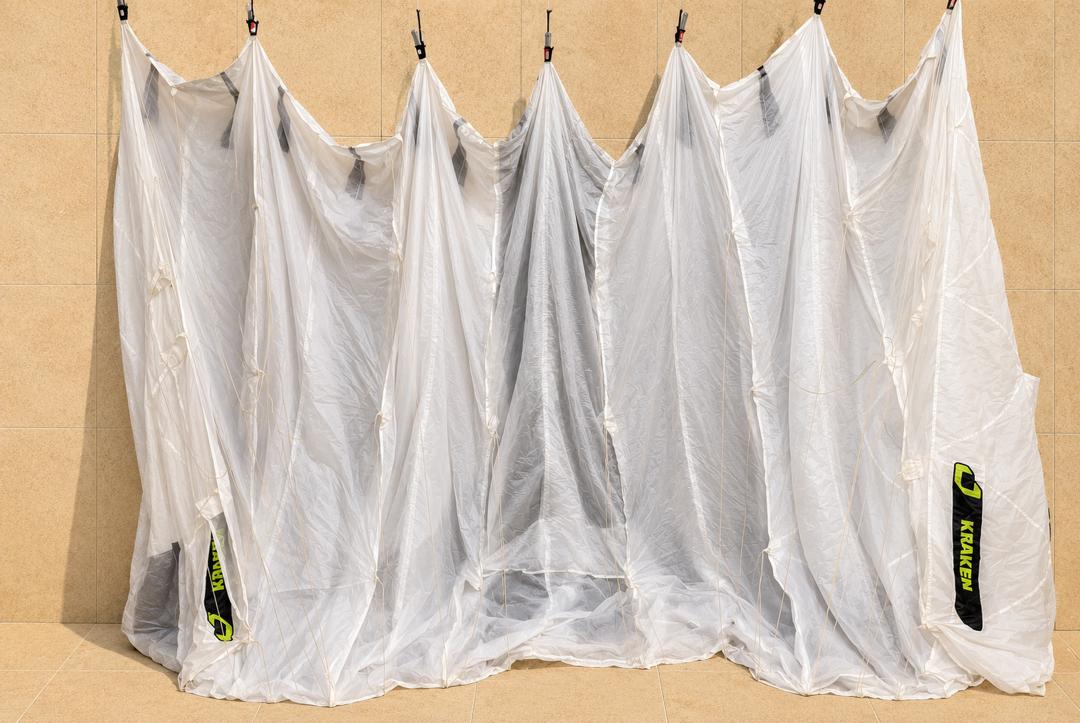


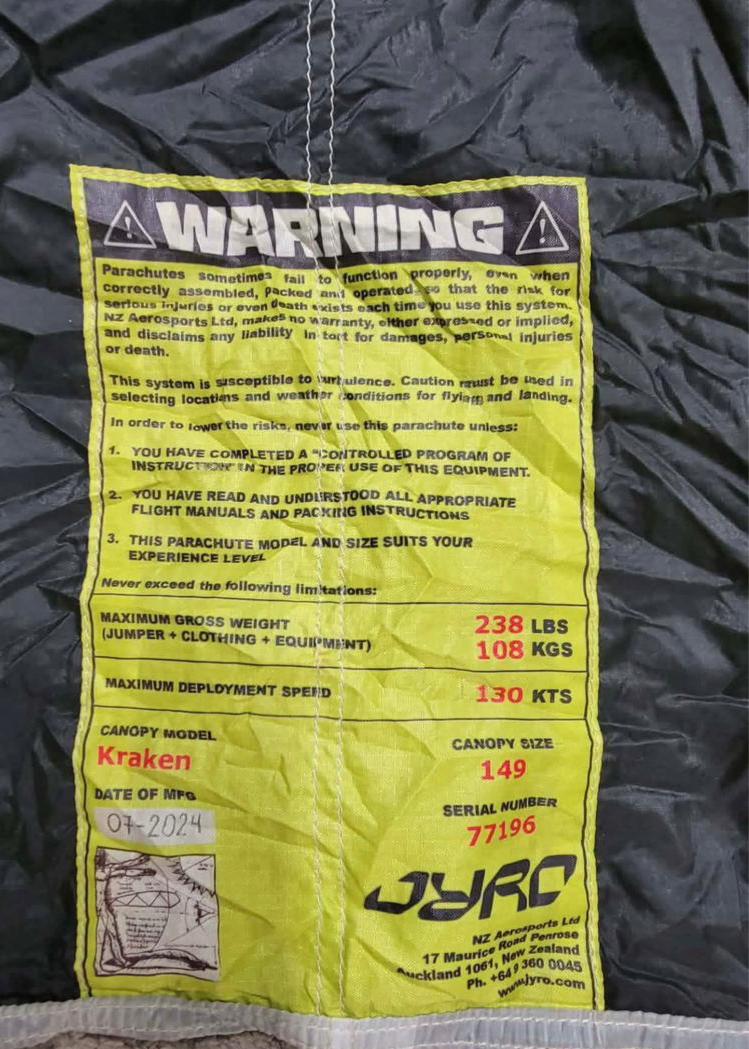

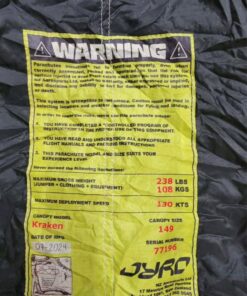
USED JYRO Kraken 149 LPV
€1,400.00
USED JYRO Kraken 149 LPV Product Description
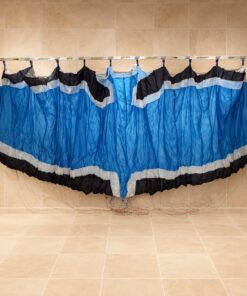
The USED JYRO Kraken 149 LPV is a lightweight 149 sq ft seven-cell main canopy developed specifically for wingsuit skydiving. Its low-bulk construction is designed to reduce packed volume while maintaining the stability, opening characteristics, handling, and landing performance expected from a modern specialized main canopy.
Built around a compact seven-cell planform, the design focuses heavily on controlled and predictable deployments in the disturbed airflow commonly created behind a wingsuit. Its lower aspect ratio and carefully engineered shaping help support heading stability during inflation, while the canopy remains responsive and enjoyable once fully pressurized.
The LPV construction uses lightweight material to reduce overall pack volume, making the canopy particularly attractive for jumpers who want a larger surface area without requiring an unnecessarily bulky container. This can provide a cleaner rig profile while still preserving practical canopy size and flight performance.
Once open, the canopy offers useful glide, progressive control response, dependable directional control, and strong flare capability when correctly loaded and flown. Its handling allows experienced pilots to make precise heading corrections while maintaining the stable characteristics expected from a wingsuit-oriented design.
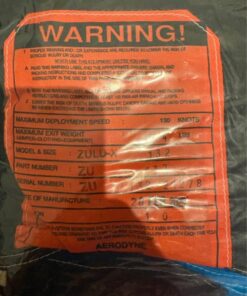
Because this is a used canopy, its condition should be evaluated individually. Important factors include total jump count, date of manufacture, fabric condition, suspension-line condition, line trim, slider condition, repairs, previous water exposure, storage history, and any prior line-set replacement.
The 149 sq ft size should also be matched carefully to the pilot’s exit weight, experience, currency, previous canopy history, and intended flying style. Selection should never be based on surface area alone.
Before installation, the canopy should be professionally inspected and confirmed compatible with the intended harness-container system.
For an appropriately experienced pilot, a well-maintained JYRO Kraken 149 LPV can provide an excellent combination of compact packing, stable wingsuit deployments, responsive flight characteristics, useful glide, and dependable landing performance, making it a practical choice for regular wingsuit use and experienced sport skydiving.
USED JYRO Kraken 149 LPV – Low-Pack-Volume Wingsuit Main Canopy with Stable Openings and Responsive Flight
The USED JYRO Kraken 149 LPV is a specialized 149-square-foot main canopy designed around the demands of wingsuit pilots who need dependable deployment characteristics without giving up enjoyable flight performance after opening. Rather than functioning like a conventional bulky seven-cell design, the Kraken combines a compact planform, low aspect ratio, reduced ellipticity, advanced three-dimensional shaping, and carefully selected lightweight materials.
JYRO currently lists the Kraken Low Bulk in sizes from 119 through 189 and recommends a wing-loading range of approximately 1.0 to 1.5. The manufacturer specifically describes the design as a wingsuit-focused canopy that combines strong heading performance with useful handling and flare characteristics.
Because this example is used, its exact condition, total jump number, line-set condition, repair history, manufacturing date, and previous loading should be confirmed individually. A professional inspection is strongly recommended before installation or use.
Why Choose the JYRO Kraken 149 LPV?
One of the biggest reasons to consider this canopy is its balance between deployment stability and post-opening performance.
Many traditional seven-cell wings are selected primarily because they offer forgiving openings and greater stability. However, that stability can sometimes come with reduced glide or relatively subdued handling.
The Kraken was engineered to address that compromise.
JYRO explains that its lower-aspect-ratio, lower-ellipticity seven-cell configuration is intended to improve heading performance and stability during line twists. At the same time, the aerodynamic design was developed to provide a more enjoyable flying canopy after deployment.
For an appropriately experienced pilot, that combination can make the 149 particularly useful for regular wingsuit operations.
How Good Is the Low-Pack-Volume Construction?
The LPV designation is particularly important.
JYRO constructs the low-bulk Kraken primarily from its proprietary L-ZP material, described as an ultralight 20-denier silicone-coated nylon developed to reduce pack volume while retaining durability.
Additional structural support is provided by the manufacturer’s conventional J-ZP material in areas including the center cell and powerband. Consequently, lightweight construction is combined with reinforcement where additional structure is useful.
According to JYRO, the Kraken packs approximately 15% smaller than comparable non-crossbraced nine-cell designs. As a general reference, the manufacturer indicates that a Kraken 149 can occupy roughly the container volume associated with a conventional 139-sized Safire 3 or Crossfire 3. Actual fit still depends on canopy age, container geometry, packing technique, and previous canopy fit.
Precision Through 3D Engineering
The canopy was developed using advanced three-dimensional CAD methods.
JYRO states that this process allows individual panels to be shaped with greater accuracy, producing a smoother aerodynamic surface and more precise overall geometry.
Computational Fluid Dynamics testing was also employed during development. CFD allows designers to study airflow, turbulence behavior, and recovery characteristics before relying solely on physical prototypes.
This engineering approach is particularly valuable for a canopy intended to open behind the disturbed airflow created by a wingsuit.
Opening Performance
Opening behavior is one of the most important considerations for this type of equipment.
A wingsuit creates a large aerodynamic wake behind the jumper. Therefore, the deployment environment can be significantly different from conventional freefall.
The Kraken’s broader seven-cell architecture was designed to support strong heading performance and useful stability when line twists occur.
However, no canopy can compensate for poor deployment technique in every situation. Body position, deployment airspeed, pilot-chute selection, bridle configuration, packing quality, line condition, and currency remain important.
A used example should therefore be inspected carefully before its opening characteristics are evaluated.
Flight Characteristics After Deployment
The canopy was not designed simply to survive deployment and descend.
Its compact outline gives the pilot a relatively responsive feel compared with many traditional wingsuit-specific seven-cell designs.
This means normal canopy flight can remain engaging rather than feeling excessively slow or unresponsive.
Its usefulness can be particularly noticeable during pattern planning, heading changes, and normal approaches.
Nevertheless, response will vary according to loading, pilot weight, field elevation, weather, and line condition.
Flare and Landing Performance
Useful flare authority is another important characteristic.
Energy available during the landing sequence depends on airspeed, loading, technique, atmospheric conditions, and canopy condition.
Therefore, a 149 should never be selected solely because another jumper reports strong landing performance.
Correct sizing is essential.
The manufacturer’s recommended loading range of roughly 1.0–1.5 provides a starting reference, but actual suitability should be determined with qualified canopy coaching.
Why the 149 Size Matters
A 149-square-foot canopy occupies an important middle position in the range.
For some experienced pilots, it may provide a desirable compromise between manageable loading and compact pack volume.
However, square footage alone does not indicate whether it is appropriate for a specific person.
Exit weight, number of jumps, recent experience, previous canopy size, wingsuit experience, landing consistency, and local operating conditions must all be considered.
A professional instructor or canopy coach should be involved when changing size or significantly altering loading.
Used-Canopy Condition and Inspection
Because this canopy is pre-owned, condition is just as important as model specification.
Buyers should ask about:
- Approximate total jumps
- Date of manufacture
- Original owner history
- Suspension-line condition
- Line-set replacement history
- Slider condition
- Fabric condition
- Patches or previous repairs
- Water or saltwater exposure
- Storage history
- Previous wing loading
- Frequency of wingsuit use
- Any unusual deployments or damage
An independent inspection can determine whether the canopy remains suitable for continued service.
Line Condition and Trim
Line condition directly influences deployment and flight characteristics.
Repeated use can change trim and create wear at attachment points, steering lines, links, and high-friction areas.
Therefore, an apparently clean canopy may still require line measurement.
A qualified rigger can compare current trim with the manufacturer’s specifications and assess whether replacement may be appropriate.
Everest Skydive and High-Altitude Skydiving
Searches for everest skydive, mount everest skydiving, mount everest skydive, skydiving from mount everest, skydiving in nepa, skydiving in nepal, nepal skydiving, and everest parachute jump concern specialized high-altitude experiences rather than normal product specifications.
Likewise, everest skydive, gunung everest, mt everest kathmandu, highest skydiving place in the world, highest skydiving in the world, top 10 highest skydive in the world for public, sky diving in world, and paragliding mount everest relate to destination or altitude research.
Anyone searching what altitude do you skydive from should understand that operating altitude depends on the aircraft, drop zone, oxygen requirements, licensing framework, and type of jump.
Nepal Skydiving and Travel Searches
The phrase skydiving in nepal pokhara price concerns travel pricing rather than the value of this canopy.
Equipment taken internationally should be checked against local drop-zone policies, insurance requirements, licensing rules, and equipment regulations.
High-altitude environments may introduce additional operational considerations that should be addressed by qualified organizers.
United States Skydiving Locations
Terms including iskydive miami, iskydive new york city, iskydive los angeles, iskydive dallas fort worth, iskydive nyc, iskydive dallas, homestead skydiving, skydiving in la california, skydiving new york state, skydive america california, parachute jump ny, skydiving charleston sc, and skydiving ventura describe location-oriented searches.
Similarly, wishlist skydiving, safest skydiving in the world, and ifly colorado springs relate to experiences, facilities, or destination research rather than canopy construction.
Australian Skydiving Searches
Searches including skydive australia, skydive aus, skydiving australia, sky diving australia, skydive australia airlie beach, skydive airlie beach, parachute jump melbourne, parachute jump australia, skydive byron bay, and cairns skydiving refer to Australian jumping locations and experiences.
A personally owned canopy may be used internationally only when local rules, equipment requirements, and drop-zone procedures are satisfied.
Weight Limit and Canopy Selection
The term weight limit skydiving is especially relevant when choosing a canopy size.
The manufacturer’s recommended loading range provides useful guidance, but it is not a substitute for professional evaluation.
A skydiving downsizing chart may also provide general educational information; however, downsizing should be based on demonstrated skill, currency, consistent landing performance, and qualified coaching rather than a numerical chart alone.
Wingsuit Sport and Tracking Applications
The Kraken was specifically developed with wingsuit sport use in mind.
Its stable architecture and deployment characteristics make it relevant to wingsuit pilots, while a tracking jump represents a different freefall configuration with different deployment airflow.
The term vector wingsuit refers to other equipment searches and should not be interpreted as a model feature of this canopy.
Appropriate deployment technique should always match the discipline being flown.
Parachute Rig Compatibility
The canopy must be matched to an appropriate parachute rig.
Because the LPV construction reduces packing volume, a 149 may fit into a container normally associated with a smaller conventional canopy. JYRO specifically notes approximately 15% reduced pack volume compared with typical non-crossbraced nine-cell designs.
However, container compatibility should always be confirmed with the container manufacturer and a qualified rigger.
Linewear and Professional Inspection
Visible linewear should never be ignored.
Suspension lines, steering components, links, slider grommets, attachment points, and stitching should all be examined.
Professional skydiving rigging inspection can also identify trim changes or hidden damage that may not be obvious in photographs.
Helmets and Eye Protection
A skydiving helmet, skydive helmets, sky helmet skydiving, full face skydiving helmet, sky diving helmet, skydiving helmet full face, and skydiving glasses are separate pieces of personal equipment.
They are not included with the canopy unless specifically stated by the seller.
Emergency Cutting Equipment
Search phrases including hook blade knife, hook knife skydiving, skydive hook knife, and similar terminology refer to emergency cutting tools carried by some experienced jumpers.
These are independent accessories and are not structural components of the canopy.
Proper equipment selection and placement should follow professional training.
Landing Controls and Risers
The phrase landing flight risers relates to canopy control techniques rather than a unique feature of this product.
Riser-based control should be practiced under appropriate coaching and at sufficient altitude before being incorporated into normal flight planning.
The same phrase landing flight risers may appear in search data more than once, but its practical meaning remains focused on control technique.
BASE and Specialized Jumping
Terms including base jumping and baseline jumping concern a separate discipline using purpose-designed systems and different operating procedures.
A skydiving main canopy should not automatically be considered appropriate for fixed-object applications simply because it has a seven-cell planform.
Training and equipment requirements differ significantly.
Other Skydiving Search Topics
Searches for fire parachute, cypress fire skydiving, and nude parachute jump do not describe features of this canopy.
They represent unrelated or highly specific search intent and should not be interpreted as engineering specifications.
Important Information Before Purchase
The most important attributes of the USED JYRO Kraken 149 LPV are its 149-square-foot size, seven-cell wingsuit-focused architecture, low-pack-volume L-ZP construction, reinforced J-ZP structural areas, stable heading characteristics, 3D CAD shaping, CFD-informed aerodynamic development, useful handling, and practical flare performance.
JYRO currently lists 149 among the sizes available through its demonstration programs, confirming that it remains an active size within the current Kraken range.
For a used example, however, actual value depends heavily on condition.
Jump count, manufacture date, line condition, repairs, fabric condition, storage history, and professional inspection status should all be confirmed.
When the canopy is correctly sized, professionally inspected, compatible with the intended container, and matched to the pilot’s experience, the 149 can provide a compelling combination of compact packing, dependable wingsuit-oriented deployment behavior, responsive flight, and useful landing performance.
Opening Behavior, Flight Characteristics, Pack Volume, Handling, and Practical Use
Controlled Opening Performance
A canopy designed for wingsuit deployment needs to manage a very different airflow environment from ordinary freefall. The wake created behind a large suit can be disturbed, uneven, and lower in pressure than clean relative wind.
For that reason, opening behavior becomes one of the most important characteristics to evaluate.
A well-matched seven-cell design can provide a broader and more stable inflation pattern, helping the canopy remain manageable during deployment. However, body position, pilot chute performance, bridle length, line condition, packing technique, and deployment speed still influence the result.
No canopy should be expected to correct every poor deployment automatically.
Heading Stability
Heading stability is especially valuable after deployment because significant off-heading turns can quickly increase workload.
A stable opening allows the pilot to establish control sooner and assess airspace more effectively.
This becomes particularly important after flights where multiple jumpers may deploy within the same general area.
Consistent body position during deployment still matters.
A well-designed canopy can support stable inflation, but the jumper should remain symmetrical and avoid excessive movement during the deployment sequence whenever possible.
Why the Seven-Cell Layout Matters
A seven-cell planform generally provides a compact wing shape with characteristics that can suit specialized deployment environments.
Fewer cells can contribute to a lower aspect ratio and a broader, more stable platform.
This does not mean every seven-cell canopy behaves the same way.
Airfoil profile, line trim, cell width, nose design, fabric, reinforcement, and shaping all influence performance.
In this design, the overall architecture aims to combine stability with a flight experience that remains enjoyable once the canopy is fully open.
Low-Bulk Material Advantage
Low-bulk construction is one of the most practical advantages of this canopy.
Lightweight fabric can reduce packed volume significantly.
That can allow a relatively large wing to fit into a smaller container than would normally be expected with traditional fabric.
This may improve comfort and reduce unnecessary bulk on the jumper’s back.
However, low-pack-volume construction should never be used as a reason to force an unsuitable canopy into an undersized container.
Container compatibility must still be confirmed properly.
Compact Packing Characteristics
A smaller packed volume can make the system easier to close and can provide a cleaner external profile when the container is appropriately sized.
Packing may also feel less bulky compared with a conventional canopy of similar area.
However, lightweight fabric can behave differently during packing.
It may feel softer, more flexible, or more difficult to control on windy surfaces.
A consistent packing routine therefore becomes useful.
The material should also be protected from rough ground, sharp objects, and unnecessary abrasion.
Glide Performance
After deployment, the canopy is intended to provide practical glide rather than simply descend steeply.
Useful glide gives the pilot more options when returning from a longer spot.
Wind direction still has a major effect.
A tailwind can extend ground travel considerably, while a strong headwind can reduce penetration.
For this reason, glide should be evaluated over several jumps and under different conditions.
The pilot should learn how the canopy performs in both full flight and moderate brakes before relying on assumptions.
Toggle Response
Toggle input should produce a predictable and progressive response.
Light input may create small heading corrections, while deeper movement increases turn rate and changes descent characteristics.
Smooth control is generally preferable to abrupt movement.
A responsive canopy can provide enjoyable handling, but aggressive inputs close to the ground should not be used without appropriate training.
The best way to understand the control range is to explore it gradually at sufficient altitude.
Harness Input
Harness movement can also influence heading.
The degree of response depends on loading, airspeed, and canopy design.
A pilot who remains balanced in the harness can produce cleaner and more predictable flight.
Excessive body movement may create unwanted heading changes.
As familiarity develops, controlled weight shift can become another useful input.
However, it should first be explored at altitude under appropriate coaching.
Rear Control Performance
Rear control inputs can be useful for certain heading corrections and glide adjustments.
Because they typically preserve more airspeed than deep toggle input, they may offer an efficient way to manage small changes in direction.
However, they should not be relied upon without practice.
The pilot should understand how much pressure is required and how quickly the canopy responds.
Transitioning back to normal controls should also be smooth and deliberate.
Full-Flight Speed
Full-flight speed depends on canopy size, loading, atmospheric conditions, and trim.
A moderate loading can provide a balance between forward speed and manageable control.
Higher loading will generally increase speed, descent rate, and responsiveness.
For that reason, the canopy should be selected according to demonstrated ability rather than desired speed alone.
A suitable size can provide more predictable landings and reduce unnecessary workload.
Braked Flight
Braked flight is useful for understanding how the canopy behaves at reduced airspeed.
Light brakes may alter glide and descent characteristics without creating major instability.
Deeper input approaches the lower end of the control range and should be explored carefully.
The pilot should become familiar with how the canopy responds before using deeper braking in practical situations.
This training should occur at sufficient altitude.
Flare Performance
Landing quality depends heavily on available airspeed and flare timing.
A smooth flare should convert forward speed into lift and reduce descent before touchdown.
Starting too early may use available lift before reaching the ground.
Starting too late may leave insufficient time to complete the movement.
The canopy can provide useful flare authority, but technique remains essential.
Consistent straight-in approaches are one of the best ways to learn the correct timing.
Landing Predictability
Predictable landing behavior is especially valuable when transitioning to a different design.
The pilot should avoid making large changes in technique immediately.
Instead, early jumps should focus on conservative patterns, straight approaches, and consistent flare input.
This makes it easier to identify the canopy’s natural behavior.
Once basic performance becomes familiar, more advanced control techniques can be introduced gradually.
Line Condition and Trim
Line condition has a major influence on both opening and flight characteristics.
As lines age, they may change in length, wear unevenly, or lose their original trim.
These changes can affect heading stability, glide, turn response, and flare timing.
A used canopy should therefore be inspected carefully.
Visual appearance alone may not reveal trim changes.
Measurements performed by a qualified specialist provide a more accurate assessment.
Slider Condition
The slider also plays an important role during deployment.
Fabric, reinforcement, grommets, and stitching should remain in good condition.
Sharp or damaged grommets can wear suspension lines.
A distorted or heavily worn slider may also affect opening behavior.
If deployment characteristics change significantly, slider condition should be included in the inspection process.
Fabric Inspection
Lightweight material should be checked for holes, abrasion, staining, damaged stitching, or other signs of wear.
Areas near reinforcement points deserve particular attention.
The material should be handled carefully during packing and storage.
Dragging the canopy across rough concrete or gravel should be avoided.
Sunlight exposure should also be minimized when the equipment is not being used.
Proper care can help preserve both strength and air retention.
Used-Canopy Evaluation
A pre-owned canopy should be assessed as a complete system rather than judged only by age or appearance.
Important information includes jump count, storage history, previous repairs, water exposure, line replacement history, and prior loading.
A professional inspection can provide useful reassurance before purchase or installation.
This is particularly important when detailed ownership history is unavailable.
Container Compatibility
A low-bulk canopy may pack smaller than expected, but correct container fit still matters.
The deployment bag should sit securely without excessive compression or unnecessary looseness.
The closing system should operate within the intended range.
A qualified rigger or container manufacturer should confirm compatibility before regular use.
Physical fit alone does not always prove that a combination is appropriate.
Long-Term Practical Value
A well-maintained used canopy can provide excellent value when its condition, size, and flight characteristics match the pilot properly.
Its strongest advantages come from compact packing, stable deployment behavior, useful glide, responsive controls, and practical landing performance.
Ultimately, dependable use comes from correct sizing, professional inspection, careful packing, proper storage, currency, and disciplined flight technique.
When these areas are managed correctly, the canopy can remain a capable and enjoyable option for many future jumps.
Canopy Control, Flight Planning, Landing Technique, Stability, and Consistent Performance
Building Familiarity With the Wing
A used canopy should be approached progressively, even when the pilot already has substantial experience. Every design has its own opening feel, glide angle, toggle pressure, riser response, recovery characteristics, and flare timing.
The first jumps should therefore focus on observation rather than aggressive input.
A conservative approach allows the pilot to learn how the wing behaves in full flight, how quickly it responds to control changes, and how much altitude is lost during turns.
Repeated exposure under controlled conditions builds a more accurate understanding of the canopy than assumptions based on previous equipment.
Full-Flight Performance
Full flight provides the baseline for understanding the entire control range.
The pilot should become familiar with forward speed, natural glide, descent rate, and heading stability before introducing more complex techniques.
This baseline makes later comparisons much easier.
If the canopy begins to feel noticeably different over time, the pilot can identify those changes sooner.
A clear understanding of normal behavior also helps with traffic management and landing-pattern planning.
Toggle Response
Toggle input should be smooth, deliberate, and progressive.
Small movements can be used for minor heading corrections, while deeper input produces stronger turns and changes in descent behavior.
The pilot should avoid unnecessary abrupt movements.
Large or sudden control inputs can create excessive roll, pitch, or altitude loss.
Learning how the canopy responds to gradual pressure is much more useful than attempting to discover maximum turn capability.
Harness Input
Harness movement can influence the wing without requiring significant toggle input.
This can be useful, but it can also introduce unwanted heading changes if the pilot shifts unevenly.
Balanced body position is therefore important.
Once the pilot understands the response, deliberate weight shift can become another precise control method.
However, this should be explored gradually and only at sufficient altitude.
Glide Management
Glide performance changes with wind, loading, control input, and atmospheric conditions.
A headwind can reduce ground distance significantly.
A tailwind can increase it.
Crosswinds may move the canopy sideways relative to the planned course.
For that reason, glide should be judged according to actual conditions rather than one previous flight.
The pilot should also understand how the wing behaves in light brakes because small control changes can alter both glide angle and descent rate.
Braked Flight
Braked flight is useful for understanding low-speed behavior.
Light braking may help reduce descent and change forward travel.
Deeper braking moves the canopy closer to the lower end of its flight envelope.
This area should be explored carefully at altitude.
The pilot should pay attention to control pressure, response, and recovery.
The goal is not to approach the limit unnecessarily.
The goal is to understand how much control range is available and how the canopy communicates changes in airspeed.
Turn Management
Every turn consumes altitude.
The exact amount depends on input type, duration, loading, and airspeed.
This makes altitude awareness essential.
A turn that feels routine at high altitude can become hazardous when performed too low.
For that reason, pattern turns should remain conservative until the pilot fully understands the wing.
Advanced approaches should only be introduced through structured training and appropriate coaching.
Recovery Characteristics
After a turn, the canopy requires time and altitude to return toward a more neutral flight path.
The recovery process varies between designs.
Some wings recover quickly, while others continue diving for longer.
Understanding this characteristic is important because it affects how the canopy should be managed during approaches.
The pilot should become familiar with recovery behavior at altitude before relying on it near the ground.
Pattern Planning
A consistent landing pattern improves predictability.
Entry points, turn locations, and final-approach direction should be planned in relation to wind and traffic.
However, the pattern should remain adaptable.
Other canopy pilots, changing conditions, obstacles, or limited landing areas may require adjustments.
The safest pattern is not always the one that matches the original plan exactly.
Awareness and separation remain the priorities.
Traffic Awareness
A pilot should constantly monitor surrounding traffic.
This is especially important during busy landing periods.
Predictable movement helps other jumpers understand intended direction.
Sudden or unnecessary heading changes can increase conflict risk.
A conservative approach with clear separation is generally more valuable than forcing an ideal landing point.
The landing area should be viewed as shared airspace rather than an individual target.
Straight-In Approaches
Straight-in approaches provide one of the best methods for learning a different canopy.
They reduce unnecessary variables and allow the pilot to focus on speed, descent, heading, and flare timing.
This makes it easier to evaluate how the wing behaves naturally.
For the first several jumps, a simple approach usually provides more useful information than aggressive maneuvers.
Once the baseline is well understood, more advanced techniques can be considered under coaching.
Flare Timing
Flare timing has a major influence on landing quality.
The pilot should begin the movement at the appropriate height and continue smoothly through the available control range.
Starting too early can use lift before touchdown.
Starting too late may leave insufficient time to reduce descent.
The correct timing becomes easier to recognize through repetition.
Wind, loading, field elevation, and approach speed can all affect how the flare feels.
Flare Technique
A progressive flare is generally more effective than a sudden downward pull.
The pilot should allow the canopy to respond through each stage of the movement.
The first part helps change the flight path.
The later portion continues reducing descent while managing remaining speed.
The exact feel varies by canopy, so technique should be refined through conservative practice rather than guesswork.
Landing in Different Wind Conditions
Wind changes the ground picture significantly.
A strong headwind can make the canopy appear slower even though airspeed remains adequate.
A tailwind can make the ground approach much faster.
Crosswinds introduce sideways movement that may require earlier planning.
For this reason, visual judgment should be based on actual descent behavior rather than ground speed alone.
Wind awareness should begin before boarding and continue throughout the canopy flight.
Accuracy Development
Landing accuracy improves when the pilot uses repeatable reference points.
Instead of chasing the exact target late in the pattern, the pilot should establish a consistent approach structure.
Small early corrections are usually more effective than large late corrections.
Over time, the pilot learns how much distance is covered from each part of the pattern.
This makes landing decisions more predictable and reduces unnecessary workload.
Managing Off-Heading Openings
Even a generally stable canopy can occasionally open away from the intended heading.
The pilot should first maintain control and assess nearby traffic.
Corrections should be smooth.
A single unusual opening does not automatically indicate a mechanical problem.
However, repeated off-heading behavior may justify inspection.
Body position, packing, line condition, slider behavior, and trim may all contribute.
Recognizing Changes in Flight
A used canopy may gradually change as lines wear or trim shifts.
The pilot should pay attention to changes in toggle pressure, heading stability, flare strength, glide, or opening behavior.
Repeated differences deserve investigation.
Technique should not be used indefinitely to compensate for a mechanical change.
If performance begins to feel consistently different, professional inspection is appropriate.
Monitoring Line Trim
Line trim influences the geometry of the entire wing.
As lines age, the relative lengths between different groups can change.
This may alter pitch, glide, control response, and opening behavior.
A canopy can still look visually clean while being out of trim.
Periodic measurement provides a more accurate picture of actual condition.
Managing Pilot Fatigue
Fatigue can affect timing, judgment, awareness, and landing decisions.
After multiple jumps, small mistakes may become more likely.
Pilots should be willing to stop when concentration begins to decline.
The final jump of the day should receive the same level of attention as the first.
Currency also matters.
After a long break, conservative flying is generally more appropriate until normal timing and confidence return.
Building Long-Term Consistency
Long-term consistency develops through disciplined habits.
The pilot should use predictable control inputs, monitor traffic carefully, maintain a stable pattern, and evaluate changes in flight behavior.
Equipment condition should also be monitored regularly.
A canopy performs best when the pilot understands its normal characteristics and recognizes when something changes.
Ultimately, dependable performance comes from gradual progression, careful observation, strong altitude awareness, conservative landing decisions, and regular professional inspection.
When these habits are maintained, the wing becomes easier to understand, easier to manage, and more predictable across many future jumps.
Reliability, Maintenance, Inspection, Storage, Safety, and Long-Term Ownership
Long-Term Reliability
A lightweight main canopy can remain dependable for a long service life when it is inspected regularly, packed carefully, stored properly, and used within suitable operating conditions.
Reliability depends on more than fabric age.
Suspension lines, stitching, slider components, reinforcement areas, attachment points, control lines, deployment hardware, and the overall condition of the material all influence long-term performance.
A canopy with relatively few jumps may still require attention if it has been stored poorly or exposed to damaging conditions.
Likewise, a canopy with substantial use may remain serviceable if it has been maintained correctly and inspected consistently.
Why Preventive Inspection Matters
Preventive inspection helps identify wear before it develops into a larger issue.
Small changes can be difficult to notice during normal use.
A minor area of abrasion, a damaged stitch pattern, an uneven line group, or a worn slider grommet may not immediately affect performance, but these issues can become more significant over time.
Routine inspection therefore provides an important layer of protection.
The canopy should be observed during packing as well as during scheduled professional checks.
Fabric Condition
Lightweight fabric should be handled with particular care.
It should be inspected for holes, tears, abrasions, burns, staining, contamination, and damaged seams.
The upper surface, lower surface, ribs, reinforcement points, and trailing edge should all be examined periodically.
Small cosmetic marks may not affect airworthiness, but structural damage requires professional evaluation.
Fabric should not be dragged across rough concrete, gravel, asphalt, or dirty packing surfaces.
Repeated abrasion can weaken lightweight materials gradually.
Ultraviolet Exposure
Extended exposure to sunlight can reduce the strength of nylon materials over time.
The canopy should therefore be protected from unnecessary ultraviolet exposure.
Leaving it unpacked in direct sunlight for long periods should be avoided.
Short periods during normal packing are expected, but prolonged exposure provides no practical benefit.
When the system is not being used, it should be stored in a protected environment away from direct sunlight.
Suspension Line Condition
Suspension lines experience repeated loading during every deployment and flight.
Over time, they can become fuzzy, discolored, uneven, glazed, or altered in length.
Line condition directly affects canopy geometry.
Changes in trim may influence opening behavior, heading stability, glide, turn response, and flare characteristics.
Visual inspection is useful, but it cannot always confirm whether the line set remains within specification.
Periodic measurement by a qualified specialist provides a more accurate assessment.
Steering Line Wear
Steering lines deserve additional attention because they move through guide rings repeatedly and are handled during every packing sequence.
Wear can develop faster in these areas.
The lines should be checked for fraying, glazing, thinning, and damaged stitching.
Unequal steering-line lengths may also affect handling.
If one side begins to feel different from the other, the system should be inspected.
Any questionable component should be evaluated before continued use.
Attachment Point Inspection
Line attachment points transfer significant loads into the canopy structure.
They should remain secure and free from damaged stitching, distortion, excessive abrasion, or separation.
Reinforcement areas should also be examined carefully.
These points are structurally important and should never be repaired casually.
If damage is found, professional repair is required.
Slider Maintenance
The slider plays a major role in controlling inflation.
Its fabric, tapes, stitching, grommets, and reinforcement areas should remain in good condition.
Grommets should be smooth and free from sharp edges.
A damaged grommet can accelerate line wear.
The slider should also maintain its intended shape.
If it becomes distorted or heavily worn, deployment characteristics may change.
Unexpected differences in opening speed or slider descent should be investigated.
Control System Inspection
Control lines, brake settings, guide rings, and associated components should remain consistent.
The brakes should set and release correctly.
Any difference between the left and right sides should be examined.
Control components should not be modified without proper technical guidance.
Small changes to line length can influence handling and landing characteristics.
A qualified specialist should confirm any required adjustment.
Packing Surface and Handling
A clean packing area helps protect lightweight fabric.
Sharp objects, gravel, metal fragments, oil, and dirt can damage or contaminate the material.
The canopy should be gathered and controlled carefully rather than dragged.
When packing outdoors, wind can make lightweight fabric more difficult to manage.
The pilot should take additional care to prevent the canopy from contacting rough surfaces.
Consistent packing habits help reduce unnecessary wear.
Moisture Exposure
Moisture should be managed carefully.
If the canopy becomes wet, it should be dried properly before extended storage.
Packing damp equipment and leaving it closed for long periods can create odor, staining, and material degradation.
Saltwater exposure requires even greater attention.
Salt residue can affect fabric, lines, metal components, and stitching.
Any significant water exposure should be followed by appropriate inspection and care.
Chemical Contamination
Fuel, oil, solvents, cleaning chemicals, and battery fluids can seriously damage synthetic materials.
The canopy should therefore be kept away from these substances.
Contamination may not always be visible immediately.
If chemical exposure is suspected, the equipment should not simply be cleaned with household products.
Professional advice should be obtained before further use.
Storage Conditions
Proper storage has a major influence on long-term condition.
The system should be kept in a cool, dry, clean environment.
Excessive heat should be avoided.
Long-term storage in a hot vehicle or enclosed space exposed to direct sunlight can accelerate material aging.
A protective gear bag is useful for preventing dust and accidental damage.
However, the canopy should be dry before it is stored.
Transport Protection
During transport, the packed system should be protected from impact, sharp objects, heavy loads, and contamination.
It should not be placed underneath equipment that could crush or distort the container.
Care should also be taken around fuel cans, lubricants, batteries, or other chemicals.
A dedicated protective bag provides useful separation from other equipment.
Used-Canopy History
Ownership history can provide valuable information.
Buyers should ask about total estimated jumps, line-set replacement, previous repairs, water exposure, hard deployments, storage conditions, and any unusual incidents.
A complete service history is especially useful.
However, written information should still be supported by physical inspection.
A seller may not always know every detail from previous ownership.
Professional Inspection
A qualified rigger should inspect a used canopy before it enters regular service.
The inspection should include fabric condition, seams, reinforcement areas, suspension lines, steering lines, slider components, attachment points, links, and repair history.
This is particularly important when the canopy has changed owners.
Photographs may provide useful information, but they cannot replace an in-person inspection.
Monitoring Performance Changes
Changes in opening, glide, turn response, control pressure, or flare performance should be taken seriously when they occur repeatedly.
One unusual jump may result from packing, body position, wind, or another temporary factor.
However, repeated changes may indicate developing wear or trim variation.
Pilots should avoid compensating indefinitely for mechanical changes through technique.
The cause should be identified instead.
Safe Progression
A canopy should match current ability, not past experience alone.
Currency matters.
After an extended break, timing and judgment may be less precise.
Conservative flying provides an opportunity to rebuild familiarity.
Any major change in loading, equipment, or operating environment should be approached progressively.
Training and professional coaching remain valuable even for experienced pilots.
Building a Strong Ownership Routine
A good ownership routine combines inspection, careful packing, proper storage, professional maintenance, and honest evaluation of equipment condition.
Before use, the canopy and visible components can be checked.
During operation, unusual changes should be noted.
Afterward, the equipment should be protected from moisture, dirt, heat, and unnecessary sunlight.
Long-term reliability is built through consistent habits.
When the canopy is maintained carefully, inspected professionally, stored correctly, and flown within an appropriate skill level, it is more likely to remain predictable, serviceable, and dependable across many future jumps.
Be the first to review “USED JYRO Kraken 149 LPV”
Related products

used products

used products
used products
used products

used products
used products
Reviews
There are no reviews yet.