

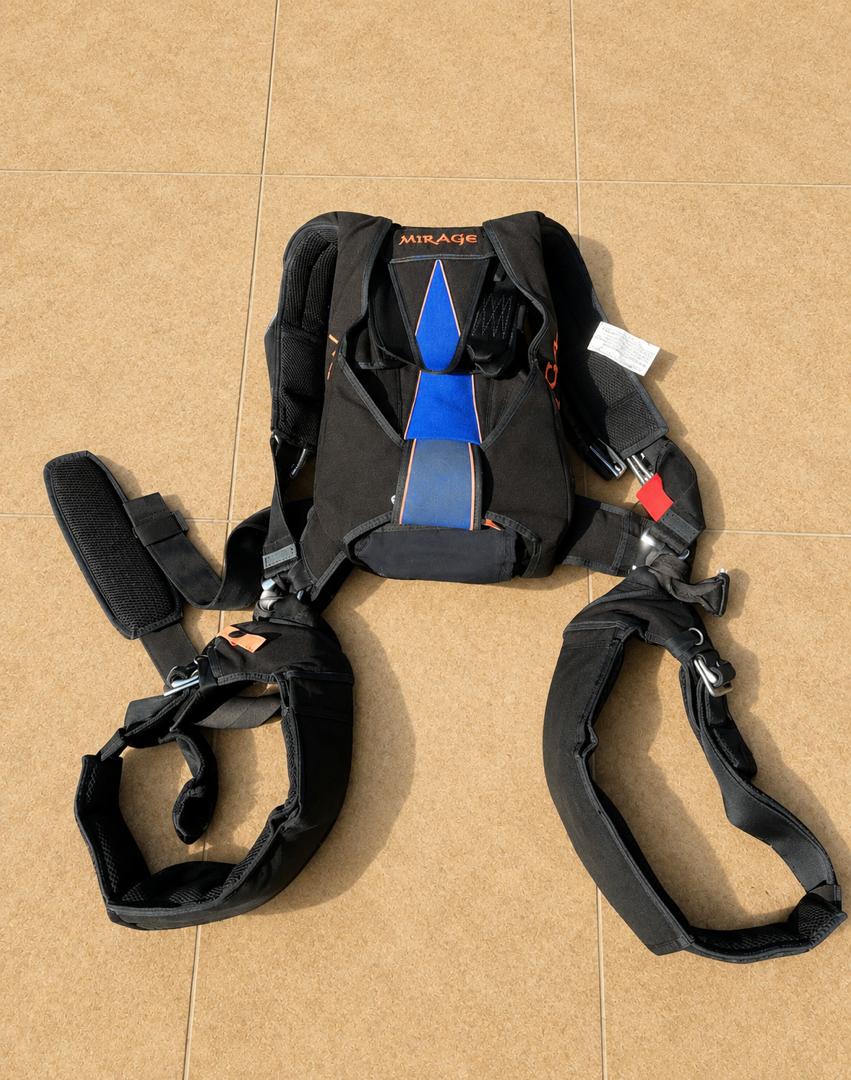
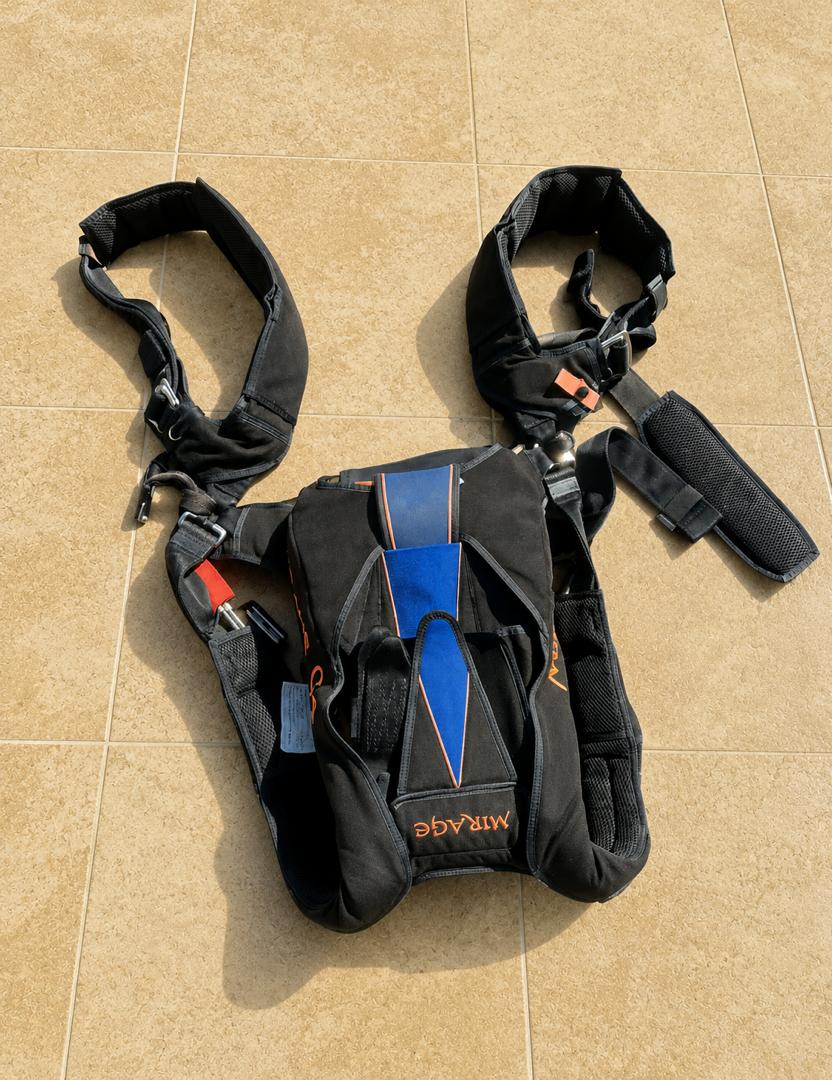
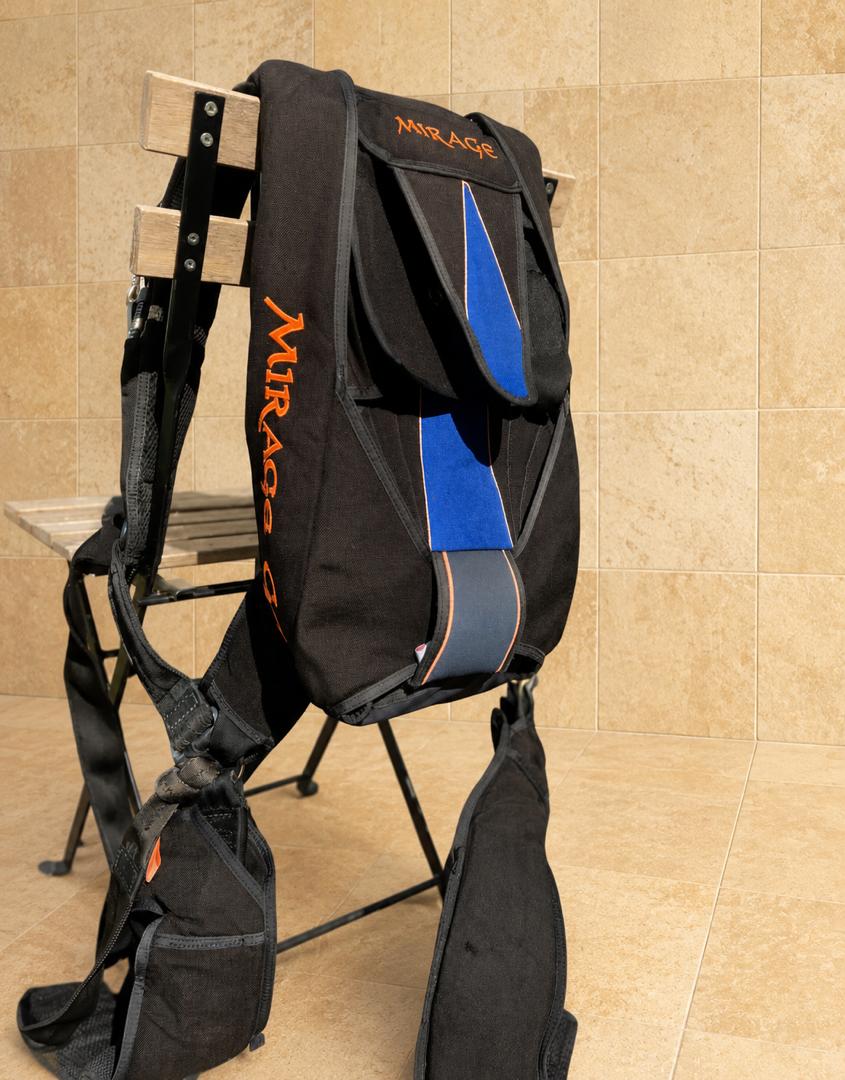
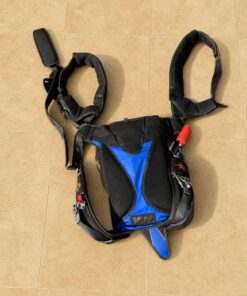
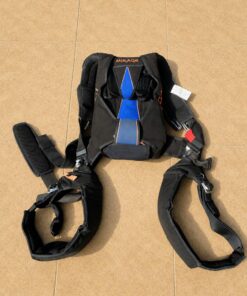
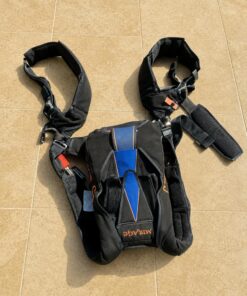


Mirage G4.1 MX 1/2 Container


€600.00
The Mirage G4.1 MX 1/2 Container is a compact harness-and-container system designed for experienced skydivers who want a close-fitting, streamlined rig capable of accommodating smaller main and reserve canopy combinations. The MX size belongs to the smaller end of the Mirage sizing range, making correct canopy selection, harness measurements, and professional compatibility checks particularly important.
Mirage developed the G4.1 platform around secure container geometry, dependable deployment architecture, durable harness construction, and a clean profile suited to modern sport skydiving. The system combines the main container, reserve container, harness assembly, deployment components, closing system, riser protection, and emergency-handle arrangement into one integrated platform.
Because the MX 1/2 is a compact configuration, it should not be selected solely because a jumper prefers the appearance of a smaller rig. The main and reserve canopies must physically match the intended pack volumes, and the harness itself must match the jumper’s body dimensions.
Compact MX 1/2 Configuration
The MX 1/2 configuration is particularly relevant to jumpers using relatively small canopy combinations.
Historical used examples show MX 1/2 systems configured with compact reserves and small high-performance main canopies. For example, one documented complete system used an Optimum 113 reserve with a Leia 74 main. That example demonstrates the compact nature of this container size, although it should not be treated as a universal compatibility specification.
Canopy pack volume changes significantly between manufacturers and designs. Fabric type, line type, age, construction method, and canopy condition can all affect how tightly a particular wing packs.
Consequently, the exact main and reserve combination should always be checked against Mirage sizing guidance and confirmed by a qualified rigger.
Harness Construction and Fit
One of the most important aspects of any Mirage system is harness fit.
The harness should follow the jumper’s torso closely while providing secure support through the shoulders, main lift web, chest area, waist, and leg straps.
Correct fit influences much more than comfort.
It affects container position, emergency-handle accessibility, movement during freefall, load distribution after deployment, and the stability of the complete system.
A used MX 1/2 should therefore be evaluated using its actual harness measurements instead of relying only on the previous owner’s height and weight.
Mirage systems have been offered with articulated harness arrangements and stainless-steel hardware, while Mirage documentation also identifies different harness configurations and sizing adjustments.
Secure Main Container Design
The main compartment is designed to hold the deployment bag securely while maintaining controlled extraction during deployment.
Correct pack volume is essential.
If an oversized canopy is forced into a small container, closing pressure can become excessive. This may distort the flaps, increase wear, complicate packing, and affect the intended deployment geometry.
Conversely, an excessively small canopy can create insufficient container tension.
The correct setup should produce a properly shaped container without forcing the closing system beyond its intended range.
Reserve Container Integration
The upper section of the system houses the reserve assembly.
This area works with the reserve deployment bag, pilot chute, closing loop, reserve handle, reserve ripcord, and any approved emergency-device components.
The Mirage owner documentation emphasizes that only compatible canopies and appropriate system components should be used. Mirage specifically advises owners to confirm compatibility when there is uncertainty.
Reserve installation, inspection, and repacking must be performed according to applicable regulations by appropriately qualified personnel.
For a used container, the reserve tray should also be checked for previous repairs, excessive wear, damage around flap edges, closing-loop condition, pilot-chute condition, and compatibility with the intended reserve.
Deployment Bag Options
Mirage documentation identifies Standard, Split, and Semi-Stowless main deployment bag arrangements for the G4.1 family.
These designs primarily differ in how suspension lines are managed and stowed before deployment.
Therefore, a used system should be inspected to determine exactly which deployment bag is included rather than assuming that all G4.1 rigs use the same configuration.
The bag should match the container size and intended canopy volume.
Main Pilot Chute and Bridle
The pilot chute initiates the main deployment sequence, so its condition is important.
Fabric, mesh, centerline, handle attachment, stitching, bridle condition, and overall retention should be inspected periodically.
The pilot chute should sit securely in its pouch while remaining accessible for normal deployment.
Likewise, the bridle should be routed correctly and should remain free from significant abrasion, heat damage, cuts, or weakened stitching.
A stretched pouch or worn deployment component may require professional attention.
Mirage G4.1 MX 1/2 Container – Compact Harness-Container Design, Freefly Security and Proven Mirage Engineering
The Mirage G4.1 MX 1/2 Container is a compact harness-and-container system from Mirage Systems, designed for experienced skydivers who require a streamlined rig with secure riser and pin protection, configurable harness sizing, reserve integration, and compatibility with appropriately sized main and reserve canopies. The MX 1/2 designation refers to a compact configuration within the older G4.1 family, and historical listings show the size being used with very small high-performance mains and compact reserve systems.
Because this is a container rather than a complete parachute rig, exact suitability depends on the specific harness measurements, main canopy, reserve canopy, automatic activation device, deployment system, and rigger approval. Mirage continues to emphasize canopy compatibility and harness sizing across its current systems, including stabilizer, yoke, main lift web, leg-pad, riser, and reserve-system choices used Mirage G4.1 MX 1/2 Container.
Why the MX 1/2 Size Matters
The compact MX 1/2 configuration is intended for relatively small canopy packages.
A documented G4.1 MX 1/2 complete system has been paired with an Optimum 113 reserve and a Leia 74 main, illustrating the highly compact canopy range that may be associated with this size.
However, this should never be treated as a universal compatibility chart.
Actual pack volume varies according to canopy model, fabric type, age, line type, and packing characteristics. A qualified rigger and Mirage compatibility guidance should therefore be used before installing any main or reserve canopy.
Harness Fit and Comfort
Harness fit is one of the most important factors when evaluating a used container.
Mirage sizing takes into account the main lift web, leg pads, stabilizer length, yoke, waist, chest, height, weight, and body proportions. Current Mirage documentation also notes that stabilizers are sized in half-inch increments and that yoke extensions can significantly affect shoulder comfort.
A container may technically fit the correct canopies while still fitting the jumper poorly.
Therefore, measurements should be checked rather than relying only on the previous owner’s height or weight.
Everest Skydive and High-Altitude Search Interest
Terms including everest skydive, mount everest skydiving, mount everest skydive, skydiving from mount everest, skydiving in nepa, skydiving in nepal, nepal skydiving, and everest parachute jump refer to specialized high-altitude jumping experiences rather than features of this container.
Likewise, gunung everest, mt everest kathmandu, highest skydiving place in the world, highest skydiving in the world, top 10 highest skydive in the world for public, sky diving in world, and paragliding mount everest are destination or altitude-related search topics.
Anyone asking what altitude do you skydive from should follow the procedures of the specific drop zone and operation because aircraft, oxygen requirements, training standards, and local regulations vary.
Nepal and Pokhara Skydiving Searches
The phrase skydiving in nepal pokhara price relates to travel and operator pricing rather than the physical specification of the container.
A personal system used internationally may also be subject to local documentation, reserve repack, equipment, and licensing requirements.
Therefore, before traveling, the jumper should confirm the policies of the intended drop zone and local aviation authority.
United States Skydiving Searches
Keywords such as iskydive miami, iskydive new york city, iskydive los angeles, iskydive dallas fort worth, iskydive nyc, iskydive dallas, homestead skydiving, skydiving in la california, skydiving new york state, skydive america california, parachute jump ny, skydiving charleston sc, and skydiving ventura represent location or drop-zone searches.
Similarly, wishlist skydiving and safest skydiving in the world reflect experience-oriented search intent.
They do not describe factory features of the harness-container system.
Australia Skydiving Searches
Search terms including skydive australia, skydive aus, skydiving australia, sky diving australia, skydive australia airlie beach, skydive airlie beach, parachute jump melbourne, parachute jump australia, skydive byron bay, and cairns skydiving refer to Australian jump locations and operators.
Traveling with a personal system should involve checking reserve repack validity, AAD requirements, local licensing recognition, and drop-zone policies before jumping.
Freefly Security and Riser Protection
The G4.1 family was designed during an era when secure pin protection, riser-cover security, and clean external geometry became increasingly important for freefly disciplines.
Current Mirage systems offer either traditional tuck-tab or magnetic riser covers depending on configuration, along with multiple main-bag, pilot-chute, RSL, and MARD options.
A used G4.1 should be inspected to determine exactly which options are installed rather than assuming that every example has the same configuration.
Reserve System and AAD Compatibility
A reserve canopy and automatic activation device are separate components that must be installed correctly.
Historical and current Mirage systems are designed around compatible reserve containers, freebags, pilot chutes, reserve ripcords, and optional RSL or MARD configurations.
Search terms such as fire parachute and cypress fire skydiving should not be confused with ordinary AAD terminology.
Any installed reserve or electronic activation device should be checked for age, service status, battery requirements, maintenance interval, and compatibility.
Weight Limit Skydiving and Harness Suitability
The phrase weight limit skydiving cannot be answered from container size alone.
Harness fit, certified equipment limits, reserve specifications, canopy loading, body dimensions, and component ratings all matter.
Mirage also distinguishes between standard thin risers and wider riser webbing for heavier users in its current configuration documentation.
The correct system should therefore be evaluated as a complete assembly rather than by container label alone.
Skydiving Helmets and Personal Equipment
A skydiving helmet, skydive helmets, sky helmet skydiving, full face skydiving helmet, sky diving helmet, skydiving helmet full face, and skydiving glasses are separate personal-equipment items.
They are not part of the container unless specifically included by a seller.
Likewise, a hook blade knife, hook knife skydiving, or skydive hook knife is emergency equipment that may be carried in a suitable location.
Current Mirage order documentation even provides an optional hook-knife pocket, demonstrating that such equipment can be accommodated without being integral to every rig.
Tracking, Wingsuit, and Specialized Flying
A tracking jump or wingsuit sport jump can place different airflow demands on external container components.
Searches such as vector wingsuit relate to other equipment families and should not be confused with Mirage products.
Modern Mirage order options include semi-open wingsuit corners and specialized hook-knife pockets, but those features may not be present on an older G4.1.
Any wingsuit-specific use should be evaluated by an experienced rigger and instructor.
BASE and Other Specialized Disciplines
Search terms such as base jumping and baseline jumping describe a separate discipline using specialized equipment.
A conventional dual-parachute skydiving container should not automatically be considered appropriate for fixed-object jumping.
Equipment, deployment methods, risk profiles, and training requirements differ substantially.
The same distinction applies to unusual search phrases such as nude parachute jump, which are unrelated to container engineering.
Linewear, Riser Condition, and Rigging Inspection
Although linewear primarily concerns the main and reserve canopies, risers, 3-ring assemblies, steering components, and webbing should also be inspected.
A professional skydiving rigging inspection should examine harness webbing, stitching, hardware, closing loops, riser covers, pin protection, reserve components, deployment bags, pilot chutes, and previous repairs.
Historical used listings of the MX 1/2 show examples with replacement leg straps, reserve freebags, and pilot chutes, reinforcing the importance of assessing actual component history rather than assuming everything remains original.
Landing Flight Risers and Canopy Control Equipment
The phrase landing flight risers relates to canopy-control hardware and techniques rather than the container itself.
Mirage systems can be configured with different riser widths, lengths, and dive-loop styles, but actual installed risers should be inspected individually.
Advanced canopy-control techniques should always be learned under qualified coaching.
Skydiving Downsizing Chart and Canopy Selection
A skydiving downsizing chart may provide general guidance, but it should never replace professional assessment.
Canopy choice depends on exit weight, jump numbers, currency, landing consistency, environmental conditions, and coaching history.
A compact container capable of holding a small main does not mean the jumper should use the smallest canopy that physically fits.
Container capability and pilot capability are separate questions.
Important Information About the Mirage G4.1 MX 1/2
The most important characteristics of the Mirage G4.1 MX 1/2 are its compact harness-container architecture, small canopy pack-volume range, customizable harness geometry, secure external design, reserve integration, AAD compatibility, and suitability for appropriately experienced skydivers when configured correctly.
Historical listings confirm that MX 1/2 systems have been used with very small high-performance mains and compact reserves, while Mirage documentation emphasizes that canopy compatibility and harness fit must always be verified individually.
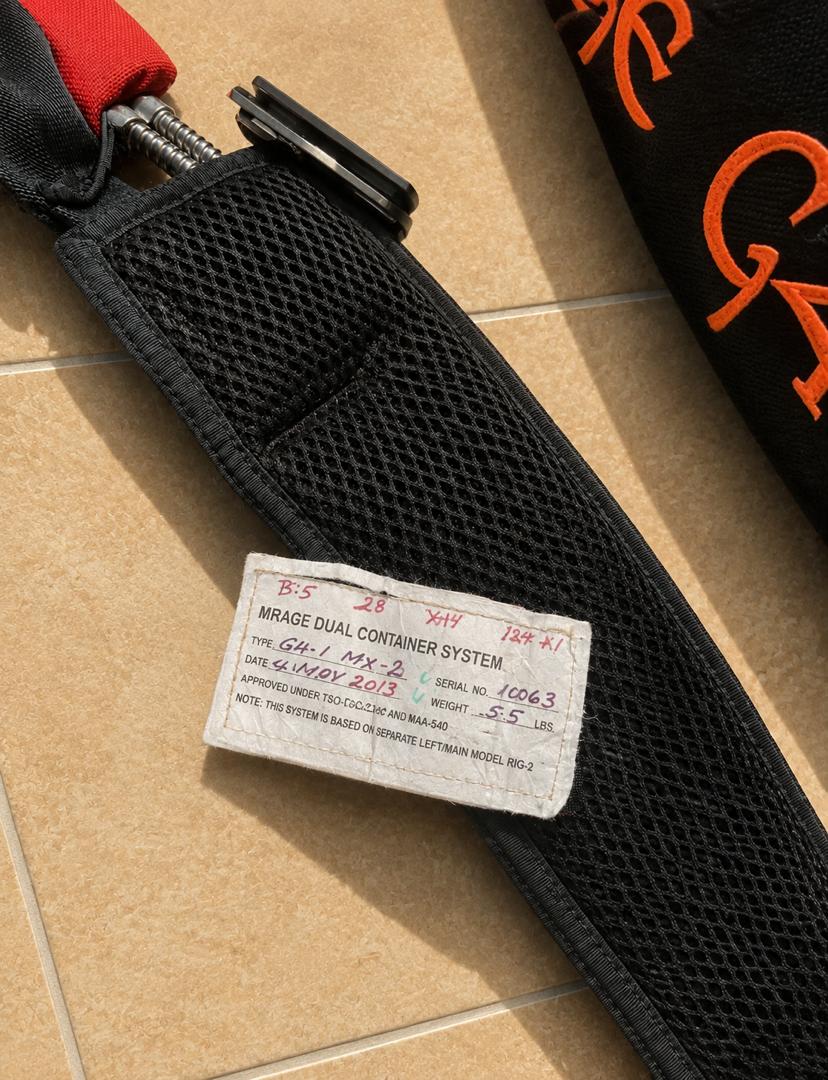
For a used system, the serial number, DOM, jump count, harness measurements, reserve configuration, AAD status, canopy compatibility, repair history, and overall rigging condition should all be checked before purchase or use.
Harness Fit, Container Security, Deployment Architecture, Comfort, and Practical Performance
Harness Fit and Body Geometry
A well-fitted harness-and-container system should distribute load evenly across the shoulders, torso, waist, and legs while remaining secure during freefall, deployment, and canopy flight.
Fit is not determined by height alone.
Torso length, shoulder width, chest dimensions, waist size, leg circumference, and overall body proportions all influence how the system sits on the jumper.
A poorly fitted harness may feel loose in one area and excessively tight in another.
For that reason, measurements should be compared with the original harness specifications whenever possible.
A professional fitting provides much more useful information than simply comparing body weight or clothing size.
Main Lift Web Position
The main lift web has a major influence on overall fit.
If it is too long, the container may sit too low on the back and the harness can feel loose around the torso.
If it is too short, the system may ride too high and create discomfort across the shoulders.
Correct positioning helps keep the rig stable while allowing the jumper to maintain a natural body position.
Any alteration to major harness webbing should only be carried out by appropriately qualified personnel.
Structural webbing is load-bearing equipment and should never be modified casually.
Yoke and Shoulder Comfort
The yoke determines how the upper section of the harness sits across the shoulders.
A properly fitted yoke should feel secure without creating excessive pressure around the neck.
Shoulder comfort becomes especially important during longer jump days because repeated wear can reveal small fit problems that may not be obvious during a brief fitting.
The container should remain centered on the back.
If it consistently shifts to one side, harness fit, adjustment, or body position may need to be evaluated.
Comfort and stability should work together rather than one being sacrificed for the other.
Leg Strap Fit
Leg straps must remain secure throughout the entire jump sequence.
They should be adjusted evenly and positioned so that they do not restrict normal movement unnecessarily.
If one side is tighter than the other, the harness may sit unevenly.
Excessive looseness can also reduce stability.
Webbing condition, hardware, stitching, and padding should be inspected regularly.
Any fraying, damaged hardware, unusual deformation, or questionable stitching deserves professional evaluation.
Because leg straps are structural components, their condition is critical.
Container Profile and Compact Design
A compact container can provide a clean profile when paired with correctly sized internal components.
The goal is controlled containment rather than simply achieving the smallest possible appearance.
A container that is overstuffed may place excessive tension on closing flaps and create packing difficulty.
Likewise, one that is too empty may not maintain the intended shape.
Proper volume matching supports a cleaner exterior profile and more predictable deployment behavior.
This is why compatibility should always be confirmed using actual pack volume rather than nominal canopy area alone.
Main Tray Fit
The main deployment bag should fit the main tray appropriately.
If the canopy package is excessively tight, closing the container may require too much force.
This can affect flap geometry and increase wear.
If the package is too loose, the deployment bag may move more than intended.
The correct balance allows secure closure while preserving intended extraction behavior.
A qualified specialist should evaluate the complete combination when a different canopy is installed.
Pack volume can vary significantly between designs.
Reserve Tray Considerations
The reserve compartment should be treated with even greater care because it forms part of the emergency system.
Reserve size, fabric type, packing volume, freebag configuration, pilot chute, closing loop, and activation-device installation all need to work together correctly.
The reserve compartment should not be treated as adjustable storage space.
Only approved combinations should be used.
Any change to the reserve configuration should be carried out by the appropriately rated specialist according to applicable regulations and manufacturer guidance.
Pin Protection
Secure pin protection is particularly important during high-speed freefall.
The closing flap should protect the pin from accidental contact while still allowing normal deployment.
The flap should remain firmly closed without requiring excessive force.
If the cover begins to open unexpectedly, or if the fit becomes noticeably different, the system should be inspected.
Wear around flap edges, stiffeners, stitching, or closing components can gradually affect security.
Regular inspection helps identify these changes before they become significant.
Riser Cover Security
Riser covers should remain secure during freefall while releasing correctly during deployment.
They should close consistently and sit flush against the container.
If one side repeatedly opens earlier than the other while on the ground, wear or alignment may need attention.
Debris, damaged stiffeners, weakened closure systems, or distortion can affect performance.
Riser covers should therefore be examined during routine packing and gear checks.
Symmetry is particularly important because uneven release can contribute to an untidy deployment sequence.
Pilot Chute and Bridle Routing
The pilot chute and bridle should be routed exactly as intended.
The pilot chute pouch should retain the handle securely while still allowing a smooth extraction.
The bridle should not be exposed unnecessarily.
Incorrect routing can create deployment problems.
For that reason, packing procedures should remain consistent.
Any uncertainty about bridle placement, handle security, or pouch condition should be addressed before jumping.
Deployment components experience regular wear and should be inspected throughout the life of the system.
Closing Loop Condition
The closing loop is a small component with an important role.
It should remain within the correct length range and should not show excessive wear.
A loop that becomes too long may reduce container security.
A loop that is too short can make closing unnecessarily difficult and place additional tension on flaps.
The condition should be checked regularly.
If fraying, glazing, discoloration, or thinning is visible, replacement may be appropriate.
Correct loop length should be established according to the system configuration rather than guesswork.
Handle Security
Deployment and emergency handles should remain secure while also being accessible.
The jumper should be able to locate them consistently without looking.
Handle position should therefore be checked after putting the system on.
Changing clothing thickness can alter how the harness sits, so handle location may feel slightly different between seasons.
Practice touches during routine gear checks can help reinforce consistent awareness.
Loose or poorly seated handles should be corrected before boarding.
Freefall Stability
A properly fitted system should remain stable during belly, back, sit, and other approved body positions within the jumper’s training level.
Excessive movement of the container can indicate poor fit or incorrect adjustment.
A stable rig helps reduce unnecessary shifting of handles, straps, and deployment components.
However, fit should be checked under realistic clothing conditions.
A harness that feels ideal over a thin shirt may behave differently when worn over thick layers.
Adjustment should therefore account for actual operating conditions.
Comfort During Canopy Flight
Harness comfort remains important after deployment.
Load should be distributed across the leg straps and main webbing without creating severe pressure points.
If discomfort appears consistently after opening, fit may require professional evaluation.
The jumper should also be able to reach normal controls without excessive stretching.
A comfortable harness supports better concentration during the canopy flight because attention can remain on traffic, navigation, and landing rather than on unnecessary discomfort.
Inspection Before Each Jump Day
A short visual inspection before the first jump of the day can identify obvious problems.
Webbing, hardware, handles, flaps, pins, covers, closing loops, and visible stitching can all be checked quickly.
This does not replace scheduled professional maintenance.
However, it provides an additional layer of awareness.
Any unexpected change should be investigated before the equipment is used.
Minor issues are easier to address early than after they develop into more serious problems.
Used-System Evaluation
A used harness-and-container system should be assessed as a complete assembly rather than judged only by appearance.
Important factors include manufacture date, jump history, harness alterations, reserve configuration, activation-device compatibility, repair history, hardware condition, webbing wear, and current canopy fit.
Cosmetic condition can provide useful clues, but it should not replace a structural inspection.
A clean-looking system may still contain worn internal components.
Likewise, visible cosmetic wear does not automatically mean the system is structurally unsuitable.
Long-Term Practical Value
A well-maintained used container can provide strong long-term value when it fits the jumper correctly and accommodates appropriate components.
The most important factors are compatibility, structural condition, secure closure, comfortable harness geometry, and professional inspection.
Ultimately, dependable performance comes from correct sizing, careful packing, routine inspection, suitable canopy matching, and responsible maintenance.
When these areas are managed correctly, the system can remain comfortable, secure, and predictable across many future jumps.
Fit Refinement, Packing Consistency, Deployment Readiness, Comfort, and Long-Term Use
Building a Consistent Fit
A harness-container system performs best when the fit remains stable from one jump to the next. Proper fit supports comfort, handle accessibility, body position, and overall security.
The system should sit naturally against the back without excessive movement.
Shoulder position, leg strap tension, chest strap placement, and torso length all contribute to the final fit.
A good setup should feel secure without creating unnecessary pressure points.
When the system is used with different clothing layers, small adjustments may be required.
However, the basic geometry should remain consistent.
Shoulder and Yoke Position
The upper harness should sit comfortably across the shoulders.
If it rides too high, pressure may develop around the neck.
If it sits too low, the system may feel loose and unstable.
The yoke should remain centered.
Uneven shoulder pressure may indicate that the harness is twisted, adjusted incorrectly, or not ideally sized for the jumper.
Before every jump day, the harness should be inspected while worn.
A mirror or qualified gear check can help confirm that the system is sitting evenly.
Leg Strap Adjustment
Leg straps should be adjusted evenly and securely.
They should support the body without causing excessive discomfort.
Uneven adjustment can change the way the harness sits during freefall and under canopy.
The hardware should lie flat without twisted webbing.
Padding should also remain centered around the legs.
If one strap repeatedly loosens or feels different, the buckle, webbing, or adjustment path should be inspected.
Consistent leg strap adjustment supports both comfort and stability.
Chest Strap Position
The chest strap helps maintain harness geometry across the upper torso.
It should sit securely without being excessively tight.
Over-tightening can restrict movement and create discomfort.
A strap that is too loose may allow unnecessary harness movement.
The ideal position depends on the jumper’s body shape and the system’s harness dimensions.
The webbing should lie flat through the hardware.
Twists should be corrected before use.
Handle Accessibility
All handles should remain easy to locate by touch.
The jumper should be able to reach the normal deployment handle and emergency handles without excessive stretching.
Harness fit can influence handle position.
Therefore, any major clothing change should be followed by another gear check.
Practice touches can help reinforce muscle memory.
This is especially useful after a long break from jumping or when using a different system.
Handle accessibility should never be assumed simply because the harness feels comfortable.
Packing Consistency
Consistent packing contributes to more predictable deployment behavior.
The deployment bag, bridle, pilot chute, closing loop, flaps, and riser covers should all be positioned according to the manufacturer’s intended sequence.
The main pack volume should also remain appropriate for the container.
If the package becomes unusually difficult to close, the reason should be identified.
A poor fit between the canopy and container can create unnecessary stress on flaps and closing components.
Likewise, an excessively loose package can affect container shape.
Closing Loop Inspection
The closing loop should be checked regularly.
It should remain at the correct length and should not show excessive wear.
Fraying, glazing, thinning, or visible damage are signs that replacement may be appropriate.
The loop should not be shortened simply to make the container feel tighter.
Closing tension should remain within the intended range.
Excessive tension can place unnecessary load on pins and flaps.
Correct loop condition supports both security and reliable deployment.
Main Pin Security
The main closing pin should sit correctly and remain protected by the cover flap.
It should not be excessively loose or difficult to move.
The bridle should be routed cleanly.
Any visible damage to the pin, bridle, or surrounding fabric should be inspected.
The cover flap should remain closed during normal movement.
If it begins opening unexpectedly, the closure system may require attention.
Pin protection should be checked during every gear inspection.
Riser Cover Condition
Riser covers should stay securely closed during freefall while releasing properly during deployment.
Both sides should appear symmetrical.
If one cover sits differently from the other, the cause should be identified.
Wear, distortion, damaged stiffeners, or weakened closure components can affect security.
The covers should be checked after packing and again before boarding.
Regular observation helps identify gradual changes.
Pilot Chute Condition
The pilot chute should remain clean, undamaged, and correctly packed.
Fabric condition, mesh, stitching, handle attachment, and pouch security all matter.
A worn pilot chute can affect deployment performance.
The handle should remain secure in the pouch while still allowing smooth extraction.
If the pouch becomes stretched or loose, retention may be reduced.
The pilot chute should therefore be inspected periodically as part of the complete deployment system.
Bridle Routing
The bridle should follow the correct routing path.
It should not be twisted or trapped under components where it does not belong.
Clean routing helps reduce the chance of deployment interference.
The bridle should also be checked for abrasion, damaged stitching, or unusual wear.
Because it experiences repeated loading and movement, its condition can change over time.
Any questionable damage should be evaluated before continued use.
Reserve System Readiness
The reserve compartment should remain sealed and maintained according to applicable regulations.
The reserve pin, seal, cable, handle, and container should be inspected during appropriate gear checks.
Only qualified personnel should open or repack the reserve system.
The reserve configuration should remain compatible with the container and harness.
Any change to the reserve canopy, deployment components, or emergency system should be evaluated professionally.
Automatic Activation Device Considerations
An installed electronic emergency device should remain within its service requirements.
Battery status, maintenance intervals, replacement schedules, and mode settings should all be checked according to the manufacturer’s instructions.
The device should not be treated as a substitute for correct emergency procedures.
It is an additional safety layer.
The display and control unit should remain accessible for pre-jump checks.
Any service warning should be addressed before use.
Comfort During Freefall
A properly fitted system should remain stable during freefall.
The container should not shift excessively across the back.
Leg straps should stay in position.
Handles should remain where expected.
If the system moves significantly during routine body positions, harness fit or adjustment may need attention.
A stable fit improves comfort and helps the jumper maintain consistent body position.
This becomes increasingly important during longer training days.
Comfort Under Canopy
After deployment, the harness should distribute load evenly.
Excessive pressure in one area may indicate poor adjustment or unsuitable fit.
The jumper should be able to reach control systems without excessive stretching.
The harness should also allow normal movement while remaining secure.
Repeated discomfort should not simply be accepted.
A fitter or rigger may be able to identify adjustment changes or structural fit issues.
Used Equipment History
A used system should be evaluated with as much history as possible.
Important information includes manufacture date, total jumps, ownership history, repairs, harness alterations, reserve configuration, and previous canopy combinations.
Service records can provide valuable context.
However, written history should still be supported by physical inspection.
A complete inspection can identify wear that may not be documented.
Monitoring Wear Over Time
Wear tends to develop gradually.
Webbing may become fuzzy.
Hardware may show surface marks.
Flap edges can soften.
Closing loops can wear.
Pilot chute fabric may lose its original condition.
These changes do not always mean immediate replacement is required, but they should be monitored.
A consistent inspection routine makes gradual deterioration easier to identify.
Storage Between Jump Days
The system should be stored in a clean, dry environment.
Excessive heat, direct sunlight, moisture, chemicals, and rough surfaces should be avoided.
A gear bag can provide useful protection.
However, damp equipment should not be sealed away for long periods.
Moisture should be allowed to dry appropriately before extended storage.
Good storage habits can significantly extend the useful life of fabric, webbing, and hardware.
Developing Long-Term Familiarity
Familiarity with the system improves confidence.
Over time, the jumper learns how the harness should feel, where every handle sits, how the container closes, and how the deployment system normally looks.
This makes unusual changes easier to recognize.
Ultimately, dependable long-term use comes from correct fit, consistent packing, regular inspection, proper component compatibility, professional maintenance, and disciplined gear checks.
When these habits are maintained, the system is more likely to remain secure, comfortable, and predictable across many future jumps.
Reliability, Inspection, Maintenance, Storage, Safety, and Long-Term Ownership
Long-Term Reliability
A harness-container system can remain dependable for many years when it is inspected regularly, maintained correctly, stored under suitable conditions, and used with compatible components.
Reliability depends on the condition of the harness webbing, stitching, hardware, closing system, deployment components, reserve compartment, handles, riser covers, pilot chute pouch, and internal container structure.
Age alone does not determine serviceability.
A relatively recent system may show significant wear if it has accumulated many jumps, while an older one may remain in excellent condition if it has been used lightly and stored carefully.
For that reason, physical condition should always be evaluated directly.
Why Preventive Inspection Matters
Preventive inspection helps identify small issues before they develop into larger problems.
Frayed webbing, damaged stitching, worn closing loops, weakened elastic, stretched pouches, distorted flaps, or loose hardware may begin gradually.
These changes are easier to manage when they are identified early.
Routine visual checks should therefore become part of normal ownership.
However, personal inspection should not replace formal professional servicing.
Structural components and emergency systems require qualified evaluation.
Harness Webbing Condition
Load-bearing webbing should remain free from cuts, burns, deep abrasion, chemical contamination, and severe fraying.
High-wear areas deserve particular attention.
These include the shoulders, leg straps, chest area, junction points, hardware contact surfaces, and regions where webbing repeatedly moves through buckles.
Slight surface wear may develop naturally over time.
However, structural damage should never be ignored.
If webbing condition is uncertain, the system should be professionally inspected before continued use.
Structural Stitching
Stitching holds many critical components together.
Load-bearing stitch patterns should remain complete and secure.
Broken threads, loose stitching, pulled seams, or visible separation should be investigated.
Cosmetic thread wear does not always indicate structural failure, but the distinction should be made by a qualified specialist when uncertainty exists.
Improvised repairs are not appropriate for structural harness components.
Professional repair methods should follow accepted procedures and manufacturer guidance.
Hardware Inspection
Metal hardware should operate smoothly and remain free from cracks, severe corrosion, deformation, or sharp edges.
Friction adapters, rings, buckles, and connecting hardware should be inspected periodically.
The webbing that passes through these components should also be checked for concentrated wear.
Hardware should not be lubricated casually because inappropriate products can contaminate fabric or attract dirt.
If movement becomes unusual or corrosion develops, professional evaluation may be necessary.
Closing Loop Condition
The closing loop is a small but important component.
It should remain within the correct length range and should not show excessive wear.
Fraying, thinning, glazing, discoloration, or visible damage may indicate that replacement is appropriate.
A loop that becomes too long can reduce closure security.
A loop that is too short can make packing unnecessarily difficult and place additional tension on flaps and pins.
Correct length should be established according to the specific configuration.
Main Closing Pin Inspection
The main pin should remain smooth, secure, and correctly routed.
Its surrounding bridle and protective flap should also be inspected.
The pin should not show deep scratches, sharp edges, deformation, or corrosion.
The cover flap should remain closed under normal movement.
If the pin becomes unusually loose or difficult to move, the reason should be identified before use.
Deployment components work as a system, so one small change can influence overall behavior.
Riser Cover Condition
Riser covers should remain securely closed while packed and release correctly during deployment.
Both sides should sit evenly.
Wear around stiffeners, tuck areas, magnets, stitching, or flap edges may gradually affect closure security.
If one side repeatedly sits differently from the other, inspection is appropriate.
The covers should be checked during packing and before the first jump of the day.
Consistent symmetry helps maintain a clean deployment sequence.
Pilot Chute Pouch and Handle Security
The pilot chute pouch should provide secure retention without making extraction excessively difficult.
Over time, pouch material can stretch.
If retention becomes weak, the handle may sit less securely.
The handle attachment, pilot chute fabric, mesh, stitching, and bridle connection should also be inspected.
Any unusual looseness, damage, or abrasion deserves attention.
The complete deployment assembly should remain clean and protected from unnecessary contamination.
Bridle Condition
The bridle experiences repeated loading and friction.
It should be checked for abrasion, damaged stitching, heat damage, cuts, and contamination.
Routing should remain clean and consistent.
Twists or incorrect placement can interfere with normal deployment.
Any unusual wear pattern should be evaluated.
A worn bridle should not be ignored simply because it continues to function during normal packing.
Reserve Compartment Care
The reserve compartment is a critical emergency system.
It should only be opened, inspected, packed, or serviced by appropriately qualified personnel under applicable regulations.
The reserve pin, cable, handle, freebag, pilot chute, closing loop, and surrounding container should all remain in proper condition.
Required repack intervals should be followed.
Any change to the reserve configuration should be evaluated for compatibility before the system is returned to service.
Emergency Device Maintenance
If an electronic activation system is installed, service intervals, battery requirements, replacement dates, and manufacturer recommendations should be followed carefully.
The control unit should be checked before use.
Any warning or service indication should be taken seriously.
The device provides an additional layer of protection, but it should never replace proper emergency training or equipment awareness.
Its installation should also remain compatible with the reserve compartment.
Harness Fit Over Time
Fit can change over time because the jumper’s body weight, clothing, or equipment configuration may change.
A system that fit correctly several years earlier may no longer sit the same way.
Shoulder position, leg strap fit, chest strap placement, and handle access should therefore be reassessed periodically.
Repeated discomfort should not simply be accepted.
A professional fitting can help determine whether adjustment or alteration is appropriate.
Canopy Compatibility
Main and reserve compatibility should be checked whenever a canopy is changed.
Pack volume varies between designs even when the stated surface area appears similar.
Fabric type, line type, canopy age, and construction can influence packed volume.
An excessively tight fit can place unnecessary stress on closing components.
An excessively loose fit can also affect deployment behavior.
The intended configuration should therefore be confirmed before regular use.
Repair History
A used system should have its repair and alteration history reviewed whenever possible.
Approved repairs may be completely acceptable when completed correctly.
However, the buyer should understand what was changed and why.
Harness resizing, replaced webbing, new leg straps, container repairs, or emergency-system modifications should all be documented where possible.
Unknown alterations deserve professional inspection.
Clear maintenance history improves long-term ownership confidence.
Proper Storage Conditions
Storage has a significant effect on long-term condition.
The system should be kept in a cool, dry environment away from direct sunlight, excessive heat, moisture, oils, fuel, solvents, and harsh chemicals.
Long-term storage inside a hot vehicle should be avoided.
A protective gear bag can reduce dust and physical damage.
However, damp equipment should not be sealed inside a bag for extended periods.
Moisture should be allowed to dry appropriately before storage.
Transport Protection
During transport, the system should be protected from sharp objects, crushing loads, contamination, and excessive heat.
Heavy items should not be stacked on top of the container.
Care should also be taken around fuel containers, batteries, chemicals, and dirty equipment.
Small amounts of chemical contamination can be more serious than ordinary cosmetic dirt.
A dedicated gear bag offers useful protection during travel.
Pre-Jump Inspection Routine
A short inspection before the first jump of the day can identify obvious problems.
Handles, pins, covers, webbing, hardware, closing loops, and visible stitching should be checked.
The jumper should also confirm that the system is fitted correctly.
A second person can provide an additional gear check when appropriate.
This routine does not replace professional inspection, but it adds another layer of awareness.
Building a Strong Ownership Routine
Good long-term ownership comes from consistent habits.
Before use, fit, handles, pins, covers, webbing, and general condition can be checked.
During operation, unusual movement or changes in fit should be noticed.
Afterward, the system should be protected from moisture, heat, dirt, and rough handling.
Professional servicing should be completed when required.
Ultimately, dependable long-term performance comes from correct fit, proper component compatibility, disciplined inspection, careful storage, professional maintenance, and respect for the system’s structural and emergency functions.
When these habits remain consistent, a well-maintained harness-container system can remain secure, comfortable, and dependable across many future jumps.
Be the first to review “Mirage G4.1 MX 1/2 Container”
Related products

used products

used products
used products


used products

used products

used products
used products
used products
Reviews
There are no reviews yet.