
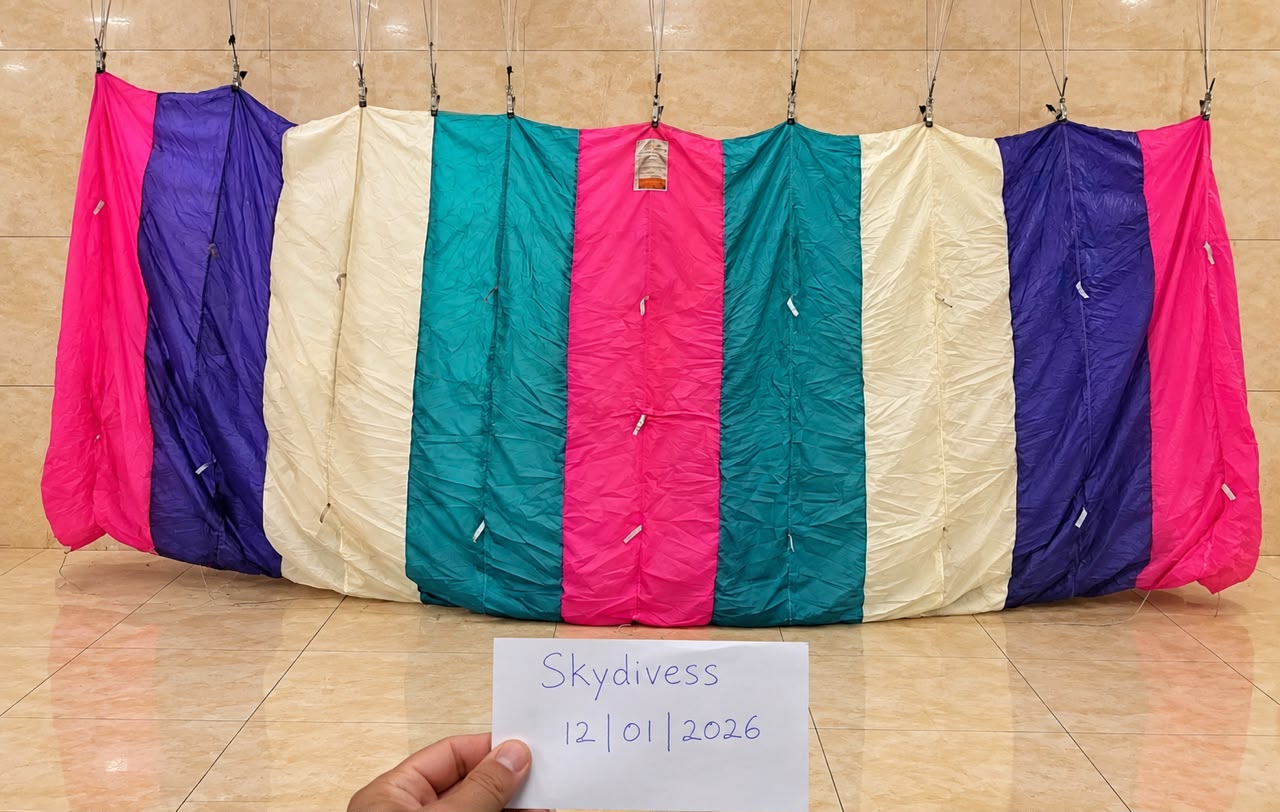
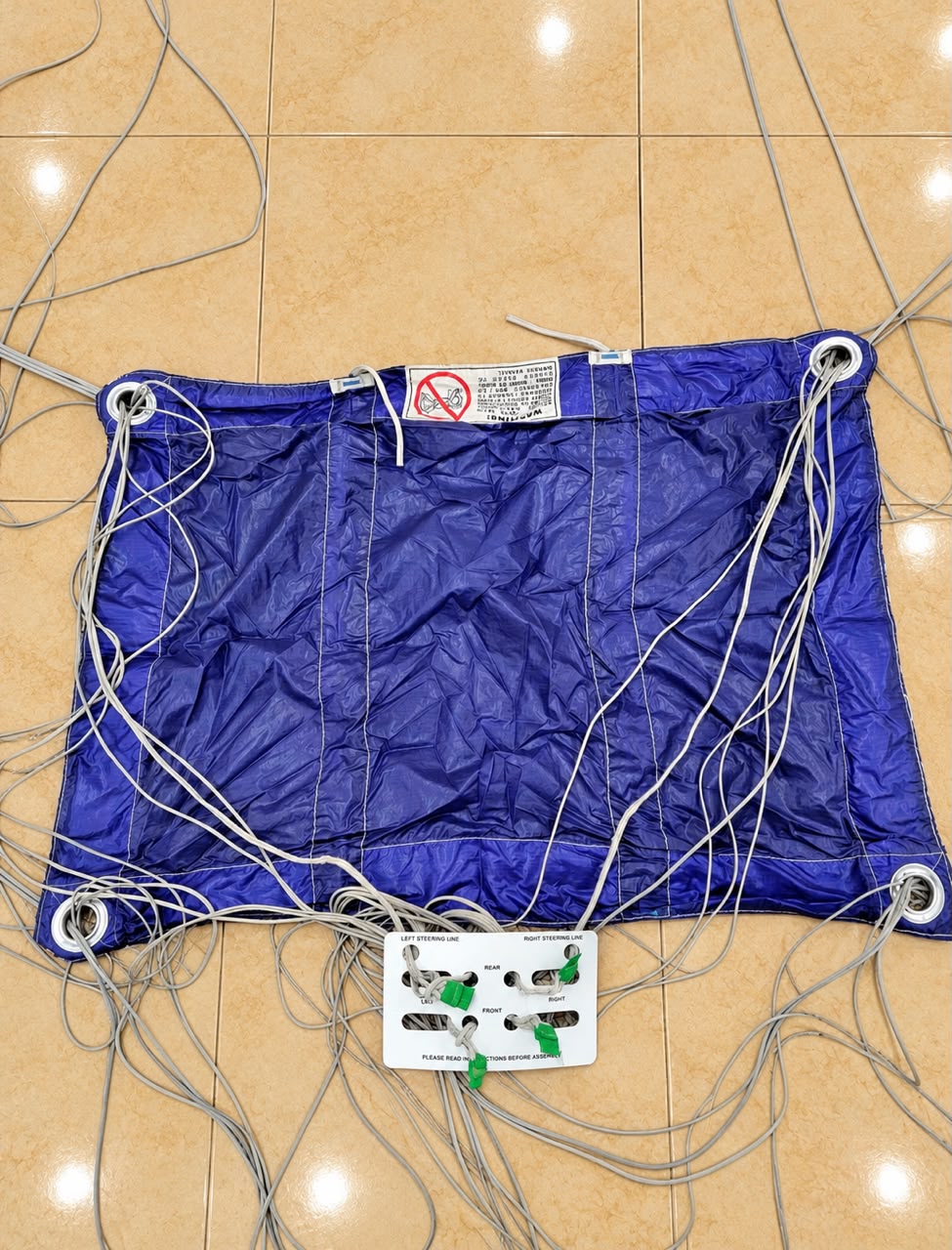
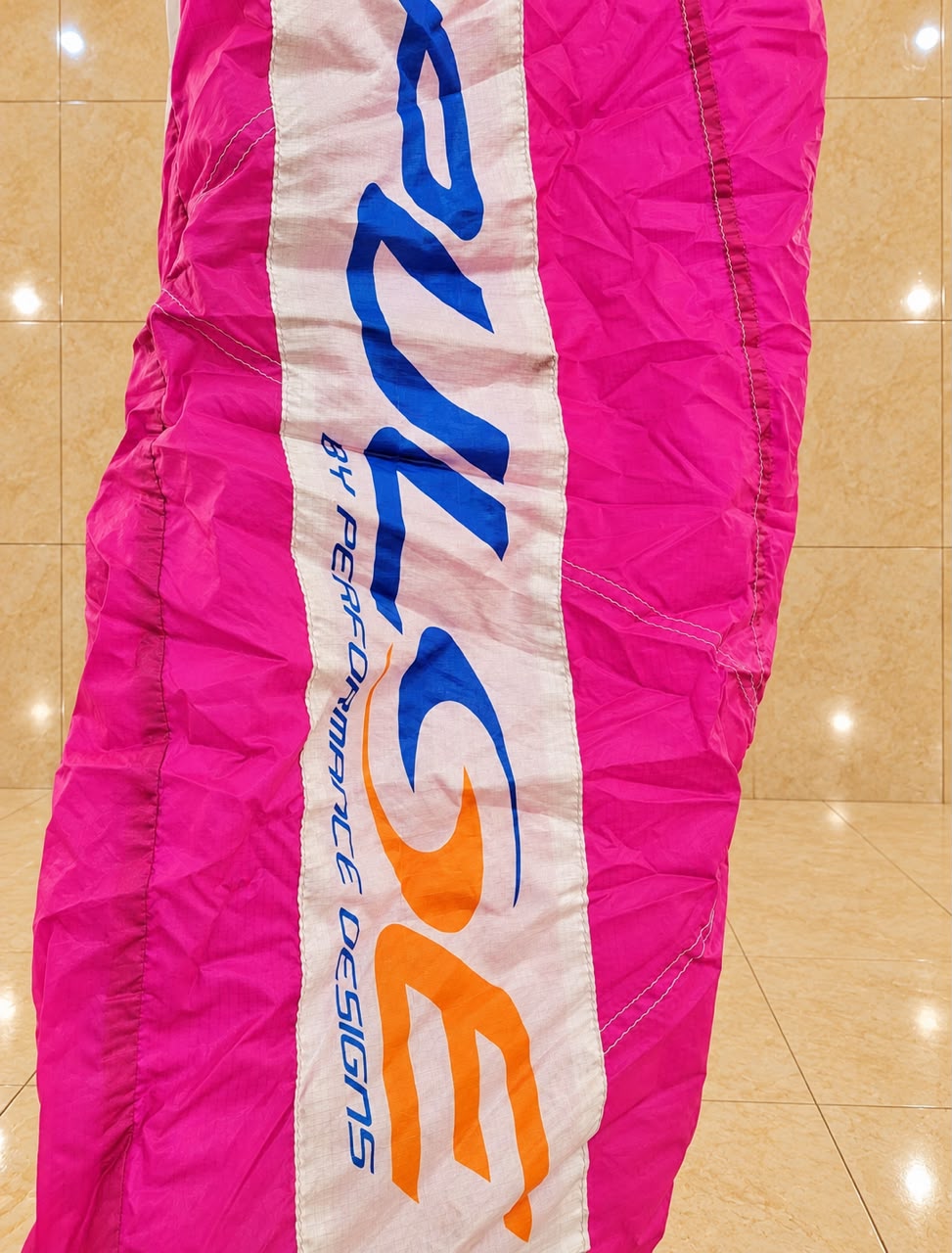
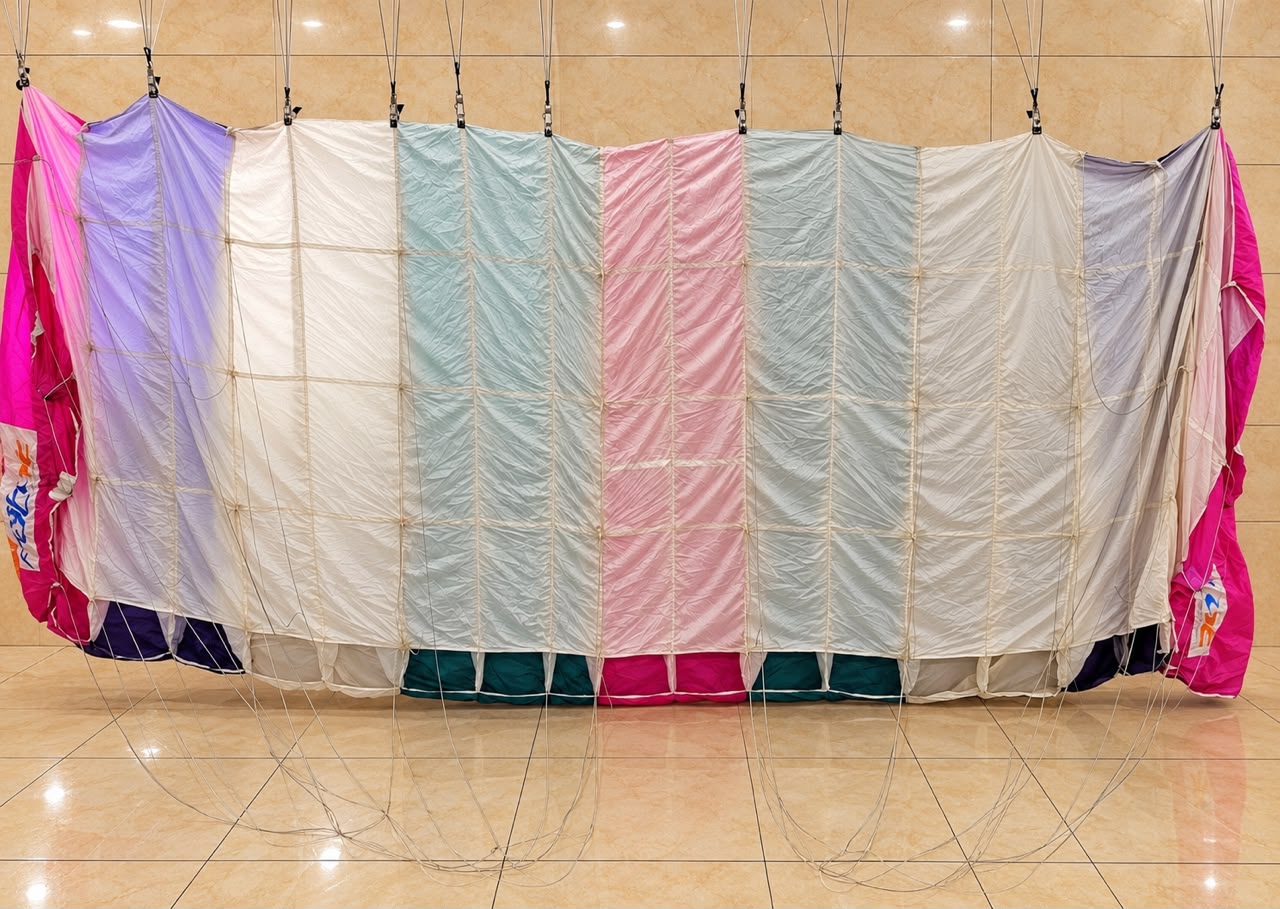

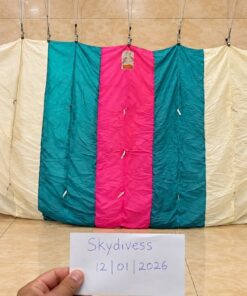



Used PD Pulse 150

€1,000.00
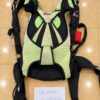
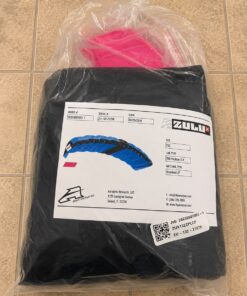
Used PD Pulse 150 – Performance Designs Low-Pack-Volume Skydiving Canopy
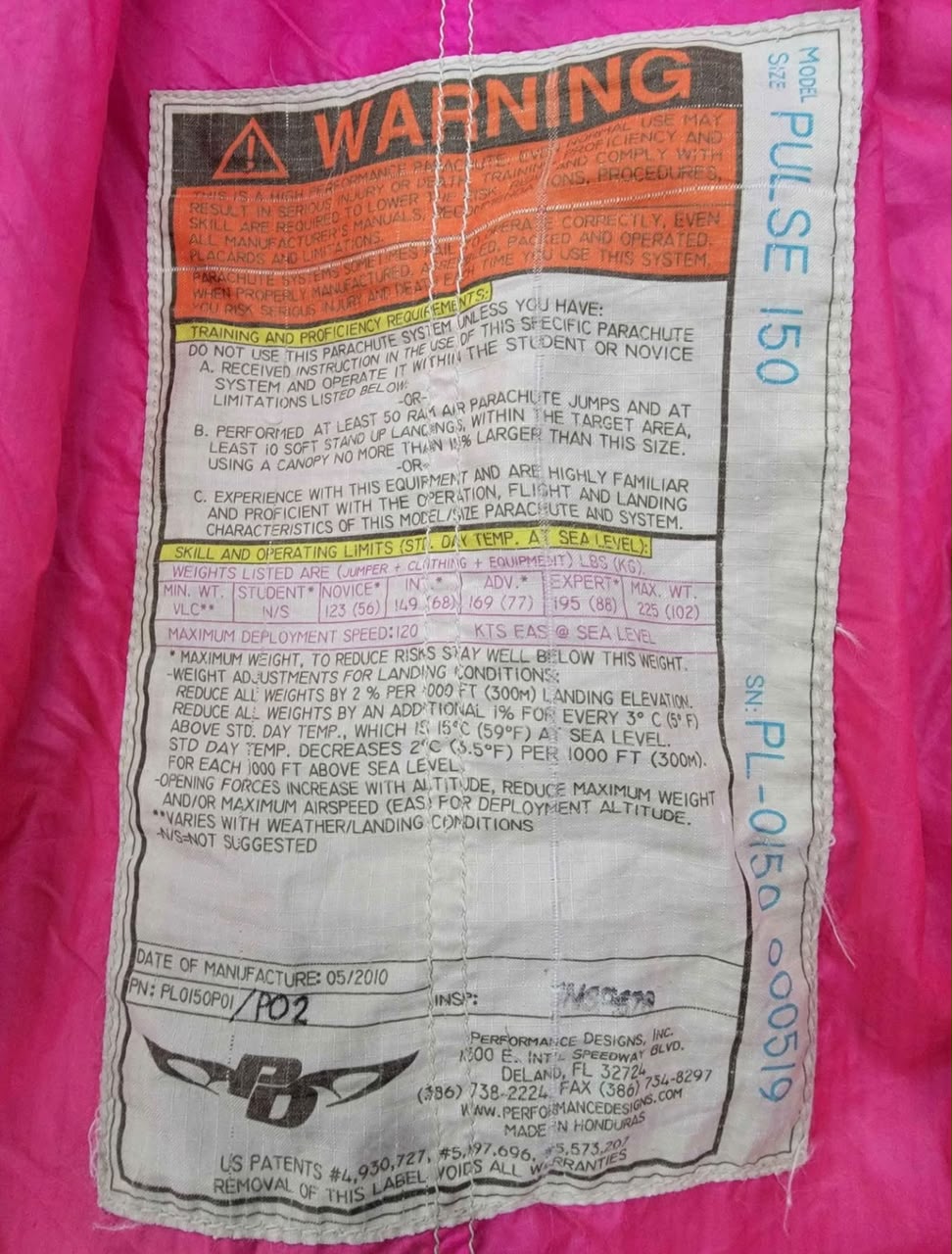
The Used PD Pulse 150 is a premium 9-cell main parachute designed for smooth openings, efficient glide and responsive canopy flight. Manufactured by Performance Designs, this lightweight canopy features advanced low-bulk fabric technology, allowing its 150 sq. ft. design to pack approximately like a conventional 135 sq. ft. canopy.
Key Features & Specifications:
- Brand: Performance Designs (PD)
- Model: Pulse 150
- Canopy Size: 150 sq. ft.
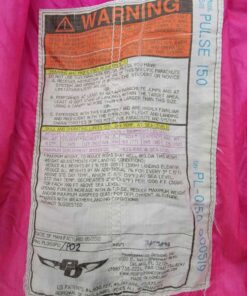
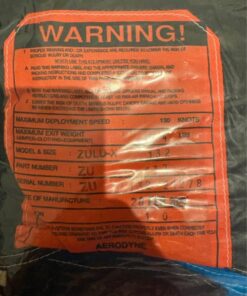
- Date of Manufacture: May 2010
- Condition: Used, with disclosed fabric wear
- Design: 9-cell, lightly elliptical canopy
- Fabric: Zero-porosity upper surface and low-bulk bottom skin
- Packing Volume: Approximately equivalent to a conventional 135 sq. ft. canopy
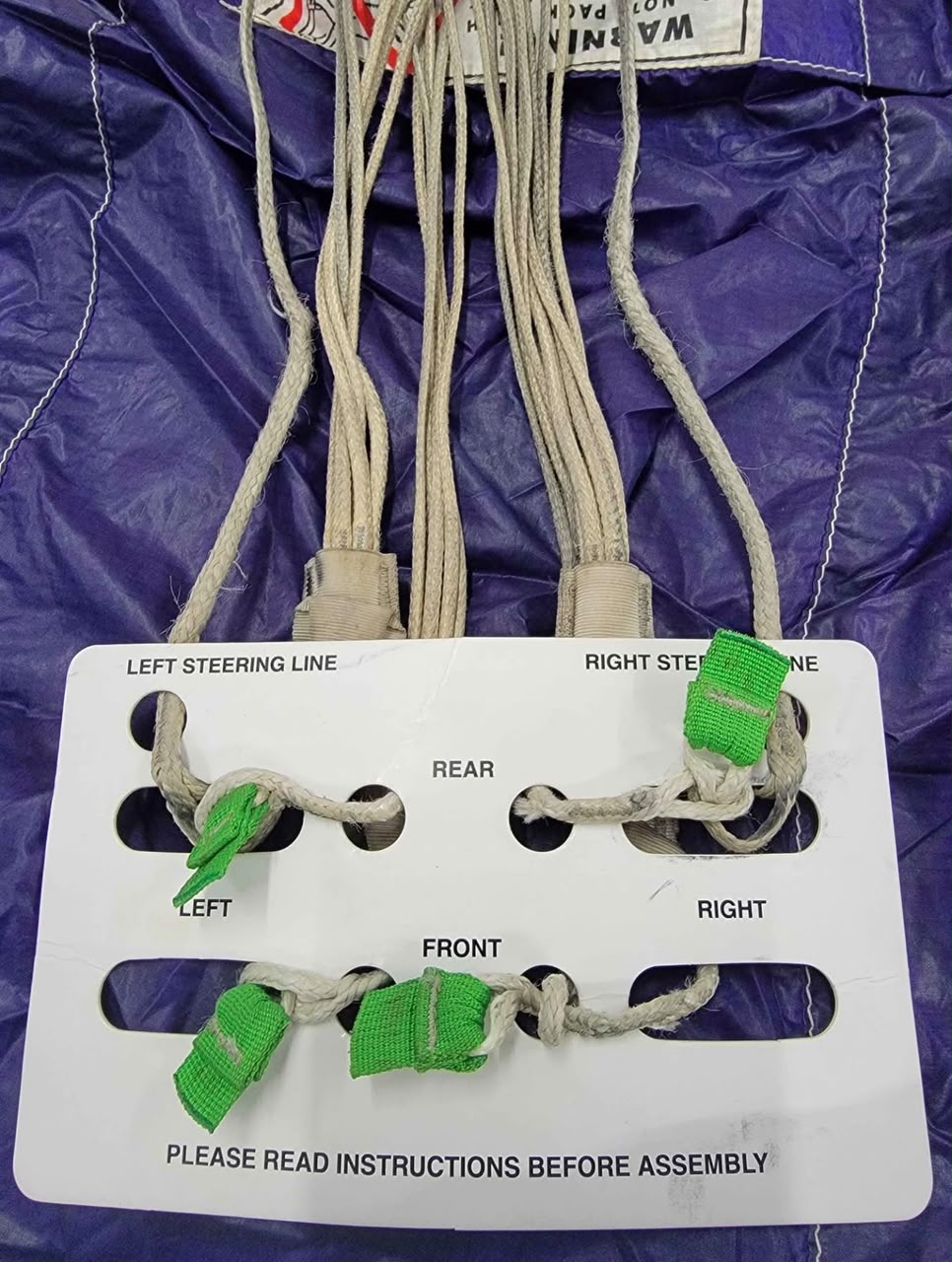
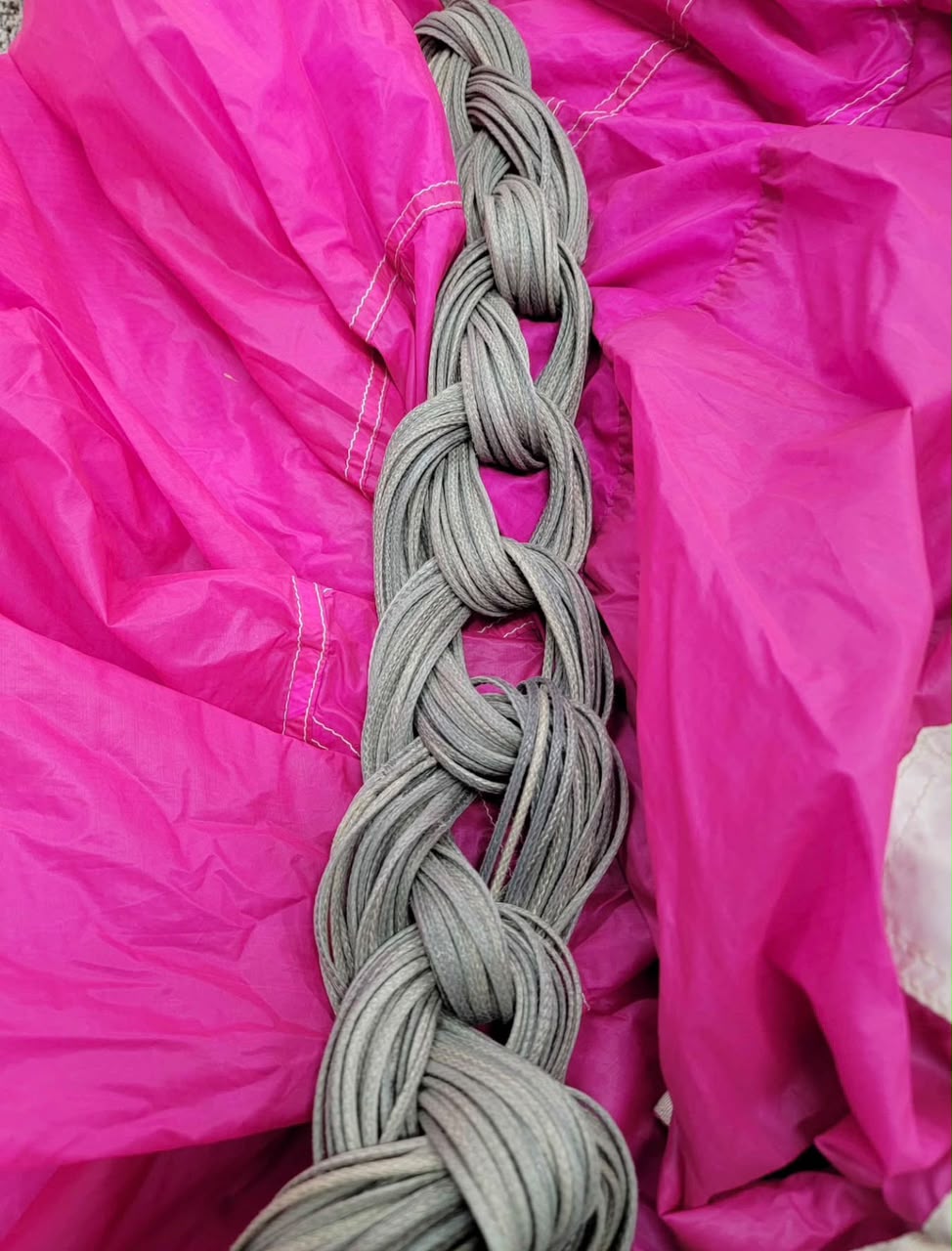
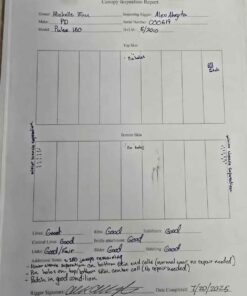
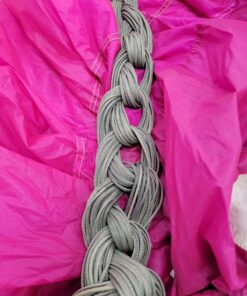
- Lineset: Approximately 170 jumps
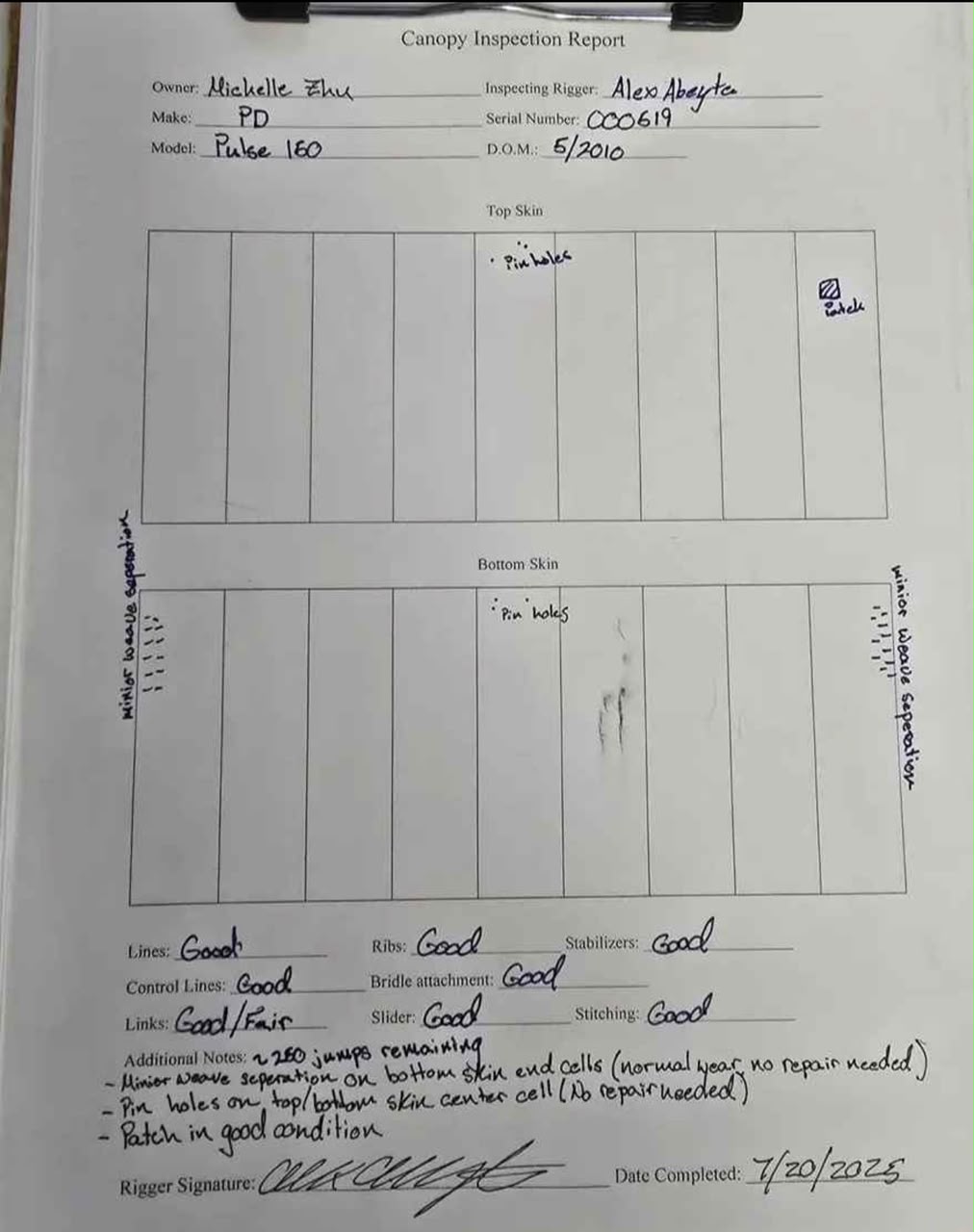
- Repairs: One professionally completed patch on the right side
- Fabric Condition: Minor weave separation on the bottom skin and small pinholes near the tail
- Inspection: Independent rigger report dated July 2025
- Repair Status: No additional repairs were reportedly required at the July 2025 inspection
The PD Pulse 150 combines compact packing, established aerodynamic engineering and enjoyable flight characteristics. Its disclosed maintenance history makes it a practical option for experienced buyers seeking a pre-owned Performance Designs canopy.
An updated professional inspection, container compatibility assessment are done and good to go.
Used PD Pulse 150 – Performance Designs Low-Pack-Volume Main Parachute Canopy with Smooth Openings, Flat Glide and Premium Aerodynamic Engineering
Used PD Pulse 150 – Advanced Canopy Engineering, Low-Bulk Fabric, Flight Performance, Condition and Skydiving Equipment Compatibility
Used PD Pulse 150 – Premium Performance Designs Main Parachute
The Used PD Pulse 150 is a nine-cell, lightly elliptical main parachute developed by Performance Designs for recreational skydivers who appreciate reduced packing volume, relatively flat glide characteristics and predictable opening behavior.
Manufactured in May 2010, this pre-owned canopy features a zero-porosity upper surface combined with proprietary low-bulk fabric used throughout much of its remaining construction Used PD Pulse 150 canopy.
Furthermore, the particular canopy is reported to pack similarly to a conventional 135-square-foot full-ZP parachute, despite having a nominal area of 150 square feet.
The manufacturer’s design emphasizes soft, generally on-heading openings, a shorter snivel, responsive handling and an efficient glide.
With approximately 170 jumps on its current lineset, this example offers documented condition information for buyers researching used parachute equipment.
However, its age and disclosed fabric imperfections make an updated professional inspection particularly important.
Used PD Pulse 150 Condition – DOM, Professional Patch, Weave Separation and Rigger Report
Understanding the actual condition of a pre-owned canopy is essential before making a purchasing decision.
Product Specifications and Reported Condition:
-
Manufacturer: Performance Designs
-
Model: Pulse 150
-
Type: Main ram-air parachute
-
Canopy area: 150 square feet
-
Date of manufacture: May 2010
-
Construction: Nine-cell, lightly elliptical
-
Upper surface: Zero-porosity fabric
-
Lower surface: Proprietary low-bulk fabric
-
Packing volume: Reportedly comparable to a conventional 135-square-foot canopy
-
Suspension lines: Approximately 170 jumps on the current lineset
-
Previous repair: One professionally completed patch on the right side
-
Reported fabric issue: Minor weave separation on the bottom skin
-
Additional condition detail: Pinholes near the tail
-
Previous inspection: Independent rigger report dated July 2025
-
Repairs: Reportedly none required at the time of that inspection
-
Total canopy jumps: Not provided
-
Current airworthiness: Requires updated professional assessment
The July 2025 rigger report is an important part of the advertised history. Nevertheless, because the inspection occurred more than a year ago, its findings should not be presented as a current airworthiness certification.
Low-Bulk Fabric Construction – Compact Packing and Parachute Rig Compatibility
One of the most distinctive characteristics of the Pulse is its specialized fabric arrangement.
Unlike conventional all-ZP parachutes, the design incorporates Performance Designs’ proprietary low-bulk material across the bottom surface and much of the internal structure.
Consequently, the canopy can occupy substantially less packing volume than a similarly sized full-ZP design.
This feature is especially relevant when researching a parachute rig, skydiving rig, container skydive, parts of a parachute and skydiving rigging.
However, reduced packing volume does not guarantee compatibility with a particular container.
A qualified rigger must assess the exact canopy, container, deployment system and manufacturer’s approved packing-volume range.
Canopy Flight, Skydiving Speed and Aerodynamic Characteristics
The Pulse was developed around a combination of manageable opening characteristics, relatively flat glide and a short recovery arc.
Furthermore, its aerodynamic design distinguishes it from parachutes built primarily around aggressive high-performance flight characteristics.
Skydivers researching canopy flight, skydiving speed, speed sky diving, landing flight risers and skydiving downsizing chart information should understand that individual results vary considerably with wing loading, environmental conditions and experience.
Other related canopy searches include Safire 3, Fluid Wings, CRW skydiving and smallest canopy.
However, these terms represent different equipment designs or disciplines and should not be treated as interchangeable specifications.
Suspension Lines, Linewear and Previous Maintenance
The current lineset reportedly has approximately 170 jumps.
This information provides a useful starting point for evaluating maintenance history.
Nevertheless, linewear depends on more than jump count. Material condition, installation quality, previous handling and environmental exposure also matter.
Furthermore, the manufacturer’s standard configuration uses Vectran suspension lines, although the material installed on this particular used canopy should be confirmed through inspection.
The condition of the fabric, attachment points, seams and existing patch should also be reviewed.
Wingsuit Sport, Tracking Jump and Specialized Flight Equipment
The wider skydiving community includes participants interested in tracking jump, wingsuit sport, wingsuit, vector wingsuit, gliding suit wingsuit and skydiving gliding suit equipment.
Additional searches include fly suits, wing suits for sale, indoor wingsuit, tandem wingsuit, price of wingsuit and skydiving tube.
The manufacturer’s compact-packing technology and opening characteristics have made the Pulse a consideration for some suitably qualified wingsuit flyers.
However, equipment selection for specialized disciplines requires professional evaluation.
Similarly, base jumping, baseline jumping, base canopy and jumper pilot searches concern activities with different operational requirements.
Skydiving Helmet, Emergency Equipment and Essential Accessories
Protective equipment is another important part of responsible skydiving participation.
Popular searches include skydiving helmet, skydive helmets, sky helmet skydiving, sky diving helmet, full face skydiving helmet and skydiving helmet full face.
Related equipment includes the Cookie G4 helmet, G35 helmet, skydiver goggles and skydiving glasses.
Questions such as can you wear glasses while skydiving should be addressed according to the chosen protective equipment and the requirements of the drop zone.
Meanwhile, searches for hook blade knife, hook knife skydiving, skydive hook knife, freefly pud handle, fire parachute and cypress fire skydiving concern emergency equipment or deployment-system components.
A gear bag skydive search may help identify suitable storage accessories, while a complete skydiving equipment list should reflect the requirements of qualified instructors and equipment specialists.
International Skydiving Destinations and Recreational Opportunities
Skydiving enthusiasts frequently research parachute jump Australia, Skydive Byron Bay, Cairns skydiving and weight limit skydiving when exploring different recreational opportunities.
Other popular destination searches include Skydive Belize, skydiving Blue Hole Belize and iFLY Colorado Springs.
Online interests such as new skydive, #skydiving latest and skydiving website often concern sporting news and equipment developments.
Meanwhile, niche searches including nude parachute jump and skydiving nude describe activities unrelated to the canopy’s technical construction.
Regardless of destination, equipment eligibility remains subject to local requirements and qualified professional inspection.
Why Choose This Used PD Pulse 150 Main Canopy?
The Used PD Pulse 150 combines an established Performance Designs airfoil, specialized low-bulk construction and a detailed description of its present known condition.
Its compact packing characteristics distinguish it from many conventional full-ZP canopies. Furthermore, the reported 170-jump lineset and disclosed professional patch provide useful maintenance context.
Although the July 2025 inspection reportedly identified no repairs as necessary, the minor weave separation and tail pinholes must be reassessed before use.
For a suitably qualified skydiver whose equipment and experience are compatible, this canopy offers an opportunity to acquire a distinctive low-pack-volume design with a transparent history.
The Used PD Pulse 150 is best evaluated for its proven model characteristics, disclosed maintenance history and potential long-term value, subject to updated airworthiness inspection and professional approval.
Advanced Aerodynamic Engineering, Premium Fabric Construction, Exceptional Flight Characteristics, Long-Term Durability and Professional Ownership Benefits
Understanding the Importance of Advanced Parachute Engineering
A high-quality main parachute represents the successful integration of aerodynamic research, textile technology, structural engineering and manufacturing precision. Every component contributes to the overall characteristics of the equipment, from the external fabric surfaces to the internal supporting structures and suspension lines. Furthermore, the relationship between these components determines how the complete canopy behaves during deployment, flight and descent.
Modern parachute engineering has progressed considerably through developments in lightweight materials, manufacturing technology and aerodynamic design. Consequently, manufacturers can produce specialized equipment that combines carefully considered flight characteristics with practical features such as reduced packing volume.
However, the quality of a parachute cannot be evaluated through one feature alone. Fabric condition, construction accuracy, suspension-line integrity and compatibility with the complete equipment system remain equally important.
A well-engineered canopy must satisfy demanding structural requirements while maintaining its intended aerodynamic shape. This requires careful coordination between design teams, material suppliers and manufacturing specialists.
Furthermore, production consistency is essential because small differences in component dimensions or material characteristics can influence the finished product.
For experienced enthusiasts, advanced parachute engineering offers an appealing combination of technical sophistication and traditional sporting craftsmanship.
Nevertheless, equipment suitability must always be established through qualified professional assessment, particularly when purchasing a previously owned canopy.
The Relationship Between Aerodynamic Design and Flight Performance
Aerodynamic design plays a central role in the development of ram-air parachutes. The shape of the inflated canopy influences the movement of air around its surfaces, creating forces that determine its flight characteristics.
Lift and drag are particularly important considerations. Although these forces are commonly discussed separately, they interact continuously throughout flight.
Consequently, manufacturers must consider the complete aerodynamic profile rather than focusing exclusively on one performance objective.
A relatively flat-gliding design may offer different characteristics from a parachute developed around more aggressive turning behavior. Similarly, the balance between stability and responsiveness varies between models.
Furthermore, the same canopy can behave differently under different loading and environmental conditions.
Air density, turbulence, wind and the suspended weight all influence the actual experience.
For this reason, advertised performance characteristics should be understood as general descriptions of the manufacturer’s design intentions.
They cannot guarantee identical results for every user.
A responsible evaluation considers the intended application, documented experience requirements and condition of the individual equipment.
Why Nine-Cell Construction Remains Popular
Nine-cell construction is a widely established design approach in modern ram-air parachutes.
The canopy incorporates nine principal cells distributed across its span. These cells contribute to the internal structure that supports the inflated aerodynamic profile.
However, cell count alone does not determine the quality or suitability of a parachute.
Other characteristics, including airfoil geometry, fabric selection, internal ribs and suspension-line configuration, influence the complete design.
Consequently, different nine-cell models may display significantly different handling characteristics.
Manufacturers establish specific design objectives for each product.
Some configurations emphasize particular deployment characteristics, while others prioritize specialized flight applications.
Furthermore, the construction of individual fabric panels influences the integrity of the finished assembly.
Accurate manufacturing and consistent stitching help preserve the intended relationship between the various structural elements.
For prospective buyers, nine-cell construction provides useful background information but should never replace model-specific evaluation.
The Importance of a Carefully Developed Airfoil
The airfoil represents one of the most significant elements of parachute design.
Its shape influences the interaction between the canopy and the surrounding airflow.
Manufacturers develop airfoil profiles according to the desired balance of aerodynamic characteristics.
However, the final performance depends on the complete assembly.
The internal structure, fabric properties and suspension system all contribute to maintaining the intended profile.
Furthermore, material condition may influence how the canopy retains its shape over time.
Consequently, a pre-owned example should be assessed for signs of fabric deterioration, seam damage or structural changes.
A professionally maintained canopy may preserve its intended characteristics for an extended period, subject to inspection and manufacturer requirements.
Nevertheless, chronological age and previous usage must also be considered.
The original engineering provides an important foundation, but the condition of the individual parachute determines whether that foundation remains suitable for continued service.
Understanding the Benefits of Lightweight Fabric Technology
Lightweight fabric technology has contributed substantially to the development of modern parachute equipment.
Specialized materials can provide useful structural properties without unnecessary bulk.
However, reducing material weight requires careful engineering because strength, durability and air permeability remain important.
Manufacturers therefore evaluate multiple characteristics when selecting fabrics.
A material that offers excellent packing characteristics may possess different wear or handling properties from a heavier alternative.
Consequently, design decisions involve balancing numerous requirements.
Furthermore, fabric construction can influence how the finished canopy responds to repeated folding, storage and environmental exposure.
The advantages of lightweight materials are most meaningful when they form part of an appropriately engineered complete system.
Buyers should therefore examine the manufacturer’s intended specifications rather than assuming that reduced weight automatically indicates superior performance.
Why Reduced Packing Volume Is a Valuable Feature
Packing volume refers to the amount of space occupied by a parachute when prepared for storage within its approved container.
Different fabrics and construction methods can influence this characteristic.
A lower-bulk material may allow a canopy to occupy less space than another model with a similar nominal surface area.
Consequently, compact construction can provide useful flexibility when evaluating compatible equipment configurations.
However, the relationship between canopy size and packing volume is not universal.
Different manufacturers may use different materials, and individual canopies may vary with age and condition.
Furthermore, the available space inside a container must correspond to the manufacturer’s approved requirements.
A smaller packing volume does not automatically establish compatibility.
Professional evaluation remains essential because the complete deployment system must function according to its intended design.
For buyers seeking practical equipment features, reduced packing bulk can be attractive when accompanied by verified compatibility.
The Importance of Fabric Strength and Structural Integrity
Fabric strength is essential to the serviceability of a parachute.
The material must withstand the loads associated with its intended operation while maintaining appropriate structural characteristics.
Manufacturers select technical fabrics according to defined performance requirements.
However, the original material specification represents only the starting point for long-term durability.
Repeated use, environmental exposure and previous handling can influence fabric condition.
Furthermore, localized damage may occur without affecting the entire canopy uniformly.
Consequently, professional inspection should consider the condition of individual sections.
Where appropriate, specialists may use manufacturer-approved assessment or testing procedures to evaluate material integrity.
A visually satisfactory appearance cannot establish every technical property.
For this reason, buyers should avoid treating the absence of obvious damage as proof of current airworthiness.
Understanding Fabric Weave and Its Importance
Technical parachute fabrics are manufactured through carefully controlled textile processes.
The arrangement of individual fibres and yarns contributes to the material’s strength, weight and surface characteristics.
A consistent weave helps maintain the intended properties of the fabric.
However, damage or localized separation can alter the appearance and potentially affect its structural behavior.
Consequently, weave separation requires appropriate professional assessment.
The significance of the issue depends on several factors, including its location, extent and relationship to surrounding material.
Furthermore, the manufacturer’s repair criteria may establish specific requirements.
A condition previously judged acceptable should not automatically be considered acceptable indefinitely.
Material deterioration can continue over time, particularly when environmental exposure or further use occurs.
Therefore, updated inspection is important when an earlier report documents a fabric concern.
Why Small Fabric Imperfections Require Professional Attention
Minor imperfections may appear insignificant during an ordinary visual examination.
However, technical parachute materials operate under conditions that differ considerably from those experienced by everyday clothing.
Consequently, the acceptability of a defect depends on the manufacturer’s established criteria.
Small perforations, abrasion marks and localized fabric irregularities may have different implications depending on their position.
Furthermore, several imperfections occurring within the same area can require a different assessment from a single isolated mark.
Owners should therefore avoid making independent conclusions about repair requirements.
A qualified parachute rigger can evaluate the condition and determine whether additional manufacturer guidance is necessary.
Where a defect has already been documented, the inspection history should be retained.
This provides valuable context for future maintenance decisions.
The Importance of Professionally Completed Repairs
Approved repairs can extend the serviceability of technical equipment when completed within the manufacturer’s requirements.
However, the quality and suitability of a repair depend on several factors.
These include the location of the damage, the materials used and the qualifications of the person completing the work.
Furthermore, repair procedures may differ according to the structural characteristics of the affected area.
Consequently, ordinary garment-repair techniques should not be applied to parachute equipment.
A professionally completed patch can be a positive part of an ownership history when its condition remains satisfactory.
Nevertheless, previous repair work should still be examined during subsequent inspections.
The presence of a repair does not automatically mean that the equipment is unsuitable.
Equally, professional workmanship does not eliminate the need for periodic evaluation.
Transparent documentation helps future owners understand the work that has been completed.
Why Previous Inspection Reports Are Valuable
An independent inspection report provides useful information about the condition of specialized equipment at a particular point in time.
It may identify areas of wear, previous repairs and maintenance recommendations.
Furthermore, a detailed report can help distinguish general cosmetic observations from technical concerns.
However, inspection findings describe the equipment as it existed when examined.
They do not guarantee that the condition remains unchanged indefinitely.
Environmental exposure, subsequent use and storage conditions can influence the equipment after the inspection date.
Consequently, older reports should be treated as historical documentation rather than current certification.
Prospective buyers should review the original findings and arrange an updated examination where necessary.
This approach provides a more reliable basis for evaluating the equipment’s current status.
Understanding the Value of Transparent Condition Reporting
Accurate condition reporting is essential in the second-hand sporting equipment market.
A responsible seller should distinguish confirmed technical information from estimates and personal impressions.
Furthermore, known imperfections should be disclosed rather than hidden beneath general descriptions.
For example, a statement about a canopy’s appearance should not replace specific information concerning its fabric, lines or repairs.
Buyers benefit from knowing which components have received professional attention and whether any outstanding concerns remain.
Consequently, transparency can increase purchasing confidence even when the equipment is not cosmetically perfect.
A detailed description allows prospective owners to evaluate the product realistically.
However, the final assessment should remain with appropriately qualified professionals.
The Importance of Suspension-Line Quality
Suspension lines form a critical part of the complete parachute structure.
They connect the canopy to the associated equipment and contribute to the distribution of loads.
Their material characteristics influence strength, dimensional stability and durability.
Manufacturers select specific materials according to the requirements of individual designs.
Furthermore, suspension lines experience wear through use and environmental exposure.
Consequently, their condition must be evaluated periodically.
A relatively recent lineset can be an appealing feature of pre-owned equipment.
However, reported jump count does not establish serviceability by itself.
The material, installation history and present condition should all be verified.
Professional inspection helps identify whether the lines remain within the applicable specifications.
Why Lineset Age and Usage Matter
The condition of suspension lines depends on more than chronological age.
Usage frequency, environmental exposure and material properties all influence deterioration.
Furthermore, different line materials may experience different forms of wear.
Consequently, two linesets with similar usage histories may not have identical conditions.
A documented replacement provides useful maintenance information, but it does not eliminate the need for future evaluation.
Buyers should therefore consider both the reported replacement history and the current technical assessment.
Where maintenance documentation is incomplete, the information should be described accurately as reported.
This supports transparent transactions and realistic expectations.
The Importance of Original Manufacturing Specifications
Manufacturer specifications establish the intended characteristics of a parachute.
These may include nominal surface area, construction type, fabric materials and approved compatibility information.
Furthermore, technical documentation may identify specific inspection or repair requirements.
Prospective owners should consult the relevant information for the exact model and production configuration.
However, older equipment may require additional clarification where manufacturing practices or documentation have changed.
Consequently, the manufacturer or an authorized specialist may be the most appropriate source of technical guidance.
Accurate model identification is essential because different products can have similar appearances while incorporating different structural characteristics.
Understanding the Relationship Between Canopy Size and Individual Suitability
Nominal canopy size is an important specification, but it does not determine suitability independently.
The relationship between suspended weight and surface area influences wing loading.
However, two designs with similar numerical loading can exhibit different handling characteristics.
Consequently, equipment selection should consider the specific model, manufacturer recommendations and jumper experience.
Furthermore, the total suspended weight may differ from body weight alone.
A qualified instructor or canopy coach can help evaluate the relevant factors.
The objective is to select equipment appropriate to the individual’s current qualifications.
Advanced specifications should not be treated as universally beneficial.
A technically sophisticated canopy may be unsuitable for someone without the necessary experience.
Why Flight Characteristics Must Be Evaluated Carefully
Manufacturers describe canopy performance through characteristics such as glide, opening behavior and responsiveness.
These descriptions provide useful information about the intended design.
However, actual results vary according to the complete system and operating conditions.
Environmental factors, suspended weight and equipment condition all influence the experience.
Consequently, no canopy should be presented as guaranteeing a particular result.
Furthermore, an individual user’s personal impressions may differ from those of another jumper.
A responsible product description should distinguish manufacturer characteristics from subjective experience.
This distinction helps buyers understand the equipment without creating unrealistic expectations.
The Importance of Reliable Deployment-System Compatibility
The main parachute forms part of a larger assembly that includes a harness-container and associated deployment components.
Each component must remain compatible with the others.
Consequently, a canopy cannot be evaluated solely on the basis of its nominal size.
Manufacturers establish requirements concerning acceptable configurations.
Furthermore, differences in fabric construction can influence packing volume.
A canopy that occupies less space than another model may require particular consideration when evaluating the complete system.
Only an appropriately qualified professional should confirm suitability.
Physical fit inside a container does not establish approved compatibility.
Why Equipment Condition Matters More Than Cosmetic Appearance
A parachute can appear clean while containing wear that requires closer attention.
Similarly, visible imperfections do not always establish that the equipment is beyond repair.
Consequently, cosmetic appearance and technical condition should be considered separately.
Professional inspection provides the appropriate means of evaluating structural concerns.
Furthermore, a complete assessment should consider the history of the equipment.
Previous repairs, material age and storage conditions may influence its current status.
A product photograph cannot communicate all of these factors.
For this reason, buyers should rely on documented information and qualified evaluation rather than appearance alone.
Long-Term Durability and the Effects of Environmental Exposure
Technical fabrics are designed for demanding applications, but they are not immune to environmental deterioration.
Ultraviolet radiation, moisture and chemical contamination can influence material properties.
Furthermore, repeated handling may contribute to localized wear.
Consequently, appropriate storage and maintenance are important throughout the equipment’s life.
Owners should avoid unnecessary exposure to direct sunlight and excessive heat.
A clean, dry storage environment is generally preferable.
However, the manufacturer’s specific instructions should always take priority.
Regular professional evaluation can help identify deterioration that may not be immediately obvious.
Protecting Technical Materials From Sunlight
Sunlight contains ultraviolet radiation capable of affecting certain synthetic textile fibres.
The degree of deterioration depends on material composition and exposure conditions.
Consequently, prolonged unnecessary exposure should be avoided.
This is particularly relevant during storage or extended periods when the equipment is not being used.
Furthermore, excessive heat can influence some protective coatings and textile properties.
An enclosed vehicle exposed to strong sunlight may therefore provide unsuitable storage conditions.
Keeping equipment in a protected environment helps reduce avoidable exposure.
Nevertheless, environmental care cannot reverse deterioration that has already occurred.
Where material condition is uncertain, professional assessment remains necessary.
Why Moisture Control Supports Equipment Preservation
Moisture can create problems for technical sporting equipment when it remains trapped for extended periods.
Damp storage conditions may encourage contamination or deterioration.
Furthermore, prolonged humidity can affect other components within the complete equipment system.
Consequently, equipment should not remain in wet bags or unsuitable storage areas.
If exposure occurs, the manufacturer’s recommended procedures should be followed.
Improvised drying methods involving excessive heat may damage certain materials.
Professional guidance should be obtained where necessary.
Appropriate moisture control supports long-term preservation without replacing scheduled inspection requirements.
The Importance of Avoiding Chemical Contamination
Chemical contamination can present significant concerns for specialized textiles.
Certain substances may affect fibre strength, protective coatings or other material properties.
Consequently, equipment should remain protected from fuels, solvents and unknown cleaning products.
Furthermore, visible staining does not necessarily reveal the full extent of contamination.
A substance may affect material properties even when the surface appears relatively unchanged.
Owners should therefore avoid attempting unapproved chemical cleaning.
Qualified specialists can determine whether further evaluation is necessary.
The preservation of material integrity must take priority over cosmetic improvement.
Proper Storage and Long-Term Equipment Care
Storage arrangements influence the condition of parachute equipment over time.
A suitable environment should remain clean, dry and protected from unnecessary environmental exposure.
Furthermore, the equipment should be kept away from sharp objects and abrasive surfaces.
Protective storage materials can reduce accidental contact with dirt.
However, storage bags do not automatically prevent moisture or temperature-related problems.
Consequently, the surrounding environment remains important.
The manufacturer’s guidance should determine the preferred storage method.
Where the equipment will remain unused for an extended period, professional advice may be appropriate.
Why Careful Transportation Matters
Transportation exposes equipment to additional handling and environmental conditions.
Bags may be moved repeatedly or placed against hard surfaces.
Consequently, appropriate protection can help preserve the condition of technical materials.
A suitable carrying bag can reduce unnecessary contact with dirt and abrasive objects.
Furthermore, careful organization helps prevent accidental contamination.
However, equipment should not be transported near fuels, solvents or other substances capable of damaging fabrics.
The objective is to preserve its condition between authorized sporting activities.
The Importance of Professional Rigger Evaluation
A qualified parachute rigger provides specialized knowledge concerning equipment condition and maintenance.
Professional evaluation can identify issues that are not obvious during casual inspection.
Furthermore, an experienced specialist can review previous repair work and determine whether additional manufacturer guidance is required.
The qualifications of the person conducting the inspection should match the relevant equipment and legal requirements.
Consequently, informal opinions should not replace authorized technical assessment.
This is particularly important for older equipment with documented fabric concerns.
An updated inspection provides a more reliable understanding of present condition.
Why Historical Maintenance Records Should Be Preserved
Maintenance records help establish the history of pre-owned equipment.
They may identify previous repairs, component replacements and professional inspections.
Furthermore, documentation can support future evaluations.
A detailed record is especially useful when equipment passes between multiple owners.
However, missing information should not be replaced with assumptions.
Where previous maintenance cannot be independently verified, the uncertainty should be disclosed.
Transparent documentation contributes to informed purchasing decisions and responsible ownership.
The Importance of Manufacturer-Approved Repairs
Repair procedures must preserve the original engineering requirements of the parachute.
Consequently, appropriate materials and qualified workmanship are essential.
Ordinary textile repair techniques may not satisfy the specifications required for specialized equipment.
Furthermore, some forms of damage may exceed approved repair limits.
The manufacturer or an appropriately qualified specialist should determine the acceptable course of action.
Unauthorized modifications can affect structural integrity.
Owners should therefore avoid alterations intended solely to improve appearance.
Maintaining the original approved configuration supports responsible long-term serviceability.
Evaluating the Benefits of Pre-Owned Equipment
Second-hand technical sporting equipment can provide access to established designs at a potentially lower purchase cost.
However, value depends on more than the initial price.
The condition of the equipment, maintenance requirements and professional inspection costs must also be considered.
Furthermore, older products may require additional attention because of material age or incomplete documentation.
Consequently, buyers should establish realistic ownership expectations.
A transparent condition history can provide useful purchasing confidence.
Nevertheless, professional assessment remains essential before the equipment is considered suitable for use.
Understanding Long-Term Ownership Costs
The total cost of ownership includes more than the original purchase price.
Professional inspections, approved repairs and potential replacement components may contribute additional expenses.
Furthermore, storage and transportation arrangements can influence the overall budget.
Consequently, buyers should avoid evaluating equipment solely according to its advertised price.
A lower-cost item requiring extensive maintenance may ultimately represent less attractive value.
Conversely, equipment with a clear history and satisfactory professional assessment may provide a more practical purchase.
Financial considerations should never override safety-related requirements.
Why Established Manufacturers Continue to Attract Interest
Established manufacturers often benefit from accumulated experience in aerodynamic development and specialized textile production.
Their products may reflect extensive design refinement and controlled manufacturing practices.
Furthermore, recognizable product families can provide access to technical documentation and experienced servicing professionals.
However, manufacturer reputation does not guarantee that an individual pre-owned example remains suitable for use.
Every canopy must be assessed according to its own condition.
Consequently, brand recognition should complement rather than replace professional inspection.
The Importance of Responsible Sporting Participation
Skydiving requires training, appropriate equipment and adherence to established safety procedures.
A technically advanced parachute does not replace the need for qualified instruction.
Furthermore, equipment selection must reflect individual experience.
Different canopies can present different handling characteristics.
Consequently, the suitability of a particular model should be evaluated by appropriately qualified instructors or coaches.
Professional riggers address equipment condition and compatibility, while instructional specialists assess the jumper’s experience and training requirements.
Both roles contribute to responsible participation.
Why Transparency Creates Long-Term Purchasing Confidence
Clear product information allows prospective buyers to evaluate equipment more effectively.
Accurate descriptions should identify known repairs, material imperfections and available maintenance records.
Furthermore, sellers should distinguish historical inspection findings from current technical certification.
This distinction is particularly important when inspection reports are more than a year old.
A responsible listing should avoid guarantees that cannot be supported.
Transparent communication helps establish realistic expectations and supports better purchasing decisions.
Final Assessment of Engineering Quality, Material Condition and Long-Term Value
A premium main parachute represents the integration of aerodynamic design, technical fabric technology and specialized manufacturing methods.
Its construction depends on carefully developed materials, accurate stitching and appropriately specified suspension components.
Furthermore, established manufacturers invest considerable attention in creating equipment that meets defined performance objectives.
However, the value of a pre-owned example depends heavily on its present condition.
Fabric age, previous repairs and maintenance history must all be considered.
A professionally completed patch may remain satisfactory, but its condition should be verified.
Similarly, minor material imperfections require assessment according to the manufacturer’s criteria.
A historical inspection report provides useful information but cannot establish current airworthiness indefinitely.
Consequently, updated professional evaluation is essential when purchasing equipment with known condition concerns.
Reduced packing volume can provide an attractive practical characteristic, particularly when evaluating compatible equipment systems.
Nevertheless, compatibility must always be confirmed by an appropriately qualified specialist.
The individual’s experience and training requirements also remain central to equipment suitability.
For prospective owners, the strongest purchasing decision combines transparent information with professional technical assessment.
Careful storage, approved maintenance and complete documentation can help preserve equipment condition over time.
Ultimately, an established parachute design may offer meaningful value when its materials, construction and current serviceability meet the necessary requirements.
Be the first to review “Used PD Pulse 150”
Related products
used products
used products

used products

used products


used products
used products

used products
used products
Reviews
There are no reviews yet.