




USED SKYDIVE COMPLETE RIG


€5,000.00
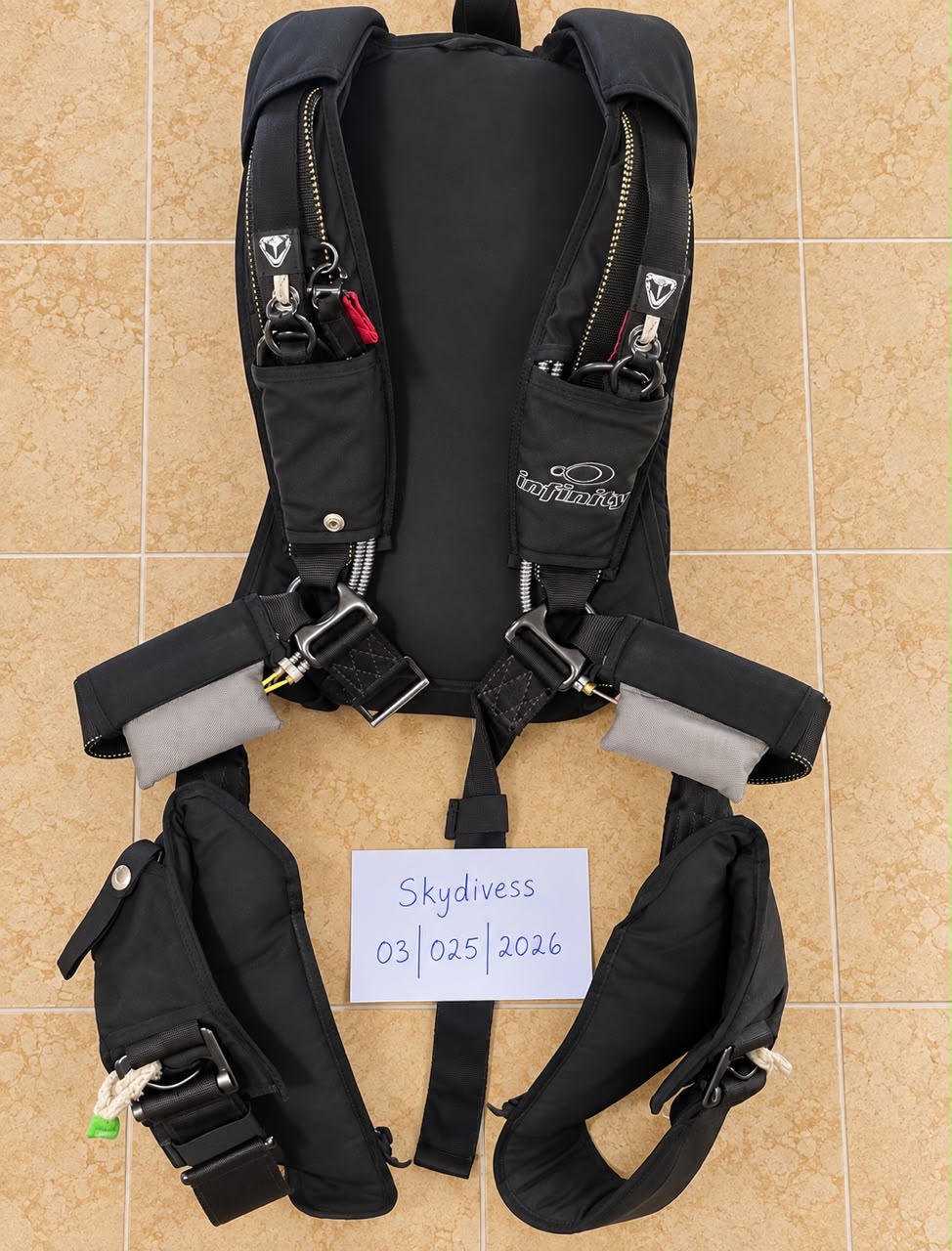
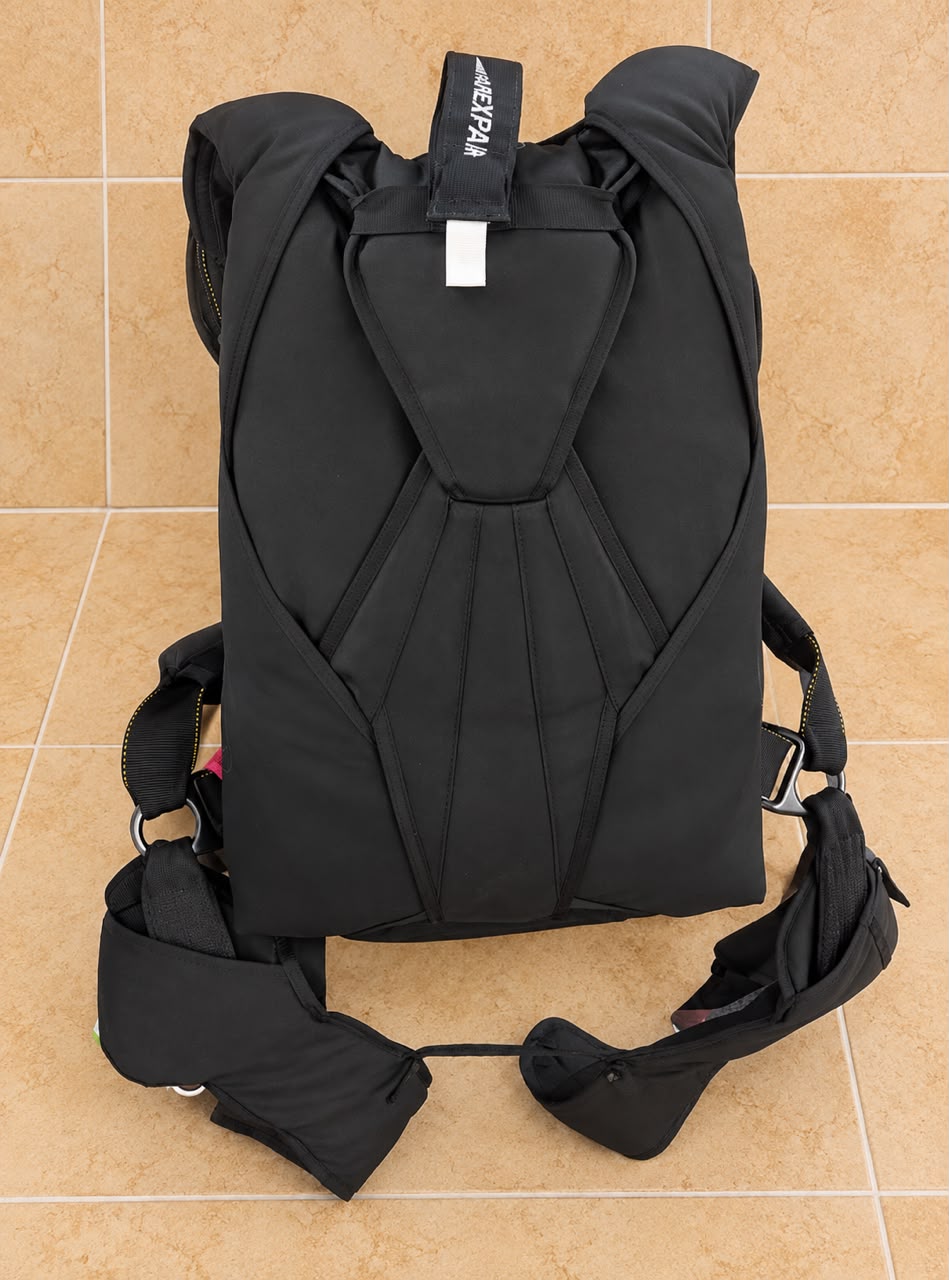
This Used Complete Rig System is a previously owned skydiving configuration featuring an Infinity I-24 container, Crossfire 2 139 main canopy, PD Optimum 143 reserve, and Cypres Expert AAD.
The Infinity I-24 was manufactured in September 2013 and has approximately 600 jumps. It is reported to be in great condition, with only a few small age-related scuffs that do not affect the fabric or hardware. The container features black hardware, RSI, FF tuck tabs, and hip rings, and has reportedly always been packed indoors on mats. It is described as a good fit for someone around 6’1″ and 85–100 kg and can accommodate canopies from approximately cross-braced 114 to 150, subject to professional compatibility and fit verification.
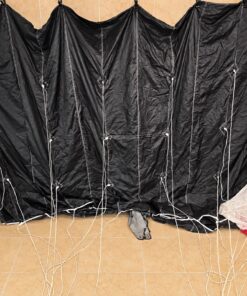
The Crossfire 2 139 main canopy, manufactured in 2014, has approximately 500 jumps ±50. It is reported to be in great condition, still relatively crispy, with no holes or patches. The brake lines were recently relined, while the main lines are reported to remain in good condition.
The PD Optimum 143 reserve, manufactured in 2013, has 10 repacks and no reported rides. Its supplied currency date is 02/04/2027, which should be verified against the original documentation and current service requirements.
The system also includes a Cypres Expert AAD, manufactured in July 2015, with the supplied status current until 01/2028. Current service status should be confirmed before operational use.
Key Specifications
- Container: Infinity I-24
- Container DOM: 09/2013
- Container jumps: Approximately 600
- Main: Crossfire 2 139
- Main DOM: 2014
- Main jumps: Approximately 500 ±50
- Main condition: No reported holes or patches; still crispy
- Recent maintenance: Brake lines relined
- Main lines: Reported in good condition
- Reserve: PD Optimum 143
- Reserve DOM: 2013
- Reserve history: 10 repacks, no reported rides
- Reserve supplied currency: Until 02/04/2027
- AAD: Cypres Expert
- AAD DOM: 07/2015
- AAD supplied currency: Until 01/2028
- Fit reference: Approximately 6’1″, 85–100 kg
- Hardware: Black
- Features: RSI, FF tuck tabs, hip rings
Professional rigger inspection, current service verification, proper fit assessment, and complete configuration compatibility checks are recommended before operational use.
USED COMPLETE RIG SYSTEM
Complete Rig Overview
Complete Used Skydiving Rig
This Used Complete Rig System is a documented parachute configuration consisting of an Infinity I-24 container, Crossfire 2 139 main canopy, PD Optimum 143 reserve, and Cypres Expert automatic activation device. Each principal component has a stated manufacturing date, while the main canopy, reserve, container, and AAD are described with individual history and condition information.
The configuration is therefore suitable for detailed component-by-component evaluation rather than being treated simply as an unidentified used parachute rig USED SKYDIVE COMPLETE RIG.
The container was manufactured in September 2013, the main canopy in 2014, the reserve in 2013, and the Cypres Expert in July 2015.
Infinity I-24 Container
The container is an Infinity I-24, with a September 2013 date of manufacture.
It has approximately 600 jumps and is described as being in great condition. The supplied condition report mentions a few small scuffs consistent with age, while specifically stating that these do not affect the fabric or hardware.
The container has black hardware, RSI, FF tuck tabs, and hip rings.
It is described as a particularly suitable fit for someone around 6’1″ and 85–100 kg. The container has reportedly always been packed indoors on mats, providing additional information about the reported packing environment.
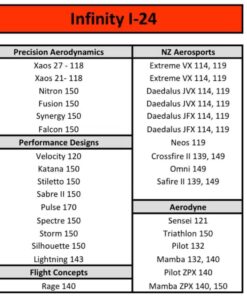
The container is also stated to accommodate canopies ranging from approximately cross-braced 114 up to 150.
Actual fit and complete system compatibility should nevertheless be confirmed by an appropriately qualified professional before operational use.
Crossfire 2 139 Main Canopy
The main canopy is a 2014 Crossfire 2 139.
It has approximately 500 jumps, plus or minus 50, according to the supplied history.
The canopy is described as being in great condition and still pretty crispy. No patches or holes are reported.
An important recent maintenance detail is that the brake lines were relined the previous week, while the main lines are reported to remain in good condition.
These details provide a useful picture of the reported history. However, current canopy condition should be established through appropriate inspection rather than relying solely on photographs or a written description.
PD Optimum 143 Reserve
The reserve is a PD Optimum 143, manufactured in 2013.
The supplied information records 10 repacks and no rides.
It is stated to be current until 02/04/2027.
Because the reserve is safety-critical equipment, its current packing status, inspection history, compatibility, and applicable service requirements should be verified by an appropriately qualified parachute rigger before use.
Cypres Expert AAD
The automatic activation device is a Cypres Expert, manufactured in July 2015.
The supplied information states that it is current until 01/2028.
Current service status should be confirmed against the applicable manufacturer documentation before operational use.
Fit and Configuration
The supplied fit information describes the Infinity I-24 as suitable for someone around 6’1″ and 85–100 kg.
The container is reported to hold canopies from cross-braced 114 through 150.
These figures should be regarded as the supplied configuration information, not as a universal sizing recommendation. Jumper body dimensions, harness fit, canopy characteristics, and complete component compatibility should be professionally evaluated.
Condition and Maintenance History
The reported condition of the system is particularly useful because several maintenance details have been supplied.
The Infinity I-24 has approximately 600 jumps and only a few small age-related scuffs reported.
The Crossfire 2 139 has approximately 500 ±50 jumps, no reported patches or holes, and recently received new brake lines.
The PD Optimum 143 has 10 repacks and no rides.
The Cypres Expert is reported current through January 2028.
This component-specific history allows the equipment to be evaluated more systematically.
What Is Included?
Based on the supplied information, the identified major components are:
- Infinity I-24 container — DOM 09/2013
- Approximately 600 container jumps
- Crossfire 2 139 main — DOM 2014
- Approximately 500 ±50 main jumps
- PD Optimum 143 reserve — DOM 2013
- 10 reserve repacks
- No reserve rides reported
- Cypres Expert AAD — DOM 07/2015
- Reported reserve status through 02/04/2027
- Reported AAD status through 01/2028
No helmet, goggles, hook knife, gear bag, wingsuit, or other accessory has been confirmed as included.
Skydiving Equipment Context
A complete skydiving equipment list can include many items beyond the rig itself. Associated equipment may include a skydiving helmet, full face skydiving helmet, skydiving glasses, skydiver goggles, hook blade knife, protective equipment, and a suitable gear bag.
However, those items should not be represented as part of this package unless specifically confirmed.
Likewise, terms such as tracking jump, wingsuit sport, vector wingsuit, CRW skydiving, canopy flight, wingsuit, gliding suit wingsuit, fly suits, and tandem wingsuit describe different activities or equipment categories and do not establish that this specific rig is configured for each discipline.
Professional Inspection
Before this used complete rig is placed into operational service, the complete configuration should be inspected by an appropriately qualified professional.
The inspection should consider the Infinity I-24 container and harness, Crossfire 2 139 main, PD Optimum 143 reserve, Cypres Expert, lines, hardware, deployment components, and compatibility of the complete configuration.
Particular attention should also be given to the age, usage history, and current condition of each component.
Overall Product Summary
This Used Complete Rig System combines an Infinity I-24 container manufactured in September 2013, a Crossfire 2 139 main manufactured in 2014, a PD Optimum 143 reserve manufactured in 2013, and a Cypres Expert manufactured in July 2015.
The container has approximately 600 jumps and is reported to be in great condition, with only a few small age-related scuffs that reportedly do not affect the fabric or hardware.
The Crossfire 2 139 has approximately 500 ±50 jumps, is reported to have no patches or holes, remains crispy, and recently received a brake-line relining.
The PD Optimum 143 has 10 repacks and no rides, with the supplied status current until 02/04/2027. The Cypres Expert is reported current until 01/2028.
Overall, the supplied documentation gives a clear starting point for evaluating the configuration. Current condition, fit, compatibility, reserve status, AAD status, and operational suitability should be independently verified by an appropriately qualified professional before use.
Detailed Equipment Condition, Configuration, Compatibility, and Ownership Considerations
A previously owned parachute system should be evaluated as a complete configuration while also being examined component by component. Every major part has its own manufacturing date, usage history, maintenance requirements, and potential wear characteristics. Therefore, a proper assessment should not rely on the overall appearance of the equipment alone.
The supplied configuration consists of a September 2013 Infinity I-24 container, a 2014 Crossfire 2 139 main canopy, a 2013 PD Optimum 143 reserve, and a July 2015 Cypres Expert automatic activation device. The available history also provides useful information about jump numbers, repacks, storage, recent line work, and reported condition.
Infinity I-24 Container
The Infinity I-24 was manufactured in September 2013 and has approximately 600 jumps.
The supplied condition report describes the container as being in great condition. A few small scuffs are present, and these have been described as normal age-related marks that do not affect the fabric or hardware.
This distinction is important. Cosmetic wear and structural deterioration should not be treated as the same thing. A small superficial mark may have little significance, whereas damage located around a load-bearing or attachment area may require immediate professional attention.
The container should therefore be inspected systematically.
Fabric, webbing, stitching, harness components, hardware, attachment areas, closures, and other structural portions should all be examined.
Storage and Packing Environment
The container has reportedly always been packed indoors on mats.
This provides useful information about its reported history because the environment in which equipment is packed and stored can influence its long-term condition.
Indoor packing can reduce exposure to rain, dirt, excessive sunlight, and other outdoor environmental factors. Nevertheless, the statement should be treated as historical information rather than as proof of current condition.
The equipment should still be professionally examined before operational use.
Fabric Assessment
The container fabric should be checked for cuts, abrasion, fraying, discoloration, contamination, and other unusual changes.
Attention should be paid to areas that experience repeated folding or contact with hardware.
A defect should not be judged solely by its apparent size. Location and function are also important.
A small defect near an important structural area may deserve more attention than a larger cosmetic mark in a non-critical area.
Stitching and Seams
Stitching should be inspected throughout the container and harness.
Repeated packing, loading, handling, and age can influence seams and stitching.
The inspection should identify loose threads, damaged stitches, separation, unusual wear, or other abnormalities.
Structural stitching should not be modified or repaired casually. If an issue is identified, an appropriately qualified professional should determine the correct course of action.
Hardware
The supplied description identifies black hardware on the container.
The hardware should be examined for corrosion, deformation, damage, unusual wear, and proper condition.
Hardware should remain in its intended configuration.
Unauthorized modification, bending, drilling, grinding, or other alterations should not be used to correct an equipment issue.
RSI, FF Tuck Tabs, and Hip Rings
The configuration includes RSI, FF tuck tabs, and hip rings.
These features form part of the container’s configuration and should be inspected as part of the complete system.
The associated fabric, stitching, hardware, and interfaces should be examined rather than evaluating each feature in isolation.
The exact configuration should be confirmed against the applicable manufacturer information and the condition of the individual components.
Container Fit
The supplied information describes the container as a good fit for someone approximately 6 feet 1 inch tall and weighing between 85 and 100 kilograms.
This information is useful for prospective owners, but it should not be interpreted as a universal fit guarantee.
Body proportions differ between individuals.
Torso length, harness geometry, leg length, shoulder position, and other physical characteristics can influence how a container fits.
Consequently, a professional fitting assessment should be completed before operational use by a new owner.
Canopy Accommodation
The container is reported to accommodate canopies ranging from approximately cross-braced 114 through 150.
This is useful configuration information, but canopy accommodation should not be determined solely from numerical size.
Different canopy models can have different pack volumes and construction characteristics.
Therefore, actual compatibility should be confirmed using the appropriate manufacturer information and professional guidance.
Crossfire 2 139 Main
The main canopy is a 2014 Crossfire 2 139.
Approximately 500 jumps are reported, with an uncertainty of approximately plus or minus 50 jumps.
The supplied condition description states that the canopy is in great condition and remains relatively crispy.
No patches or holes have been reported.
These details are useful when establishing the canopy’s history. However, they should remain descriptions of the supplied condition rather than being interpreted as a formal certification.
Main Canopy Fabric
The fabric should be inspected across the complete canopy.
The assessment should look for holes, repairs, abrasion, contamination, discoloration, seam irregularities, stitching issues, and other changes.
The supplied information reports no holes or patches.
That information should remain documented, while current condition should still be established by inspection.
Main Lines
The supplied information states that the main lines remain in good condition.
Line condition should nevertheless be inspected throughout the complete system.
Lines can experience abrasion, contamination, wear, and changes resulting from repeated use.
The attachment points should also be examined because the condition of a line cannot be considered independently from the location where it connects to the canopy.
Brake Lines
The brake lines were reportedly relined the previous week.
This is a significant recent maintenance detail.
A new brake-line installation should be appropriately documented, and the configuration should be checked to ensure that the work was completed correctly.
The recent relining does not establish the condition of the remainder of the canopy.
It simply provides information about a particular recent maintenance operation.
Jump History
The Crossfire 2 139 has approximately 500 jumps, plus or minus 50.
This should be retained as an approximate figure rather than represented as an exact count.
A jump history provides useful context, but current condition remains more important than the number alone.
Storage, packing, environmental exposure, deployment characteristics, maintenance, and handling can all influence equipment condition.
Reserve Configuration
The reserve is a PD Optimum 143 manufactured in 2013.
The supplied history records 10 repacks and no rides.
This means the reserve has not been reported as having been deployed in an emergency or intentional reserve ride.
Nevertheless, repack history and ride history are only part of a reserve assessment.
The current condition and packing status should be verified professionally.
Reserve Status
The reserve is stated to be current until 02/04/2027.
Because date formatting can be interpreted differently depending on regional convention, the exact service or currency date should be confirmed from the original documentation.
Current status should also be verified before operational use because service requirements can change and because the date alone does not establish physical condition.
Reserve Inspection
The reserve should be inspected for fabric condition, lines, stitching, attachment points, deployment components, and other relevant characteristics.
The reserve should also be assessed for contamination, moisture exposure, storage conditions, and any evidence of previous damage.
A reserve should not be considered ready for use simply because its stated currency date has not expired.
Reserve Packing
The number of repacks is listed as 10.
The current packing status should be established from the appropriate records.
A repack history is useful because it documents previous maintenance events.
However, the current status remains the relevant consideration for operational use.
Cypres Expert
The automatic activation device is a Cypres Expert manufactured in July 2015.
The supplied information states that it is current until January 2028.
The device should be checked against its applicable documentation and current service requirements.
The fact that an electronic device appears operational does not independently establish that its service requirements have been satisfied.
Electronic Service Records
The service history of the automatic activation device should be retained.
Relevant documentation may include service records, identification information, applicable maintenance records, and current status information.
A prospective owner should verify the device’s status before relying on it as part of the configuration.
Complete-System Compatibility
Compatibility should be evaluated across the entire system.
The container, main, reserve, deployment system, and automatic activation device should work together according to applicable manufacturer requirements.
Physical installation does not by itself establish complete compatibility.
This is particularly important when components have been manufactured in different years and may have been assembled together after their original purchase.
Jumper Compatibility
The intended jumper should also be considered.
The supplied container fit is approximately 6 feet 1 inch and 85–100 kilograms.
However, actual body shape and harness dimensions vary.
The prospective owner should therefore obtain an appropriate fitting assessment rather than relying exclusively on height and weight.
Canopy Choice
The main canopy is a 139-size model, while the container is reported to accommodate a range from cross-braced 114 through 150.
This does not mean that every canopy within that numerical range is appropriate for every jumper.
Canopy selection depends on more than physical pack volume.
Experience, loading, intended activity, training, and the characteristics of the specific canopy all matter.
The configuration should therefore be assessed according to the intended jumper and intended use.
Maintenance History
The available maintenance information is particularly useful.
The container has reportedly been packed indoors on mats.
The main brake lines were relined recently.
The reserve has 10 repacks and no rides.
The automatic activation device has a stated current date through January 2028.
These details should be preserved as part of the equipment record.
Environmental Exposure
Environmental exposure should be considered when assessing used equipment.
Moisture, heat, ultraviolet exposure, dirt, chemicals, and long-term poor storage can affect textile and mechanical components.
Even equipment that has generally been stored indoors can experience environmental exposure during transportation, packing, or use.
Current inspection remains the best method of establishing actual condition.
Moisture Management
The system should be kept dry.
If the equipment becomes wet, it should not be stored while damp.
Appropriate drying procedures should be followed.
Where significant moisture exposure has occurred, professional assessment may be appropriate.
Moisture can affect multiple components and may not always produce immediately obvious visual changes.
Heat and Sunlight
Excessive heat should be avoided.
A vehicle exposed to direct sunlight can reach temperatures significantly above normal indoor conditions.
Long-term storage in such an environment should therefore be avoided.
Prolonged direct sunlight should also be minimized because ultraviolet exposure can affect certain textile materials.
Chemical Contamination
The equipment should be protected from fuel, oil, solvents, cleaning agents, and other chemicals.
If contamination occurs, the correct cleaning procedure depends on the substance and the affected material.
Improvised cleaning should be avoided.
Professional guidance is appropriate where significant contamination is suspected.
Transportation
Transportation should protect the equipment against impact, abrasion, compression, excessive heat, and moisture.
A suitable protective bag should be used.
Heavy objects should not be placed on top of the system.
Sharp objects should be kept away from canopy fabric and container materials.
Following significant impact, professional inspection should be considered before operational use.
Long-Term Storage
Long-term storage should take place in a clean, dry, stable environment.
The equipment should be protected from rodents, insects, chemicals, excessive compression, moisture, and unnecessary environmental exposure.
The storage area should also be secure against unauthorized access.
Documentation
The equipment should have an organized history containing the identification and maintenance details of each major component.
For this configuration, the known information includes the September 2013 container date, 2014 main date, 2013 reserve date, and July 2015 automatic activation device date.
The container has approximately 600 jumps.
The main has approximately 500 plus or minus 50 jumps.
The reserve has 10 repacks and no rides.
The supplied currency dates should also be retained and independently verified.
Ownership Transfer
When the system changes ownership, all available documentation should accompany it where appropriate.
The new owner should know the manufacturing dates, usage estimates, maintenance information, and known condition observations.
Unknown information should remain identified as unknown.
This is particularly important for safety-critical equipment because assumptions can create unnecessary uncertainty.
What Should Be Verified?
Before operational use, several aspects should be verified.
The container’s current structural condition should be established.
The harness fit should be confirmed.
The main canopy should be inspected.
The recent brake-line work should be documented and checked.
The reserve should be inspected and its current repack status confirmed.
The automatic activation device should have its current status verified.
The compatibility of the complete configuration should be established.
Professional Assessment
A qualified parachute rigger is best placed to evaluate the complete configuration.
The inspection should not focus only on the newest or most visually attractive component.
The entire system should be considered.
This includes the container, harness, main, reserve, deployment components, hardware, and automatic activation device.
Why a Complete Inspection Matters
A complete inspection helps distinguish between cosmetic condition and functional condition.
It can also identify issues that photographs cannot reveal.
For example, fabric may appear clean while stitching or attachment areas require closer attention.
Similarly, a canopy may have no visible holes while still requiring assessment of lines, seams, slider condition, or other characteristics.
Long-Term Ownership
The system can be maintained more effectively when its history is kept current.
Future inspections should be recorded.
Any repairs should be documented.
Repack events should be recorded.
Automatic activation device service information should be retained.
Canopy usage should be updated.
This creates a continuous history that benefits both the current owner and any future owner.
Overall Condition Perspective
The supplied information presents the system as being in good overall condition.
The Infinity I-24 has only a few small age-related scuffs reported.
The Crossfire 2 139 has no reported holes or patches and is described as crispy.
The brake lines were recently replaced.
The main lines are reported to be in good condition.
The reserve has no reported rides and 10 repacks.
The automatic activation device is reported current through January 2028.
These are useful condition indicators, but they should remain distinguished from a professional certification of operational readiness.
Final Assessment
This configuration has a well-defined component history and several useful maintenance details.
The Infinity I-24 provides the container and harness platform.
The Crossfire 2 139 provides the main canopy, with approximately 500 plus or minus 50 jumps and recently replaced brake lines.
The PD Optimum 143 provides the reserve, with 10 repacks and no rides reported.
The Cypres Expert provides the automatic activation device, with the supplied currency date extending to January 2028.
The system should nevertheless undergo a complete professional inspection before use.
Current condition, fit, compatibility, reserve status, and electronic service status should all be established from appropriate documentation and inspection.
Responsible Ownership
Responsible ownership begins with accurate information.
The known specifications should be retained without exaggeration.
The few scuffs on the container should remain disclosed.
The absence of reported holes or patches on the main should remain documented.
The recent brake-line work should remain documented.
The reserve’s 10 repacks and zero reported rides should remain recorded.
The supplied service dates should be verified rather than assumed.
This approach creates a transparent equipment history.
Final Perspective
The most important consideration with a used parachute system is not simply how it looks or how complete it appears.
Its history, current condition, compatibility, fit, service status, and inspection records all matter.
This configuration offers substantial information in those areas, including manufacturing dates, approximate jump counts, maintenance details, reserve history, and reported condition.
At the same time, several decisions must remain with the appropriately qualified professional responsible for inspecting and approving the equipment.
A careful inspection and accurate documentation provide the strongest foundation for continued ownership and responsible use of this complete configuration.
Practical Ownership, Maintenance, Storage, Inspection, and Long-Term Use
A complete parachute system should be approached as a collection of interconnected safety-critical components rather than as a single ordinary piece of sporting equipment. The condition of one component can influence the suitability of the overall configuration, and therefore each part should retain its own history throughout ownership.
For this configuration, the known equipment consists of an Infinity I-24 container manufactured in September 2013, a Crossfire 2 139 main canopy manufactured in 2014, a PD Optimum 143 reserve manufactured in 2013, and a Cypres Expert automatic activation device manufactured in July 2015. The container has approximately 600 jumps, while the main has approximately 500 jumps with an uncertainty of roughly 50 jumps. The reserve has 10 repacks and no rides according to the supplied information.
The system has also been described as being in good condition. The container has a few small scuffs associated with age, while the main has no reported holes or patches and remains relatively crisp. The brake lines were recently replaced, and the main lines are reported to remain in good condition.
These details are useful, but they should always be considered alongside a current professional inspection.
Understanding the Complete Configuration
The container provides the structural harness system and houses the parachute components. The main provides the primary canopy. The reserve provides the emergency canopy. The automatic activation device provides an additional electronic safety function according to its configuration and applicable requirements.
Because these components perform different roles, their maintenance requirements are not identical.
A recent brake-line replacement on the main does not establish the condition of the container. Similarly, a current reserve repack does not establish the condition of the main canopy. The reported status of the automatic activation device does not establish the condition of the textile components.
For this reason, each component should be inspected individually before the complete configuration is assessed.
Container Maintenance
The Infinity I-24 should be kept clean, dry, and protected from unnecessary environmental exposure.
The container should periodically be examined for changes in fabric, webbing, stitching, harness components, hardware, attachment areas, closures, and other structural sections.
Particular attention should be given to areas that experience repeated loading, folding, friction, or contact with hardware.
The reported small scuffs should remain documented. If they remain superficial and do not affect structural materials, they may simply represent normal evidence of use and age. However, their actual significance should be determined during professional inspection rather than assumed from appearance.
Harness Inspection
The harness is an important structural connection between the jumper and the container.
Webbing should be examined for abrasion, cuts, unusual discoloration, contamination, or other changes. Stitching should also be inspected carefully, particularly around attachment and load-bearing areas.
Hardware should be examined for corrosion, deformation, damage, or unusual wear.
No hardware should be modified without appropriate professional authorization.
Maintaining Proper Fit
The supplied configuration is described as a good fit for someone around 6 feet 1 inch and 85 to 100 kilograms.
This information provides a useful reference point, but it should not be treated as a universal fitting specification.
Two people with the same height and weight can have substantially different body proportions. Shoulder width, torso length, leg length, and other measurements can influence the way a harness fits.
Therefore, a prospective owner should have the equipment fitted appropriately before operational use.
A satisfactory fit should allow the system to remain properly positioned while permitting the intended range of movement required by the jumper.
Main Canopy Maintenance
The Crossfire 2 139 has approximately 500 jumps, plus or minus 50.
The canopy is described as being in great condition, with no holes or patches reported. It is also described as remaining crispy.
Those observations should be retained as part of the equipment history.
However, canopy condition should be evaluated using more than appearance.
The fabric, seams, stitching, lines, attachment points, slider, deployment-related components, and other relevant areas should all be examined.
Recent Brake-Line Replacement
The brake lines were reportedly replaced the previous week.
This is an important maintenance detail and should be retained with the canopy’s records.
The date of the work, nature of the work, and any associated documentation should be preserved where available.
Recent line replacement can provide useful information about maintenance, but it does not establish that all other components of the canopy are in equivalent condition.
The main lines are reported to remain in good condition and should continue to be monitored as part of normal professional inspection.
Canopy Jump History
The reported main-canopy history is approximately 500 jumps, with an uncertainty of around 50 jumps.
An approximate jump count should remain clearly identified as approximate.
Jump numbers provide useful context because repeated deployments and packing can influence equipment over time. However, jump count alone cannot establish present condition.
Two canopies with identical jump numbers can have substantially different condition histories because of differences in storage, climate, handling, packing, and maintenance.
Reserve Maintenance
The PD Optimum 143 was manufactured in 2013.
The supplied history records 10 repacks and no rides.
The reserve’s current packing status should be confirmed through appropriate documentation.
Its fabric, lines, stitching, attachment points, deployment components, and other relevant areas should be professionally assessed.
Because the reserve is intended for emergency use, uncertainty should not be resolved through guesswork.
Reserve Service Documentation
All reserve records should be retained.
This can include repack records, inspection records, identification information, previous service information, and any available repair documentation.
The supplied status is current until 02/04/2027.
The precise date should be confirmed against the original documentation, particularly where date formatting could be interpreted differently.
The currency date should not be treated as proof of physical condition.
Automatic Activation Device
The Cypres Expert has a July 2015 manufacturing date.
The supplied information states that it is current until January 2028.
The device should be maintained and serviced according to the applicable manufacturer’s requirements.
Documentation should be retained so that its status can be verified by the owner and inspecting professional.
An electronic device should not be considered suitable merely because it appears clean or powers on.
Compatibility of the Components
The complete configuration should be checked for compatibility.
The container’s reported accommodation range extends from cross-braced 114 through 150, while the installed main is a 139.
However, physical canopy size is only one aspect of compatibility.
Pack volume, container configuration, reserve configuration, deployment system, and other technical characteristics can also matter.
The appropriate manufacturer information and professional assessment should therefore be used to confirm the complete setup.
Storage Conditions
Proper storage is one of the simplest ways to protect parachuting equipment over the long term.
The system should be stored in a clean, dry, stable environment.
It should not be left exposed to unnecessary sunlight, excessive heat, moisture, chemicals, sharp objects, or pests.
The equipment should also be protected against unnecessary compression.
The reported history that the container has always been packed indoors on mats is useful information and should remain part of the ownership record.
Moisture Protection
Moisture can be particularly undesirable for textile equipment.
The system should not be stored while wet or damp.
If the equipment becomes wet, appropriate drying procedures should be followed.
Significant moisture exposure should be disclosed during subsequent inspection.
The equipment should not simply be packed away immediately after exposure to rain or another source of moisture.
Heat Management
Excessive heat should be avoided.
Vehicles exposed to direct sunlight can become significantly hotter than the surrounding environment. Long-term storage inside such conditions is therefore inappropriate.
The system should instead be kept in a stable environment with limited temperature extremes.
Ultraviolet Exposure
Prolonged exposure to direct sunlight should be minimized.
Ultraviolet exposure can affect some textile materials over time.
The equipment should therefore remain protected when it is not being used.
A storage bag can help protect equipment from incidental environmental exposure, although the storage bag itself should also remain clean and dry.
Chemical Exposure
Fuel, oil, solvents, cleaning products, and other chemicals should be kept away from the system.
If contamination occurs, the appropriate response depends on the substance involved and the affected material.
Improvised cleaning should be avoided because an unsuitable chemical may cause additional damage.
Professional advice should be sought when significant contamination is suspected.
Transportation
Transportation should be handled carefully.
The complete system should be protected from unnecessary impact, compression, abrasion, heat, and moisture.
Sharp tools or other objects should not be placed directly against the canopy or container.
Heavy equipment should not be stacked on top of the system.
After significant impact, the equipment should be professionally assessed before being returned to operational use.
Packing Environment
The supplied history states that the container has always been packed inside on mats.
Maintaining a clean packing environment is beneficial because dirt, grit, moisture, and sharp debris can potentially come into contact with textile materials.
The packing area should therefore remain clean and free of unnecessary objects.
A suitable environment also makes it easier to identify foreign material or obvious damage during preparation.
Documentation Management
A complete equipment file should be maintained throughout ownership.
The file should identify the container, main, reserve, and automatic activation device.
Manufacturing dates should be recorded.
Jump counts should be updated when known.
Reserve repacks should be documented.
Repairs should be documented.
Inspection results should be retained.
Automatic activation device service information should also be preserved.
This creates a traceable history that can be useful throughout the equipment’s service life.
Ownership Transfer
If the system is eventually transferred to another owner, its documentation should accompany it where possible.
Known condition information should remain accurate.
The small container scuffs should remain disclosed.
The main’s approximate jump count should remain documented.
The recent brake-line replacement should be included in the history.
The reserve’s 10 repacks and no reported rides should remain recorded.
The automatic activation device’s applicable status should be verified and documented.
Independent Inspection
A professional inspection is particularly important when a complete used system changes ownership.
The inspection should evaluate the container, harness, main, reserve, automatic activation device, lines, hardware, and relevant deployment components.
The purpose is not merely to confirm that the equipment looks clean.
Instead, the objective is to establish whether the components remain appropriate, compatible, and serviceable according to the applicable technical requirements.
Why Photographs Are Not Enough
Photographs can provide useful evidence of general appearance.
They may show the color, visible condition, obvious marks, and general cleanliness of the equipment.
However, photographs cannot establish every characteristic of fabric, stitching, line condition, hardware integrity, service status, or compatibility.
Therefore, photographs should support documentation but should not replace professional inspection.
Main Canopy Inspection
The Crossfire 2 139 should be inspected carefully before operational use.
The reported absence of holes and patches should be confirmed.
The recently replaced brake lines should be examined.
The remaining lines should be evaluated.
The fabric, seams, stitching, slider, attachment points, and deployment-related components should also be inspected.
Any unusual condition should be documented and assessed appropriately.
Reserve Inspection
The reserve should receive its own inspection rather than being assumed to be satisfactory because it has no reported rides.
No-rides history is useful, but the reserve has still experienced packing and storage over its life.
Its current condition should therefore be established through appropriate inspection.
Container Inspection
The container should likewise be evaluated independently.
Its 2013 manufacturing date and approximately 600 jumps provide useful context.
The few reported scuffs should be examined to confirm that they are superficial.
The fabric, hardware, webbing, stitching, harness, closures, and attachment areas should be checked.
Electronic Inspection
The automatic activation device should have its current status verified.
The supplied January 2028 date should be checked against the original documentation.
Any applicable service requirements should be followed.
The device should remain installed and configured according to the manufacturer’s requirements.
Intended Use
The system should be used only for activities and conditions for which the complete configuration is appropriate.
Different forms of parachuting can involve different equipment demands.
A configuration suitable for ordinary recreational use should not automatically be assumed to be suitable for specialized disciplines.
Training, experience, canopy selection, equipment configuration, and professional guidance should all be considered.
Canopy Selection and Experience
The Crossfire 2 139 is a specific canopy model and size.
Its suitability should be evaluated according to the intended jumper’s experience, loading, training, and intended use.
The container’s ability to accommodate a range of canopy sizes does not mean that every canopy in that range is appropriate for every jumper.
The prospective owner should therefore assess the complete configuration rather than selecting equipment solely from numerical size.
Maintenance After Purchase
A new owner should establish a maintenance schedule based on the applicable manufacturer and professional requirements.
The owner should keep inspection records organized.
The main canopy’s jump count should be updated.
Reserve repacks should be recorded.
AAD status should be monitored.
The container should be inspected periodically.
Any repair should be documented.
Warning Signs
Changes that deserve professional attention can include unexplained fabric damage, unusual stitching changes, damaged webbing, corrosion, deformation, contamination, line damage, unexplained canopy behavior, or uncertainty about service status.
A change should not automatically be dismissed as normal aging.
When the significance is unclear, the appropriate professional should make the determination.
Responsible Long-Term Ownership
Good ownership involves more than keeping the equipment clean.
The owner should understand the history of each component.
The equipment should be stored appropriately.
Service requirements should be respected.
The system should be inspected when circumstances warrant it.
Documentation should remain current.
Repairs should be performed through appropriate channels.
These practices help preserve both the physical equipment and its history.
Important Information That Remains Unconfirmed
The supplied specifications do not establish every detail.
The exact container serial number has not been provided.
The reserve serial number has not been provided.
The exact number of jumps on the reserve is not supplied because no rides are reported.
The exact number of brake-line jumps following the recent relining is not specified.
The complete repair history is not provided.
Additional accessories have not been confirmed.
These details should remain unverified unless supporting documentation becomes available.
Final Condition Perspective
The system has several favorable reported characteristics.
The container is described as being in great condition.
The few reported scuffs are described as not affecting the fabric or hardware.
The main has no reported holes or patches.
The main remains relatively crisp USED SKYDIVE COMPLETE RIGUSED SKYDIVE COMPLETE RIGUSED SKYDIVE COMPLETE RIGUSED SKYDIVE COMPLETE RIGUSED SKYDIVE COMPLETE RIGUSED SKYDIVE COMPLETE RIGUSED SKYDIVE COMPLETE RIGUSED SKYDIVE COMPLETE RIGUSED SKYDIVE COMPLETE RIGUSED SKYDIVE COMPLETE RIG.
The brake lines were recently relined.
The main lines are reported to remain in good condition.
The reserve has 10 repacks and no rides reported.
The automatic activation device is reported current until January 2028.
These observations provide useful information, but none should be interpreted as a replacement for professional inspection.
Final Ownership Perspective
The most responsible approach to a used complete system is to combine its documented history with a current professional assessment.
The Infinity I-24 provides the container and harness platform, with approximately 600 jumps and a September 2013 manufacturing date.
The Crossfire 2 139 provides the main canopy, with approximately 500 jumps plus or minus 50 and a 2014 manufacturing date.
The PD Optimum 143 provides the reserve, with a 2013 manufacturing date, 10 repacks, and no reported rides.
The Cypres Expert provides the automatic activation device, with a July 2015 manufacturing date and a supplied currency date through January 2028.
The configuration also includes useful maintenance information, including indoor packing on mats and recent brake-line replacement.
Ultimately, the current condition and operational suitability should be established through appropriate professional inspection.
A careful inspection should confirm the condition of the container, harness, main canopy, reserve, automatic activation device, lines, hardware, and associated components while also verifying fit and compatibility USED SKYDIVE COMPLETE RIGUSED SKYDIVE COMPLETE RIGUSED SKYDIVE COMPLETE RIGUSED SKYDIVE COMPLETE RIGUSED SKYDIVE COMPLETE RIG USED SKYDIVE COMPLETE RIGUSED SKYDIVE COMPLETE RIG USED SKYDIVE COMPLETE RIGUSED SKYDIVE COMPLETE RIGUSED SKYDIVE COMPLETE RIG USED SKYDIVE COMPLETE RIGUSED SKYDIVE COMPLETE RIGUSED SKYDIVE COMPLETE RIG USED SKYDIVE COMPLETE RIGUSED SKYDIVE COMPLETE RIGUSED SKYDIVE COMPLETE RIGUSED SKYDIVE COMPLETE RIGUSED SKYDIVE COMPLETE RIGUSED SKYDIVE COMPLETE RIGUSED SKYDIVE COMPLETE RIGUSED SKYDIVE COMPLETE RIGUSED SKYDIVE COMPLETE RIG .
With accurate documentation, proper storage, appropriate maintenance, and professional inspection, the equipment history can remain clear throughout ownership. This provides a practical foundation for responsible evaluation of the complete system without relying on assumptions about components or conditions that have not been independently verified USED SKYDIVE COMPLETE RIGUSED SKYDIVE COMPLETE RIGUSED SKYDIVE COMPLETE RIGUSED SKYDIVE COMPLETE RIGUSED SKYDIVE COMPLETE RIGUSED SKYDIVE COMPLETE RIG
USED SKYDIVE COMPLETE RIGUSED SKYDIVE COMPLETE RIGUSED SKYDIVE COMPLETE RIGUSED SKYDIVE COMPLETE RIGUSED SKYDIVE COMPLETE RIGUSED SKYDIVE COMPLETE RIGUSED SKYDIVE COMPLETE RIGUSED SKYDIVE COMPLETE RIG
USED SKYDIVE COMPLETE RIGUSED SKYDIVE COMPLETE RIGUSED SKYDIVE COMPLETE RIG USED SKYDIVE COMPLETE RIGUSED SKYDIVE COMPLETE RIGUSED SKYDIVE COMPLETE RIGUSED SKYDIVE COMPLETE RIGUSED SKYDIVE COMPLETE RIGUSED SKYDIVE COMPLETE RIG
Be the first to review “USED SKYDIVE COMPLETE RIG”
Related products
used products
used products

used products

used products

used products

used products

used products
Reviews
There are no reviews yet.